

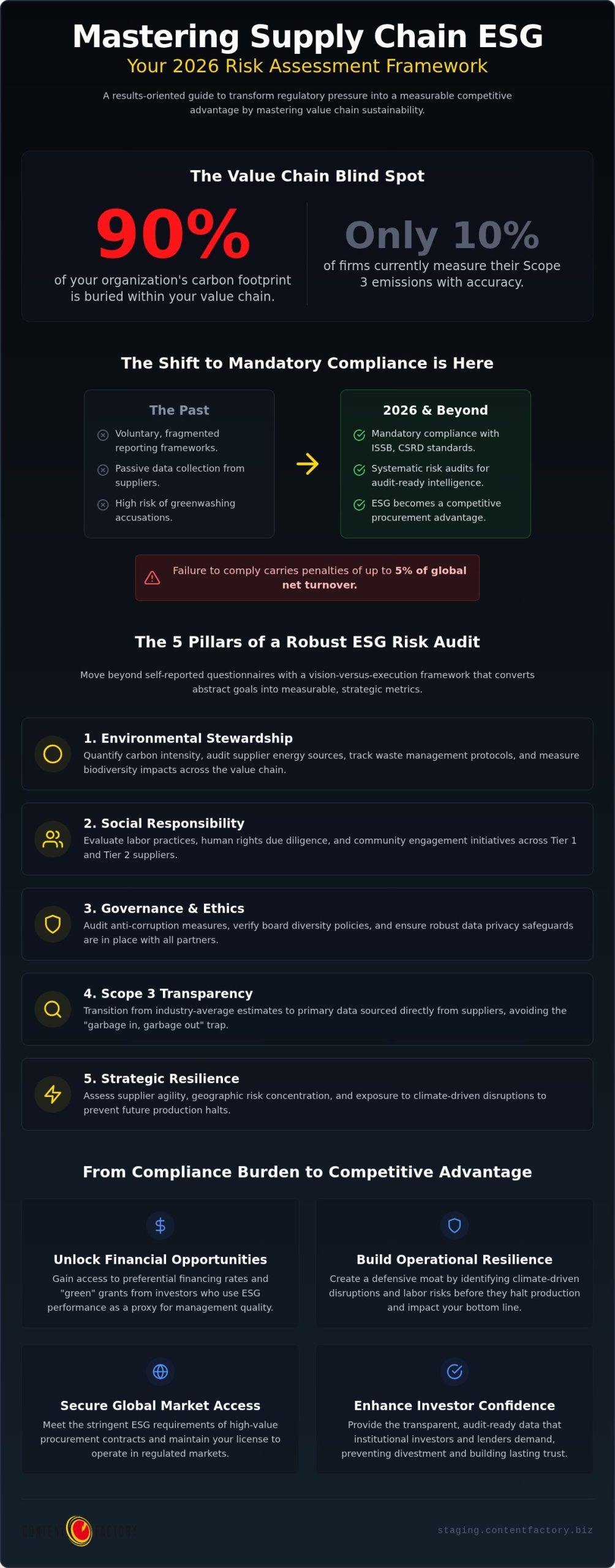
Approximately 90% of your organization’s total carbon footprint is buried within your value chain, yet only 10% of firms currently measure their Scope 3 emissions with any degree of accuracy. You’re likely feeling the weight of the August 2026 SB 253 reporting deadline or the impending EU Deforestation Regulation, while Tier 2+ supplier data remains frustratingly opaque. It’s clear that passive data collection is no longer a viable strategy for growth, making a rigorous supply chain ESG risk assessment a mandatory pillar of your operational resilience.
We understand the pressure of fragmented reporting frameworks and the legitimate fear of greenwashing accusations in an increasingly litigious environment. This guide provides a results-oriented framework to master value chain sustainability, transforming raw supplier information into audit-ready intelligence that satisfies both global regulators and institutional investors. We’ll move beyond theoretical goals to deliver a 2026 pragmatic execution checklist for identifying, mitigating, and reporting ESG risks that secures your competitive advantage in procurement. By the end of this article, you’ll have a clear roadmap for compliance and the tools to turn sustainability into a measurable driver of business value.
Key Takeaways
- Shift from voluntary reporting to mandatory compliance by adopting a systematic framework aligned with 2026 ISSB standards.
- Execute a rigorous supply chain ESG risk assessment by segmenting your supplier base according to spend, strategic importance, and risk profile.
- Implement a vision-versus-execution audit model that prioritizes measurable environmental stewardship and carbon intensity over abstract sustainability goals.
- Avoid the “garbage in, garbage out” data trap by integrating automated platforms with strategic advisory to ensure audit-ready Scope 3 disclosures.
- Transform ESG from a compliance burden into a competitive procurement advantage through integrated materiality assessments and business process reengineering.
The Strategic Necessity of Supply Chain ESG Risk Assessment in 2026
The 2026 Regulatory Landscape: ISSB, GRI, and CSRD
The transition from voluntary disclosure to mandatory compliance is now complete. For Singapore-linked entities and mid-market firms, the International Sustainability Standards Board (ISSB) standards have moved from a theoretical framework to an operational necessity. The regulatory environment is tightening globally. For instance, the EU Corporate Sustainability Due Diligence Directive (CSDDD) requires member states to transpose mandatory human rights and environmental due diligence into national law by July 26, 2026. Companies failing to meet these standards face civil liability and penalties of up to 5% of global net turnover. To maintain market access, firms must provide granular transparency. This includes addressing the significant gaps in Scope 3 Emissions Reporting Help to satisfy both regulators and upstream partners. Effectively managing supply chain sustainability is no longer a choice; it’s a prerequisite for participation in the global economy.
From Compliance to Competitive Advantage
Beyond Data Collection: The 5 Pillars of a Robust Risk Audit
A supply chain ESG risk assessment fails when it relies on unverified, self-reported questionnaires. We advocate for a vision-versus-execution framework that moves beyond high-level aspirations to the granular reality of operational data. A robust audit rests on five distinct pillars that convert abstract sustainability goals into measurable metrics. These pillars ensure that your risk profile isn’t just a compliance document but a live instrument for strategic decision-making. For firms looking to optimize the financial impact of their sustainability journey, Engineered Tax Services provides the technical engineering studies needed to uncover valuable tax incentives. By auditing these areas, you move from a reactive posture to one of operational resilience.
- Environmental Stewardship: Quantifying carbon intensity, waste management protocols, and biodiversity impacts.
- Social Responsibility: Evaluating labor practices, human rights, and community engagement across Tier 1 and Tier 2, which includes supporting localized educational resources like Learning Explorer to improve social outcomes for international staff and their families.
- Scope 3 Transparency: Transitioning from industry-average estimates to primary data sourced directly from suppliers, including specialized logistics partners like Silicon Valley Direct who offer transparent reporting for integrated fulfillment and mailing services.
- Strategic Resilience: Assessing supplier agility and geographic risk to prevent climate-driven disruptions.
- Infrastructure Sustainability: Evaluating the ESG compliance of facility partners like jm-sons.com during interior fitting-out and office transformation projects.
Environmental Risk: The Decarbonization Mandate
Effective decarbonization requires an audit of supplier energy sources and water usage intensity. It isn’t enough to track your own footprint; you must understand the energy mix of your critical vendors to avoid greenwashing risks. This aligns with a broader Net Zero Strategy Consulting approach where value chain emissions are prioritized. Your environmental due diligence checklist should include direct and indirect GHG emissions verified against utility data, effluent treatment capacity, and the ecological footprint in high-risk geographic regions. We focus on these “heavyweight” metrics to ensure your data is audit-ready for 2026 standards.
Social and Governance Risk: The “Invisible” Vulnerabilities
Social risks are often the most difficult to quantify because they’re hidden deep in regional supply chains. Modern slavery and labor exploitation don’t appear on standard balance sheets. Verification requires a combination of on-site audits and Open Source Intelligence (OSINT) to cross-reference supplier claims against local reports and regulatory databases. Governance transparency must also be verified through financial modelling to detect anomalies that suggest bribery or unethical conduct. Utilizing ESG Readiness Assessments allows firms to identify these governance gaps before they trigger regulatory penalties or damage your brand’s reputation. If you’re unsure where your vulnerabilities lie, discussing your risk profile with a specialist can help clarify your assessment boundaries and ensure your Tier 2 data is no longer a blind spot.
Internal alignment begins by defining materiality. You must determine which ESG factors actually impact your financial health and planetary footprint before setting assessment boundaries. Once the scope is clear, supplier segmentation allows you to prioritize your efforts where the risk is most concentrated. This ensures that resources aren’t wasted on low-impact vendors while Tier 1 vulnerabilities remain unaddressed. Mapping your value chain by geographic risk and commodity type is essential for identifying structural weaknesses; for instance, apparel brands might discover PowerSweet Fashion as they begin vetting manufacturing partners in Guangzhou.
- Identify which ESG factors are material to your specific industry using 2026 industry benchmarks.
- Map Tier 1 and Tier 2 suppliers by geographic risk and commodity type to identify concentration risks.
- Set assessment boundaries that include all subsidiaries and significant joint ventures.
- Define “high-risk” categories by cross-referencing current regulatory focus areas.
Phase 3 & 4: Execution and Verification
Moving into the execution phase, data solicitation must shift toward primary evidence. We recommend designing questionnaires that demand specific data points rather than vague policy affirmations. Verification is the final barrier against greenwashing accusations. Cross-referencing supplier energy bills or waste manifests allows you to verify carbon accounting claims with precision. Incorporating Carbon Accounting Services SG methodologies ensures that your emissions tracking is ready for external audit and matches the rigor of financial reporting.
- Design questionnaires that target primary data, such as actual energy consumption, rather than “yes/no” policy answers.
- Leverage Open Source Intelligence (OSINT) to cross-reference supplier claims against local news and regulatory filings.
- Perform gap analysis by comparing supplier disclosures against sector-specific industry benchmarks.
- Audit supplier waste manifests and water usage logs to verify environmental stewardship claims.
Automated Platforms vs. Strategic Advisory: Choosing Your Execution Engine
The Software Trap: Why Data Isn’t Strategy
Software-only solutions often provide a false sense of security through aggregated scores that lack operational context. A supplier might boast an impressive environmental rating while operating in a high-risk geographic cluster for labor violations that the platform’s algorithm misses. This is why human-led Materiality Assessments are essential; they align your data collection with the specific financial risks of your industry. When budgeting for your 2026 compliance cycle, consult The Real Cost of Carbon Accounting in Singapore to understand the investment required for audit-ready data versus superficial reporting.
The Advisory Advantage: Integration and Transformation
ContentFactory serves as the execution engine for organizations ready to move beyond the superficiality of voluntary reporting toward true operational resilience. We recognize that a supply chain ESG risk assessment is only as valuable as the tangible changes it triggers within your business processes. Our proprietary ESG Readiness & Materiality Assessment doesn’t just identify gaps; it builds a bridge between current vulnerabilities and future-proofed compliance. We integrate Carbon Accounting for Scopes 1, 2, and 3 directly into your risk framework, ensuring that every data point contributes to a cohesive strategy for growth and sustainability.
As a boutique partner, we offer an agile, high-intellect alternative to global consulting firms. We don’t just deliver a report and exit. We act as a hands-on extension of your leadership team, providing the localized expertise necessary to navigate the intricacies of Singapore’s regulatory environment and the broader regional ecosystem. This specialized focus allows us to address the specific pressures of mid-market firms with a level of precision and speed that larger entities can’t match. We value “doing” over “reporting,” positioning your firm as a bold innovator in value chain management.
From Assessment to Audit-Ready Reporting
Our methodology prepares firms for the complexities of multi-framework reporting, including GRI, ISSB, and TCFD. The core of our value proposition is the “Audit-Ready” promise. We ensure that your supplier data and internal metrics are robust enough to withstand rigorous third-party verification, protecting you from greenwashing claims and regulatory penalties. This high standard of governance should also apply to your digital operations; to maintain data privacy compliance, you can check out Conzent for a source-available cookie consent platform. We transform fragmented data into a single, synchronized system of record that supports both financial and non-financial disclosures with equal rigor. This process ensures your sustainability claims are backed by defensible evidence rather than vague policy affirmations.
Schedule an ESG Readiness Consultation with ContentFactory
Capability Building for Long-Term Resilience
Resilience isn’t bought; it’s built. We focus on ESG Capability Building to empower your procurement teams to identify red flags independently, often through professional development workshops for belonging that align internal culture with external ESG standards. This internal expertise is vital when conducting a supply chain ESG risk assessment in dynamic markets where supplier profiles shift rapidly. We also integrate these ESG risk insights into regional expansion and ASEAN market entry studies, ensuring that sustainability is a foundational element of your growth strategy. The ContentFactory approach is authoritative, pragmatic, and relentlessly focused on delivering commercial outcomes that strengthen your position in the global value chain. We don’t just help you comply; we help you lead.
Executing Your Strategic Value Chain Roadmap
Transitioning from theoretical sustainability to operational execution is the defining challenge for mid-market leaders in 2026. A rigorous supply chain ESG risk assessment ensures your organization isn’t just reporting data but actively building structural resilience against global regulatory shifts and climate disruptions. By prioritizing primary supplier verification and internal capability building, you transform a compliance burden into a measurable procurement advantage that secures your position in the global economy.
ContentFactory provides the execution engine needed to bridge the gap between high-level vision and audit-ready results. Led by Singapore Certified Management Consultants, we deliver a pragmatic, results-oriented framework specifically designed for the pressures of the mid-market sector. Our methodology ensures your Scope 1, 2, and 3 carbon accounting stands up to the most stringent third-party verification while integrating seamlessly with your broader financial modelling and market entry strategies.
We’re ready to help you turn these regulatory complexities into a clear, actionable path forward for sustainable growth.
Frequently Asked Questions
What is the first step in a supply chain ESG risk assessment?
The first step is a formal materiality assessment to define which environmental, social, and governance factors have a direct impact on your financial performance and planetary footprint. You must establish clear assessment boundaries before engaging suppliers. This ensures that your resource allocation focuses on the high-impact areas of your value chain. Starting with internal alignment prevents the collection of irrelevant data that complicates the final reporting process.
How does Scope 3 emissions reporting affect my ESG risk profile?
Scope 3 emissions often account for over 90% of a company’s total carbon footprint, making them the primary driver of your ESG risk profile. Regulatory bodies now mandate these disclosures for large firms, which trickles down to their mid-market partners. Failing to report Scope 3 data accurately exposes your firm to greenwashing accusations and potential loss of high-value contracts with upstream entities that require this data for their own compliance.
Can SMEs afford a comprehensive supply chain ESG audit in 2026?
What is the difference between a supplier questionnaire and a risk assessment?
You should conduct a comprehensive review annually, though high-risk supplier segments require continuous monitoring through dynamic risk management protocols. ESG risks aren’t static; they shift with regional political changes, climate events, and new regulatory transpositions. Establishing a cadence for quarterly updates on critical Tier 1 partners ensures that your leadership team remains agile. This proactive approach prevents a minor supplier failure from escalating into a major reputational or financial crisis.
Are there Singapore government grants available for ESG risk assessments?
Yes, several Singapore government grants exist to support ESG initiatives, including the Enterprise Development Grant (EDG) administered by Enterprise Singapore. These grants often cover a portion of project costs related to sustainability and business process reengineering. Our Strategic Grant Advisory team helps mid-market firms navigate these applications to secure funding for materiality assessments and carbon accounting. This financial support makes high-level strategic advisory accessible for firms targeting regional expansion.
What happens if a key supplier refuses to provide ESG data?
If a key supplier refuses to provide data, you must utilize Open Source Intelligence (OSINT) and industry-specific proxies to estimate their risk profile. This shouldn’t lead to immediate offboarding but rather the development of a collaborative corrective action plan. Documenting your attempts to solicit data is crucial for regulatory defense. If the supplier remains non-compliant over time, you must evaluate the long-term risk of maintaining that partnership against your own sustainability commitments.
How do ISSB standards change supply chain reporting requirements?
ISSB standards, specifically IFRS S2, mandate the disclosure of climate-related risks and opportunities across the entire value chain. This shift moves Scope 3 reporting from a voluntary exercise to an operational necessity for firms linked to global markets. These standards require audit-ready data that matches the rigor of financial reporting. Organizations must now demonstrate how ESG factors impact their business model and future cash flows, forcing a deeper integration of sustainability into core governance.

Article by
Mayuresh Godse
Mayuresh Godse is a Singapore Certified Management Consultant and Business Strategist specializing in Sustainability, ESG, AI-driven Digital Transformation, and business growth. Based in Singapore, he writes about Sustainability, Digital Innovation, Business Strategy, and Content Marketing for global audiences.
Disclaimer
This article is provided by ContentFactory for general information only and is not legal, tax, accounting or financial advice. Regulations and government scheme criteria change; grant eligibility and quantum are set by the relevant Singapore agencies and assessed case by case, with no outcome guaranteed. Verify current requirements before acting.
One thing worth checking on the tool side: if the disclaimer is switched on globally, the grant caveat already written into your Global Writing Instructions will appear as well, so grant articles will carry the same point twice. Remove the required-disclaimer section from the instructions file if you enable this one.