

Many Singaporean SMEs view government grants as a complex, often frustrating process. They see high rejection rates and hear stories of applications failing due to poorly defined project scopes or a misalignment with national economic priorities. The core challenge is not the paperwork itself, but the strategic thinking that must precede it. Without a clear link between your project and measurable business transformation, an application is unlikely to succeed.
This is where strategic grant application help becomes critical. It is the process of aligning your business objectives with government funding criteria, ensuring your project is not only viable but also demonstrates significant value to Singapore’s economic development. This guide moves beyond simple form-filling to provide a strategic framework for securing funding in 2026, focusing on building a robust business case that grant evaluators look for.
Discover how to transform grant applications from administrative hurdles into catalysts for genuine business growth and operational transformation.
Beyond Paperwork: Defining Strategic Grant Application Help
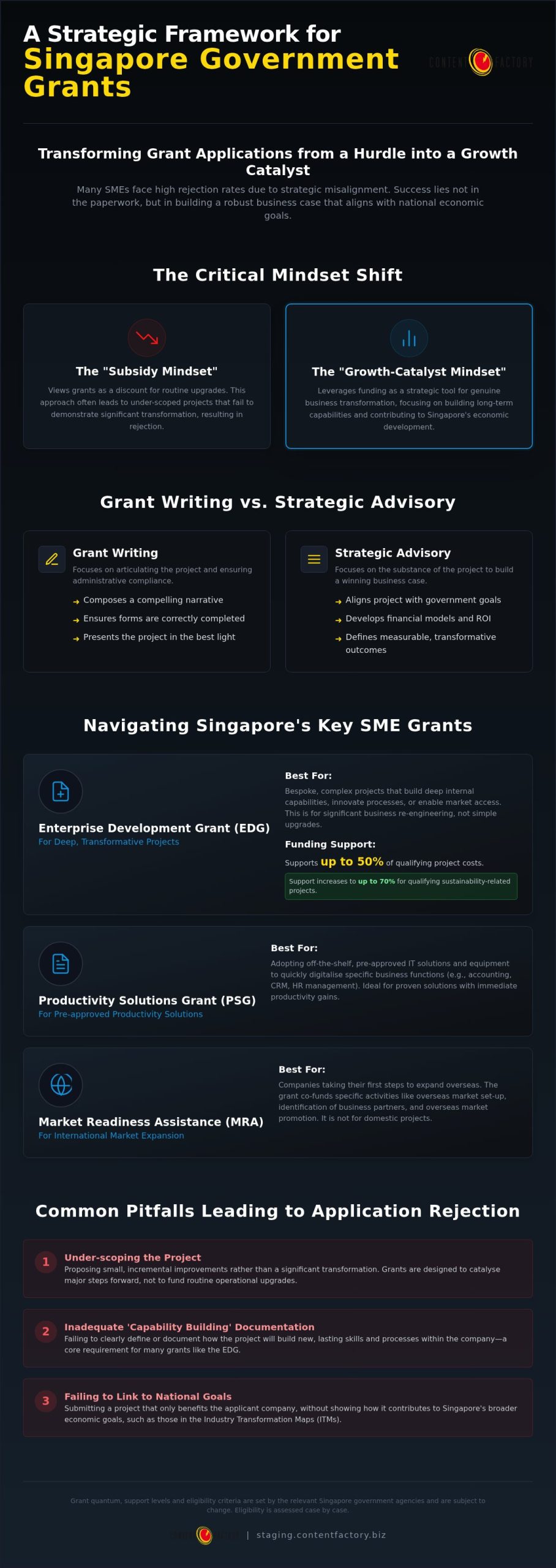
Strategic grant application help is the practice of structuring a business project to align perfectly with government funding objectives, thereby maximising the probability of approval and ensuring the project delivers tangible results. It moves beyond the narrative of an application to focus on the underlying business case, financial viability, and potential for capability development. This approach requires a shift from a ‘subsidy mindset’—seeing grants as a discount—to a ‘growth-catalyst mindset’, where funding is a tool to execute significant transformation.
- Aligning Business Goals with Funding Criteria: The primary function of a strategic consultant is to translate your commercial goals into a language that resonates with grant evaluators, focusing on productivity gains, innovation, and job creation.
- Addressing Application Weaknesses: Many DIY applications fail due to a lack of measurable outcomes, weak financial modelling, or an inability to prove the project will build lasting capabilities within the organisation.
- Identifying Opportunities: A consultant can often identify funding opportunities across multiple government frameworks that a business might overlook, creating a more comprehensive funding strategy.
The Difference Between Grant Writing and Strategic Advisory
While related, Grant writing and strategic advisory serve fundamentally different purposes. Grant writing is primarily focused on composing a compelling narrative and ensuring administrative compliance. It is about correctly filling out the forms and presenting the project in the best possible light.
Strategic advisory, in contrast, is about the substance of the project itself. It involves rigorous financial modelling to project ROI, identifying and mitigating project risks before an evaluator can, and ensuring the project scope is ambitious enough to be considered truly transformative. The advisory process builds the robust business case that a grant writer then articulates.
Common Pitfalls in Independent Grant Submissions
Businesses often underestimate the strategic depth required for a successful application. Several common errors lead to rejection by Enterprise Singapore and other agencies:
- Under-scoping the Project: Proposing small, incremental improvements rather than a significant transformation is a frequent reason for failure. Government grants are designed to catalyse major steps forward, not to fund routine operational upgrades.
- Inadequate Documentation of ‘Capability Building’: A core requirement for many grants, particularly the Enterprise Development Grant (EDG), is that the project builds new and lasting skills and processes within your company. Many applications fail to define or document how this will be achieved, for example by partnering with Inspired Leadership to develop the management capabilities needed for long-term growth.
- Failing to Link to National Goals: Applications must demonstrate how the project contributes to Singapore’s broader economic goals, often detailed in the Industry Transformation Maps (ITMs). A project that only benefits the applicant company is less compelling than one that also supports industry-wide upgrading.
Navigating Singapore’s Grant Landscape: EDG, PSG, and More
Understanding the different grants available is the first step in developing a funding strategy. Each scheme is designed for a specific purpose, and choosing the right one is crucial. While dozens of grants exist, SMEs most commonly engage with the Enterprise Development Grant (EDG), the Productivity Solutions Grant (PSG), and the Market Readiness Assistance (MRA) grant.
Comparing Key Government Grants for SMEs
Selecting the appropriate grant depends entirely on your project’s nature, scope, and objectives.
- Enterprise Development Grant (EDG): This is the primary grant for deep, transformative projects. It supports initiatives that build internal capabilities, improve operational efficiencies, or innovate. EDG projects are bespoke, complex, and require a high degree of strategic planning. It is suited for significant business process reengineering, technology adoption, or developing new business strategies. Funding supports up to 50% of qualifying costs, with support of up to 70% available for qualifying sustainability-related projects.
- Productivity Solutions Grant (PSG): The PSG is designed for the adoption of pre-approved, off-the-shelf IT solutions and equipment that improve productivity. Unlike the EDG, the PSG is for solutions with a proven track record, not for customised or new project development. It is ideal for SMEs looking to digitalise specific functions quickly, such as adopting a new accounting software or CRM system.
- Market Readiness Assistance (MRA): This grant is specifically for companies looking to expand overseas. It helps to co-fund activities like overseas market set-up, identification of business partners, and overseas market promotion. MRA is not for domestic projects.
- Other Schemes: The Career Conversion Programmes (CCP) and Company-Led Training Programme (CTP) are focused on workforce development, helping companies reskill employees or train them for new roles as the business transforms. These are often used in conjunction with larger transformation projects funded by grants like the EDG.
Understanding Qualifying Project Costs
A common point of confusion is what costs a grant will actually cover. For a typical EDG project, qualifying costs are generally broken down into three main categories:
- Third-Party Consultancy Fees: This is the largest component for most strategic projects. It covers the fees paid to external experts, such as a management consultant engaged for business process reengineering or a technology advisor for a digital transformation roadmap.
- Software and Equipment: This includes the cost of acquiring new hardware or licensing software that is integral to the project’s execution. It must be demonstrated that these tools are essential for achieving the project’s productivity goals.
- Internal Manpower Costs: In some cases, a portion of the salaries for employees directly involved in implementing the grant project may be claimed. This requires meticulous documentation of the time these employees spend on the project, separate from their routine duties. This component is often subject to the most scrutiny.
The ROI of Strategic Advisory vs. DIY Applications
Attempting a complex grant application without expert guidance can be a costly mistake. The “cost of failure” extends beyond the lost funding; it includes months of wasted management time, missed market opportunities while waiting for a decision, and a mandatory cooling-off period before a revised application can be submitted. Strategic advisory is not an expense but an investment in mitigating these risks.
A strategic consultant acts as a bridge between the C-suite’s vision and the operational details required by grant evaluators. They ensure the project’s scope, financial projections, and capability development plans are robust and audit-ready from day one. This professional preparation sets the stage for a successful current application and builds a credible track record for future funding rounds.
Why SCMC Certification Matters
For many consultancy-related projects under the Enterprise Development Grant (EDG), Enterprise Singapore requires that the third-party consultant be a Singapore Certified Management Consultant (SCMC). This is not a mere preference; it is a prerequisite for certain project types. The SCMC certification provides assurance of quality, professional ethics, and accountability.
Engaging an SCMC-certified firm like ContentFactory demonstrates to evaluators that the project will be guided by a professional who understands the Enterprise Singapore mandate and is held to a high standard of conduct. This certification, held by ContentFactory’s lead consultant Mayuresh Godse, is a critical trust signal that ensures your application is built on a foundation of recognised expertise.
Quantifying the Value of Expert Project Scoping
The most critical phase of any grant application is project scoping. This is where the value of an expert becomes most apparent. A consultant helps define the project’s boundaries to prevent “scope creep”—the gradual expansion of a project that can lead to budget overruns and the rejection of claims.
Furthermore, an advisor helps optimise the grant-to-equity ratio, ensuring the company leverages government funding effectively without over-committing its own capital. They structure the project to deliver maximum impact, ensuring every proposed activity is justifiable, measurable, and directly linked to the project’s transformative goals.
A Roadmap for High-Success Grant Submissions
A structured, methodical approach dramatically increases the chances of grant approval. A successful submission process is not a single event but a multi-stage journey that begins long before any forms are filled out and continues long after the funds are approved.
Step 1: Diagnostic and Strategic Scoping
Before writing anything, a thorough diagnostic audit is essential. This process evaluates your business’s readiness for a major transformation project and identifies the most significant funding gaps. It involves assessing the project’s materiality—its importance to your core business—and determining the right balance between ambition and feasibility.
A strong project scope makes the difference between an incremental improvement and a fundable transformation. For example, instead of proposing to “buy a new CRM,” a transformative scope would be to “reengineer the entire sales and customer service process, supported by an integrated CRM and employee training programme, to reduce customer acquisition cost by 30%.” A grant-ready project is one that balances innovation with financial viability.
Step 2: Financial Modelling and Application
With a clear scope, the next step is to build a detailed financial model. This must project the return on investment (ROI) and the cash flow impact of the funded project. It should clearly articulate the “productivity gain”—a key metric for Enterprise Singapore—in quantifiable terms, such as man-hours saved, increased output, or reduced error rates.
Only then does the application process begin. Navigating the Business Grants Portal (BGP) requires precision. A professionally prepared application, backed by a robust strategic and financial case, can navigate the evaluation process more efficiently because it pre-emptively answers the questions evaluators are trained to ask.
Step 3: Mastering the Post-Approval Claim Process
Securing approval is only half the battle; managing the claim process is equally critical. Upon approval, you receive a Letter of Offer (LOF) that outlines the specific conditions, project timeline, and reporting requirements you must meet.
- Evidence Requirements: Every dollar claimed must be backed by rigorous evidence. This includes invoices from third-party vendors, proof of payment, project reports, and documentation of achieved milestones and KPIs. Maintaining meticulous records from day one is non-negotiable.
- The Role of the Audit: For larger projects, an external auditor may be required to verify the project’s expenses and outcomes before the final claim is disbursed. Strategic advisory includes preparing your documentation to be audit-ready, preventing delays at this final stage.
- Common Claim Rejections: Claims are often delayed or rejected for simple reasons: missed deadlines, incomplete documentation, or project activities that deviate from the approved scope. Proactive project management and clear communication with the grant agency are essential to avoid these pitfalls.
- Disbursement Timing: Funds are typically disbursed on a reimbursement basis, meaning your company must incur the costs first. Understanding this is vital for managing your cash flow throughout the project’s lifecycle.
For businesses needing dedicated support during this critical phase, services for post-approval audit and compliance support can ensure that every claim is managed correctly.
Capitalising on 2026 Funding Frameworks
Securing government funding is a strategic business process, not an administrative task. By focusing on transformative projects, building a robust business case, and managing the process with professional discipline, you can turn grant applications into a powerful tool for growth. The key is to think like an evaluator, prioritising projects that build lasting capabilities and contribute to Singapore’s economic resilience.
ContentFactory provides the end-to-end strategic support necessary to navigate this complex landscape. Led by a Singapore Certified Management Consultant (SCMC), our approach is grounded in building a viable, fundable project from the ground up, from initial diagnostic to final claim submission. We focus on strategic grant advisory and financial modelling to ensure your application is built for success.
To learn how we can help structure your next transformation project for funding approval, book a strategic consultation.
Grant quantum, support levels and eligibility criteria are set by the relevant Singapore government agencies and are subject to change. Eligibility is assessed case by case.

Article by
Mayuresh Godse
Mayuresh Godse is a Singapore Certified Management Consultant and Business Strategist specializing in Sustainability, ESG, AI-driven Digital Transformation, and business growth. Based in Singapore, he writes about Sustainability, Digital Innovation, Business Strategy, and Content Marketing for global audiences.
Disclaimer
This article is provided by ContentFactory for general information only and is not legal, tax, accounting or financial advice. Regulations and government scheme criteria change; grant eligibility and quantum are set by the relevant Singapore agencies and assessed case by case, with no outcome guaranteed. Verify current requirements before acting.
One thing worth checking on the tool side: if the disclaimer is switched on globally, the grant caveat already written into your Global Writing Instructions will appear as well, so grant articles will carry the same point twice. Remove the required-disclaimer section from the instructions file if you enable this one.