

Reporting to three different global frameworks doesn’t require triple the internal resources. While the pressure from multinational clients for ESRS or ISSB alignment is intensifying, treating each standard as a separate project is a strategic error that leads to reporting fatigue. This multi framework sustainability reporting guide offers a pragmatic roadmap to consolidate these demands into a single, efficient disclosure system.
It’s understandable if your team feels overwhelmed by the lack of clear data collection processes for overlapping standards. You need a streamlined method that satisfies the 2026 ACRA mandatory reporting timelines and SGX climate disclosure requirements without duplicating effort. This article demonstrates how to build an audit-ready ESG data core that meets GRI, ISSB, and ESRS criteria simultaneously. The following sections outline the specific steps to transition from fragmented reporting to a synchronised operational model that protects your brand reputation with international partners.
Key Takeaways
- Understand the critical shift from voluntary to mandatory disclosure under the 2026 ACRA and SGX RegCo timelines for Singaporean organisations.
- Learn to distinguish between the ‘Big Three’ frameworks—GRI, ISSB, and ESRS—to satisfy both local regulators and global capital markets.
- Utilise this multi framework sustainability reporting guide to build a ‘report once, disclose many’ data architecture that eliminates redundant collection efforts.
- Identify the steps for conducting a gap analysis and establishing robust internal controls to ensure your non-financial data is audit-ready.
- Discover how to leverage integrated reporting as a strategic tool for internationalisation and securing ASEAN market access.
Navigating the Global Sustainability Reporting Landscape in 2026
The shift from voluntary to mandatory reporting is a structural change in how Singaporean firms operate. ACRA and SGX RegCo have moved beyond simple climate disclosures to a standardised regime that aligns with the global sustainability reporting landscape. This change forces your leadership team to treat ESG data with the same rigour as financial statements, moving away from marketing-led narratives toward data-driven compliance.
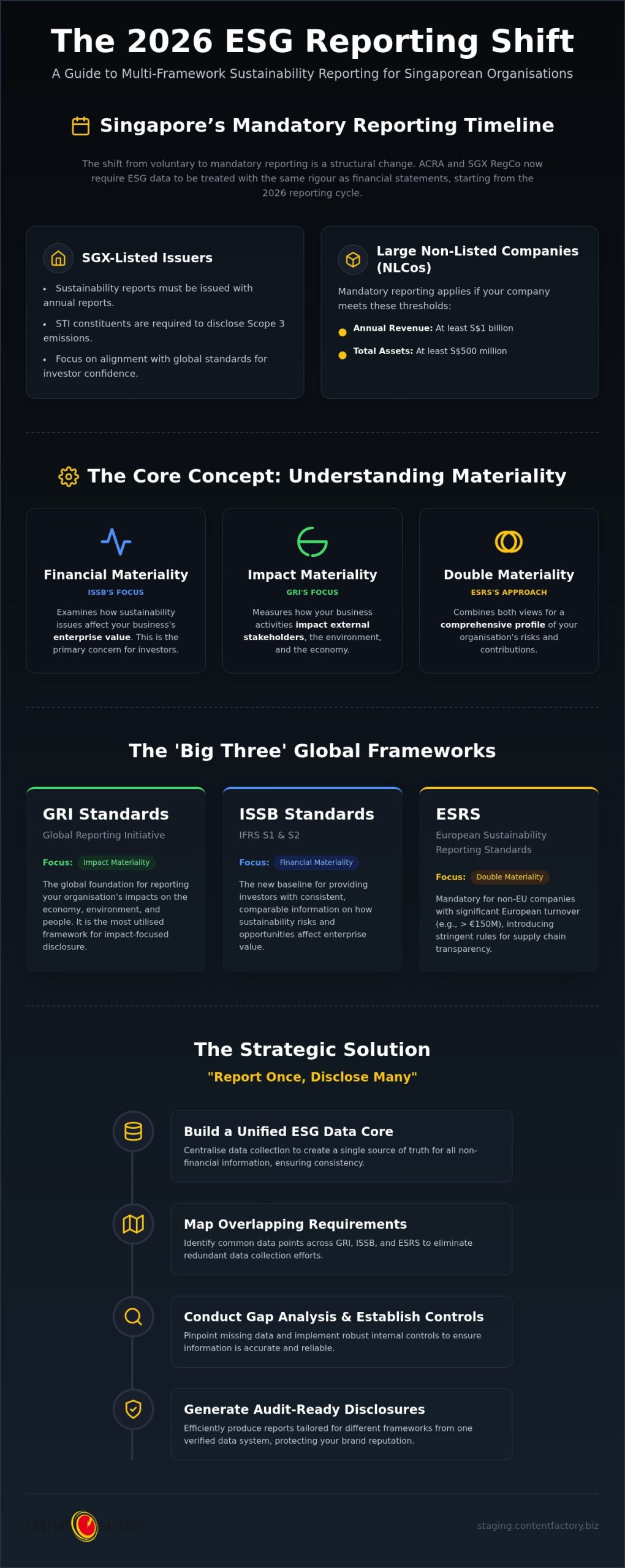
Using a multi framework sustainability reporting guide is the only way to satisfy a fragmented global market. The ‘Big Three’ frameworks form the core of modern disclosure:
- GRI Standards: The global foundation for reporting your organisation’s impacts on the economy, environment, and people.
- ISSB (IFRS S1 & S2): The baseline for financial materiality, designed to provide investors with information regarding enterprise value.
- ESRS: The mandatory European standards that introduce double materiality for firms with EU-linked supply chains or operations.
A single-framework approach is no longer sufficient. International stakeholders now look for interoperability, expecting your data to translate across different regulatory jurisdictions. By building a unified data core, you avoid the reporting fatigue that comes from redundant, manual collection processes and ensure your business remains a viable partner for multinational clients.
To better understand how these frameworks interact, watch this helpful video:
Singapore’s Mandatory Reporting Timeline for 2026
The 2026 reporting cycle marks a critical expansion of regulatory oversight. SGX-listed issuers must now issue sustainability reports simultaneously with their annual reports, with STI constituents required to disclose Scope 3 emissions. Large non-listed companies (NLCos) also fall under mandatory requirements if they meet specific thresholds: annual revenue of at least S$1 billion and total assets of at least S$500 million. This phased implementation gives your organisation time to build mandatory sustainability assurance readiness before external verification becomes a legal necessity.
Understanding Financial vs Impact Materiality
Effective disclosure requires you to distinguish between two primary perspectives. ISSB focuses on financial materiality, which examines how sustainability-related risks and opportunities affect your business’s enterprise value. This is the primary concern for investors looking at long-term financial resilience. GRI takes the opposite view, focusing on impact materiality to measure how your business activities affect external stakeholders and the environment. Double materiality combines these views, creating a comprehensive profile of your organisational risks and contributions. Adopting this dual lens ensures your reporting meets the expectations of both the finance community and the broader public.
Core Frameworks: GRI, ISSB, and the ESRS Shift
GRI remains the most utilised framework for organisations prioritising impact materiality. It provides a structured methodology for disclosing how your business affects social and environmental systems. However, relying solely on GRI is insufficient for firms seeking international investment. Navigating these requirements requires a comprehensive multi framework sustainability reporting guide to ensure your data translates across jurisdictions and satisfies diverse stakeholder groups.
Singaporean exporters must also account for the ESRS. These standards apply to non-EU companies with significant European turnover, typically exceeding €150 million. While the revised ESRS has reduced mandatory datapoints by over 60%, the remaining requirements for cross-border supply chain transparency are stringent. For a more detailed look at how these regulations impact your operations, you can speak with our consultants about your specific market exposure.
ISSB S1 and S2: The New Climate Disclosure Benchmark
IFRS S1 and S2 represent the consolidation of previous frameworks, effectively ending the ‘alphabet soup’ of fragmented standards. These standards integrate the TCFD recommendations, focusing on governance, strategy, risk management, and metrics. By following the resources in the IFRS Sustainability Knowledge Hub, businesses can ensure their climate-related risks are quantified in terms of enterprise value. This alignment is critical for SGX-listed firms that must now report Scope 1 and Scope 2 emissions as part of their mandatory obligations. Singaporean organisations navigating these requirements can benefit from a structured ISSB standards compliance advisory strategy to build an audit-ready framework aligned with ACRA and SGX timelines.
ESRS Requirements for Singaporean Subsidiaries
The Corporate Sustainability Reporting Directive (CSRD) has an extraterritorial reach that directly impacts Singaporean parent companies and subsidiaries. If your business generates a net turnover of more than €150 million in the EU for two consecutive years, you’ll likely face mandatory ESRS reporting. This includes providing detailed data on your value chain, which often requires a complete overhaul of existing data collection processes. Managing these overlapping requirements is the core focus of any robust multi framework sustainability reporting guide, as it allows you to map ESRS datapoints against existing GRI or ISSB disclosures to reduce the administrative burden.
SASB standards provide the final piece of the puzzle by offering industry-specific metrics. While ISSB and GRI provide the broad framework, SASB identifies the subset of ESG issues most relevant to your specific sector, such as logistics or manufacturing. Using these targeted metrics ensures your reporting isn’t just a compliance exercise but a tool for improving operational efficiency and long-term resilience. Jurisdictions representing 60% of global GDP have already moved to mandate ISSB-aligned disclosures, making this integration a prerequisite for regional growth.
Strategic Alignment: Mapping Frameworks to Reduce Duplication
Many firms make the mistake of treating every sustainability standard as an isolated silo. This approach results in redundant data entry and conflicting internal metrics that confuse stakeholders. A robust multi framework sustainability reporting guide prioritises the identification of common denominators across GRI and ISSB. By mapping GRI impact indicators against ISSB risk disclosures, you create a central data repository that serves multiple reporting ends without doubling your team’s workload.
Building a ‘Report Once, Disclose Many’ architecture requires shifting from manual spreadsheets to structured data management. You don’t need to reinvent your metrics for every jurisdiction. Instead, use SASB standards to satisfy the industry-specific requirements of IFRS S2 while simultaneously fulfilling GRI’s sector-specific disclosures. This method ensures your operational data remains consistent across your annual report and standalone sustainability disclosures, protecting your organisation from accusations of greenwashing or inconsistent reporting.
The Materiality Assessment as a Framework Bridge
Conducting a materiality assessment for SMEs is the first step in bridging framework gaps. This process identifies which ESG issues actually drive financial performance and stakeholder trust. By focusing on these core priorities, you avoid the trap of reporting everything to everyone. You can then prioritise disclosures that satisfy the 2026 ACRA requirements while also strengthening your brand’s commercial value in the ASEAN market.
Interoperability Guidance: GRI and IFRS S1/S2
Interoperability is a practical necessity for firms operating in regional supply chains. You can use GRI’s impact data to inform the risk assessments required by ISSB. For example, a high-impact water usage issue identified via GRI directly informs the operational risk profile disclosed under IFRS S1. Cross-referencing these points in your annual report reduces the administrative burden and provides a cohesive narrative for investors and regulators alike.
Addressing the data gaps between financial and impact disclosures is the final step in mapping. While ISSB focuses on risks to your enterprise value, GRI looks at your impact on the world. A unified mapping exercise identifies where these two perspectives overlap, such as in carbon emissions or labour practices. This integrated approach is the core focus of a multi framework sustainability reporting guide, as it allows your business to present a complete picture of resilience and responsibility without wasting internal resources.
Operationalising a Multi-Framework Reporting System
Moving from a theoretical multi framework sustainability reporting guide to operational reality requires a structural shift in how your organisation handles non-financial data. You can’t rely on annual manual collection if you intend to meet the 2026 ACRA timelines for mandatory reporting. Operationalisation means embedding ESG data collection into your business-as-usual processes, ensuring that every datapoint is captured with the same accuracy as a financial transaction.
Establishing robust internal controls is the only way to ensure your sustainability data is audit-ready. This involves treating carbon metrics and social indicators with the same rigour as your balance sheet. Integrating ESG metrics into your existing ERP and finance systems ensures that data is captured at the source, reducing the risk of reporting fatigue. This integration makes sustainability performance visible to leadership in real-time, allowing for data-driven decisions rather than reactive reporting.
With mandatory sustainability assurance approaching in Singapore, your data collection must be verifiable. Every figure in your report needs a clear source and a documented calculation methodology. Preparing for this shift now prevents the last-minute scramble that often results in reporting errors and potential regulatory scrutiny. To ensure your systems meet these rigorous standards, you can learn more about International Associates Limited and their global certification and verification services.
Assigning ownership is the first step in creating a reliable data governance structure. Your finance team, operations manager, and HR lead must each own specific ESG datapoints relevant to their functions. Implementing digital ESG integration and automation allows you to move away from error-prone manual spreadsheets. This setup creates a permanent audit trail for Scope 1, 2, and 3 emissions, which is essential for satisfying the STI constituent requirements starting in 2026.
Gap Analysis and Roadmap Development
A gap analysis identifies exactly where your current reporting falls short of global standards like GRI or ISSB. Start by comparing your existing disclosures against the ESG readiness assessment Singapore benchmarks. This process highlights missing metrics, particularly in the social and governance pillars that firms often overlook. Once identified, you should develop a three-year roadmap that prioritises high-impact disclosures first, ensuring full framework alignment by the time the next regulatory phase begins.
Using a multi framework sustainability reporting guide allows you to build a scalable system that grows with your business. By focusing on systems rather than just reports, you protect your organisation from the administrative burden of shifting global standards. This pragmatic approach ensures that your ESG transformation drives genuine commercial value and long-term resilience in the ASEAN market.
ContentFactory: Delivering Pragmatic ESG Reporting Solutions
ContentFactory functions as a dedicated extension of your leadership team, moving your organisation from a static reporting posture to active ESG execution. We understand that for Singaporean SMEs and mid-market firms, sustainability is a commercial imperative rather than a theoretical exercise. This multi framework sustainability reporting guide serves as the foundation for our partnership, ensuring your business meets global standards while maintaining operational focus.
Our advisory services cover the entire spectrum of the ESG journey. We start with a rigorous materiality assessment to define your strategic priorities and conclude with mandatory sustainability assurance readiness. This end-to-end support is particularly critical for firms expanding across the ASEAN and India regions, where local regulatory nuances and multinational client expectations often clash. We provide the localized expertise necessary to navigate these regional business ecosystems with confidence.
Our Results-Led Approach to Sustainability
We prioritise ROI-driven ESG strategies that improve your bottom line through operational efficiency. Sustainability isn’t just about compliance; it’s about reducing waste, optimising energy use, and building a resilient supply chain. To sustain these gains, we focus on building internal ESG capability and training for your leadership teams. This ensures your organisation possesses the intellectual capital to manage disclosures independently over the long term, rather than remaining dependent on outside vendors.
For qualifying sustainability projects, your business may be eligible for the Enterprise Development Grant (EDG), which can provide support of up to 70% for project costs. We assist in aligning your ESG roadmap with these schemes to accelerate implementation without straining your capital reserves. Grant quantum, support levels and eligibility criteria are set by the relevant Singapore government agencies and are subject to change. Eligibility is assessed case by case.
ContentFactory provides specialised ESG Consulting & Sustainability Transformation services designed for the complexities of the Singaporean and regional business landscape. We move beyond the “alphabet soup” of standards to deliver a synchronised reporting system that satisfies GRI, ISSB, and ESRS requirements through a single data architecture. Our team ensures your data is audit-ready and your strategy is commercially viable, protecting your brand’s reputation with international partners. Book a 30-minute discovery call.
Executing Your 2026 ESG Strategy
Transitioning your organisation from compliance-driven reporting to a strategic ESG model requires a structural shift in data architecture. By following this multi framework sustainability reporting guide, you move beyond redundant manual processes toward a unified data core that satisfies GRI, ISSB, and ESRS standards simultaneously. This approach ensures your business remains audit-ready for the 2026 ACRA mandates while strengthening your reputation with international partners.
ContentFactory provides the pragmatic execution engine needed for this transformation. Led by a Singapore Certified Management Consultant with over 25 years of experience, we bring specific expertise to the manufacturing and logistics sectors. We assist in aligning your sustainability roadmap with strategic government support, including the Enterprise Development Grant (EDG) and Market Readiness Assistance (MRA). Our focus remains on tangible outcomes that drive regional growth and operational resilience.
Grant quantum, support levels and eligibility criteria are set by the relevant Singapore government agencies and are subject to change. Eligibility is assessed case by case.
Frequently Asked Questions
What is the primary difference between GRI and ISSB for Singaporean companies?
GRI focuses on impact materiality, measuring how your organisation affects the environment and society. Conversely, ISSB prioritises financial materiality, which examines how sustainability risks affect your business’s enterprise value. For Singaporean firms, the primary difference lies in the audience; GRI speaks to broad stakeholders, while ISSB is tailored for investors. Using a multi framework sustainability reporting guide helps you bridge these two perspectives without duplicating your internal data collection efforts.
Is multi-framework reporting mandatory for all Singapore SMEs in 2026?
Mandatory reporting is currently phased for listed issuers and large non-listed companies meeting specific thresholds, such as S$1 billion in revenue. It isn’t a legal requirement for all SMEs in 2026. However, many smaller firms face commercial pressure from multinational clients who require ESRS or ISSB alignment. Proactively adopting these standards protects your position in the global supply chain and prepares your business for future regulatory expansions in Singapore.
How does the ESRS affect businesses located in Singapore?
ESRS has an extraterritorial reach that impacts Singaporean firms with net turnover exceeding €150 million in the EU for two consecutive years. Even if you don’t meet this threshold, you may be required to provide detailed sustainability data if you’re a supplier to EU-listed companies. This standard requires double materiality disclosures, meaning you must report on both your financial risks and your external environmental impacts to maintain European market access.
Can we use the same data for both SASB and GRI disclosures?
You can utilise the same data sets for both frameworks, as there’s significant overlap in metrics like GHG emissions and energy consumption. The key is to map your data points effectively. A multi framework sustainability reporting guide allows you to identify where SASB’s industry-specific metrics can satisfy GRI’s broader disclosure requirements. This integrated approach reduces reporting fatigue and ensures consistency across all your public sustainability statements and annual reports.
What are the first steps in preparing for mandatory sustainability assurance?
Your first step is to conduct a thorough gap analysis to identify missing metrics in your current disclosures. Following this, you must establish robust internal controls and data ownership across departments to ensure accuracy. Creating a clear audit trail for Scope 1, 2, and 3 emissions is essential. This preparation ensures your non-financial data is ready for the mandatory sustainability assurance requirements that Singapore is implementing in a phased approach.
How much does it cost to implement a multi-framework reporting system in Singapore?
Implementation costs depend on your current data maturity and the scale of your operations. Singaporean organisations can often offset these costs by applying for the Enterprise Development Grant (EDG), which provides up to 70% funding for qualifying sustainability projects, subject to eligibility. Investing in a synchronised reporting system should be viewed as a tool for long-term resilience and internationalisation rather than just a compliance cost. Eligibility is assessed case by case.
How often should a materiality assessment be updated for multi-framework reporting?
Materiality assessments should generally be refreshed every two to three years to remain accurate. However, you should trigger an earlier update if your business enters a new market, launches a major product line, or if local regulations like the 2026 ACRA mandates change significantly. Regular reviews ensure your reporting prioritises the ESG issues that most impact your financial performance and stakeholder trust in an evolving regulatory landscape. For a deeper understanding of how to structure your disclosures under the Global Reporting Initiative, our GRI framework sustainability reporting guide for Singapore firms provides a practical roadmap for adoption.

Article by
Mayuresh Godse
Mayuresh Godse is a Singapore Certified Management Consultant and Business Strategist specializing in Sustainability, ESG, AI-driven Digital Transformation, and business growth. Based in Singapore, he writes about Sustainability, Digital Innovation, Business Strategy, and Content Marketing for global audiences.
Disclaimer
This article is provided by ContentFactory for general information only and is not legal, tax, accounting or financial advice. Regulations and government scheme criteria change; grant eligibility and quantum are set by the relevant Singapore agencies and assessed case by case, with no outcome guaranteed. Verify current requirements before acting.
One thing worth checking on the tool side: if the disclaimer is switched on globally, the grant caveat already written into your Global Writing Instructions will appear as well, so grant articles will carry the same point twice. Remove the required-disclaimer section from the instructions file if you enable this one.