

For most mid-market firms, Scope 3 reporting isn’t just an environmental disclosure; it’s a structural stress test that exposes every fracture in your supply chain data. You likely recognize that your value chain accounts for the vast majority of your carbon footprint, yet the path to capturing that data remains obscured by uncooperative suppliers and fragmented spreadsheets. If you feel overwhelmed by the 15 distinct categories or the looming threat of greenwashing accusations, you aren’t alone. Seeking scope 3 emissions reporting help is now a commercial necessity as we approach the 2026 regulatory shift toward mandatory transparency.
This guide moves past abstract consulting theory to provide a pragmatic execution engine for your sustainability team. You’ll master a results-led roadmap designed to transform messy data into audit-ready reports that satisfy both regulators and stakeholders. We’ll examine the critical differences between spend-based and activity-based methodologies, offering a clear framework to prioritize material categories. By the end of this article, you’ll have a step-by-step strategy to engage your value chain and build the data infrastructure required for long-term commercial resilience.
Key Takeaways
- Transitioning to mandatory compliance by 2026 requires moving beyond high-level estimates toward granular value chain transparency.
- Categorizing the 15 GHG Protocol segments into upstream and downstream activities allows firms to prioritize material hotspots through systematic screening.
- Adopting a hybrid data methodology balances spend-based calculations with activity-based metrics to produce audit-ready reports that satisfy global stakeholders.
- Effective supplier engagement strategies focus on the “vital few” partners who contribute the majority of emissions, streamlining the data collection process.
- Securing expert scope 3 emissions reporting help ensures your business builds a scalable ESG infrastructure that converts regulatory pressure into commercial advantage.
Understanding Scope 3: Why Value Chain Reporting is Mandatory in 2026
Scope 3 captures all indirect emissions that occur within an organization’s broader ecosystem, spanning both upstream supply chains and downstream product lifecycles. Unlike Scope 1 and 2, which focus on direct assets and purchased energy, Scope 3 demands visibility into the activities of third-party vendors, logistics providers, and end-users. This creates a massive multiplier effect. For the vast majority of mid-market firms, value chain activities account for 70% to 90% of their total carbon footprint. Isolating operational data while ignoring these external factors provides a fragmented, inaccurate view of commercial risk. Seeking professional scope 3 emissions reporting help is no longer a luxury for the forward-thinking; it’s a prerequisite for commercial continuity.
The transition from voluntary disclosure to mandatory reporting is accelerating. By 2026, frameworks such as the ISSB and TCFD will define the baseline for corporate accountability. Organizations that fail to adopt rigorous carbon accounting principles risk more than just regulatory penalties. They face the immediate threat of losing major multinational contracts as large enterprises purge carbon-intensive or non-transparent suppliers from their books. High-level strategy must now meet operational execution to maintain market access.
The 2026 Regulatory Landscape for Private Firms
The year 2026 marks a structural shift for private firms. While initial mandates targeted listed entities, these requirements are now cascading through the entire business ecosystem. Large corporations are under immense pressure to report their own Scope 3 figures, which forces them to demand granular, audit-ready data from their SME partners. If your firm cannot provide verified emission metrics, you become a liability in their reporting chain. Maintaining market entry strategy and feasibility now depends on your ability to produce transparent ESG data that survives third-party scrutiny. This isn’t merely about reporting; it’s about securing your position in the global supply chain.
Commercial Benefits Beyond Compliance
Viewing value chain accounting through a purely defensive lens ignores the strategic advantages of transparency. Deep visibility into Scope 3 allows leadership teams to extract operational efficiencies by identifying waste and energy intensity across the supply network. Collaborative decarbonization strengthens supplier relationships, transforming transactional vendors into long-term strategic partners. Furthermore, firms with robust data infrastructure are better positioned to attract ESG-linked financing and secure strategic grants. By utilizing scope 3 emissions reporting help to build a resilient data framework, you convert a compliance burden into a competitive lever that lowers capital costs and drives sustainable growth. Firms that integrate this data with a broader net zero strategy consulting approach are best positioned to turn transparency into measurable ROI.
Decoding the 15 Categories: Identifying Your Emission Hotspots
The 15 categories established by the Corporate Value Chain (Scope 3) Standard can seem insurmountable at first glance. However, successful reporting relies on a High-Level Screening process rather than exhaustive data collection across every niche. By grouping these into 8 upstream and 7 downstream segments, firms can quickly identify where the majority of their environmental impact resides. Most mid-market organizations find that their “Big Three”—Purchased Goods and Services, Transportation, and End-of-Life Treatment—account for the lion’s share of their footprint. Focusing here first ensures you allocate resources toward the most significant hotspots without wasting effort on negligible data points.
Auditors don’t expect data for every single category if it isn’t material to your business. The key is to provide a documented justification for every exclusion. If Category 13 (Downstream Leased Assets) is irrelevant to your operations, you must state that clearly in your disclosure. This methodological rigor is where many firms struggle and eventually seek scope 3 emissions reporting help. A structured approach to materiality prevents you from drowning in low-impact data while leaving you vulnerable to greenwashing claims in areas that actually matter. It’s about building a defensible narrative that stands up to the 2026 regulatory scrutiny.
Upstream Emissions: Managing the Supply Chain
Downstream categories track the impact of your products after they leave your facility. For companies producing electronics or machinery, Category 11 (Use of Sold Products) is critical as it measures the energy consumed during the product’s lifespan. Category 12 (End-of-Life Treatment) addresses circularity, accounting for how goods are recycled or disposed of. For financial institutions or holding companies, Category 15 (Investments) often constitutes the entirety of their material footprint. Understanding these distinctions is the first step toward achieving an audit-ready status. If you’re unsure where to begin your screening, our team can provide a materiality assessment to anchor your strategy.
Methodology Showdown: Spend-Based vs. Activity-Based Data
Selecting the right calculation methodology is the most critical decision in your value chain strategy. Most firms face a significant data deficit when they first begin, making it impossible to collect granular metrics from every vendor. You must choose between spend-based accounting, which uses financial outlays multiplied by industry-average emission factors, and activity-based accounting, which relies on physical units like kilowatt-hours, liters of fuel, or tonnes of material. While many consultants push for total accuracy immediately, a pragmatic approach recognizes that scope 3 emissions reporting help should focus on balancing speed with audit-readiness. By 2026, the hybrid approach has emerged as the gold standard, allowing companies to use secondary data for the “long tail” of suppliers while focusing primary data collection on material hotspots.
The choice of methodology directly impacts your ability to claim progress. If you rely solely on spend-based data, your reported emissions only drop if you spend less money. This creates a strategic blind spot where actual decarbonisation efforts by your suppliers aren’t reflected in your disclosures. To solve this, firms utilize secondary databases like EXIOBASE or Ecoinvent to fill gaps in the short term while building the infrastructure for primary data. Moving from financial proxies to physical activity data is the only way to demonstrate real-world emission reductions to stakeholders and regulators. Embedding these metrics within a structured net zero strategy consulting framework ensures your decarbonization claims are both credible and commercially defensible.
When to Use Spend-Based Accounting
Spend-based accounting serves as an essential tool for initial baseline assessments and non-material categories. It’s the most efficient way to screen your entire supply chain to identify where the largest impacts likely reside. For low-spend suppliers or categories that contribute less than 5% of your total footprint, the effort of collecting primary data often outweighs the benefit. The primary advantage is speed and low cost; you can generate a full inventory using existing procurement records. However, the lack of specificity means you cannot track whether a specific supplier has switched to renewable energy or improved their manufacturing efficiency. Before committing to a platform or service provider, it’s worth understanding the full cost of carbon accounting in Singapore to ensure your investment is both scalable and audit-ready.
The Path to High-Quality Activity Data
High-quality activity data is the foundation of any defensible net-zero claim. You should prioritize your “vital few” suppliers, typically those representing the top 80% of your category emissions, for primary data collection. This involves standardizing data requests to ensure vendors provide specific metrics, such as the mass of raw materials or the energy intensity of their logistics. While this process is resource-intensive, it provides the accuracy required for 2026 compliance. Securing expert scope 3 emissions reporting help can streamline this transition, helping you design supplier surveys and data validation workflows that produce audit-ready results without overwhelming your procurement team.
For organizations that identify business travel or corporate events as material hotspots, Dominic Marc Short – Independent Consultant provides the specialized expertise needed to capture and validate these specific activity-based metrics, ensuring they are seamlessly integrated into your wider reporting framework.
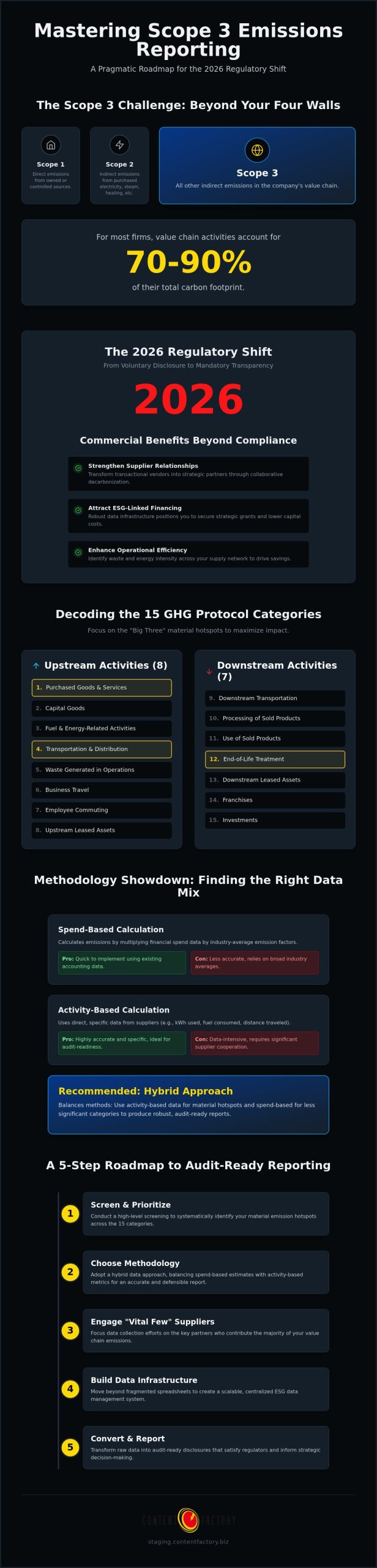
A 5-Step Roadmap to Solving Scope 3 Data Collection Gaps
Executing a Scope 3 strategy requires a transition from abstract theory to a methodical operational roadmap. You don’t need perfect data from every vendor on day one; you need a defensible process for incremental improvement. Most firms fail because they attempt to collect granular data from their entire supply chain simultaneously, leading to resource exhaustion and fragmented results. A pragmatic approach prioritizes impact over volume, ensuring your 2026 disclosures are both accurate and manageable.
- Step 1: Inventory Mapping — Extract your full procurement list and categorize every vendor by spend and estimated carbon intensity. This creates a baseline visibility of your entire value chain.
- Step 2: Supplier Tiering — Isolate the “Vital Few.” Typically, a small fraction of your suppliers contributes the vast majority of your total emissions. These are your priority for primary data collection.
- Step 3: Engagement & Education — Provide vendors with standardized reporting templates and clear guidance. Offering scope 3 emissions reporting help in the form of tools and training builds the data resilience you need for long-term compliance.
- Step 4: Data Consolidation — Aggregate disparate formats into a centralized carbon accounting platform. This eliminates manual spreadsheet errors and ensures your data is scalable and accessible for future audits.
- Step 5: Gap Analysis & Extrapolation — Fill remaining data holes for low-impact, non-material suppliers using industry averages. This ensures a complete footprint without the cost of exhaustive primary research.
Overcoming Supplier Resistance
Suppliers often view data requests as a compliance burden or a threat to proprietary business information. You must reframe these requests as a shared value proposition. Highlight how transparency leads to mutual operational efficiency and joint decarbonization opportunities that can lower costs for both parties. Utilize non-disclosure agreements and secure data platforms to reassure partners that their commercial secrets remain protected. Incentivizing disclosure by granting “preferred supplier” status to those who provide transparent metrics creates a powerful commercial motivator for cooperation. When suppliers understand that their data secures their position in your supply chain, resistance typically fades.
Ensuring Audit-Readiness from Day One
Reliable reporting hinges on a transparent “Basis of Preparation” document. This file must detail every assumption, methodology, and data source used to reach your final figures. Auditors look for a clear trail that connects raw supplier invoices to your consolidated carbon report. If you use proxies or extrapolations for certain categories, you must justify their use based on materiality. For firms requiring professional verification, engaging Carbon Accounting Services SG ensures your data infrastructure meets international standards before the 2026 regulatory shift. Documentation is the difference between a credible disclosure and a greenwashing accusation.
Scaling Your ESG Maturity with ContentFactory
ContentFactory functions as a dedicated extension of your leadership team, specializing in the transition from theoretical sustainability goals to measurable operational necessity. While global firms often deliver detached reports, we position ourselves as an execution engine. We bridge the gap between high-level vision and the granular data infrastructure required for 2026 compliance. Our Carbon Accounting (Scope 1–3) services provide the foundational accuracy needed to navigate complex value chains without the bloated overhead of a multi-national firm. We prioritize tangible outcomes that support your commercial resilience and long-term scalability.
Our Integrated ESG Approach
Our methodology begins with results-led Materiality Assessments. This ensures your reporting focuses on the categories that drive commercial value and regulatory risk rather than pursuing data for data’s sake. We align your Scope 3 data with global frameworks like GRI and ISSB, ensuring your disclosures are audit-ready for international stakeholders and financial institutions. Beyond accounting, we provide strategic advisory on decarbonization pathways and net-zero roadmaps. These roadmaps integrate with your broader business process reengineering to drive efficiency across every link in your supply chain.
Next Steps for Your Value Chain
Securing your position in the 2026 market requires immediate action. We recommend starting with a Scope 3 Readiness Gap Analysis to identify the specific vulnerabilities in your current data collection process. This diagnostic tool provides a clear view of where your supplier data falls short and which categories require urgent attention. Following this, we facilitate customized supplier engagement workshops designed to streamline data flow and secure vendor cooperation. This methodical approach ensures your firm moves quickly from identifying challenges to implementing comprehensive, multi-faceted solutions that protect your revenue. Contact us today for a results-led consultation on your emissions reporting and value chain accounting strategy.
Securing Commercial Resilience Through Value Chain Transparency
The 2026 regulatory shift converts Scope 3 reporting from a voluntary exercise into a mandatory pillar of commercial resilience. Success depends on moving beyond fragmented spreadsheets toward a structured data infrastructure that prioritizes material hotspots. By identifying your “vital few” suppliers and adopting a hybrid methodology, you can build an audit-ready inventory that satisfies both global frameworks and local regulators. This methodical approach ensures your business maintains market access while identifying operational inefficiencies across the value chain.
Effective scope 3 emissions reporting help integrates these technical requirements with a pragmatic execution strategy. Led by Singapore Certified Management Consultant Mayuresh Godse, our team specializes in ESG Readiness and Materiality Assessments that bridge the gap between high-level vision and operational reality. We provide the expertise in Scopes 1, 2, and 3 accounting required to transform your environmental disclosures into a competitive advantage. We don’t just report data; we build the internal capability your firm needs to scale sustainably.
Building a transparent value chain is a complex undertaking, but the right roadmap makes it manageable. Start today to ensure your firm remains a preferred partner in the evolving global economy. We’re ready to help you execute.
Frequently Asked Questions
What is the easiest way to start Scope 3 reporting?
Start with a spend-based assessment of your procurement data. This allows you to map your entire value chain using existing financial records and internal ledgers. Once you identify high-impact categories, you can move toward more granular data collection. This initial screening provides the foundation for more advanced scope 3 emissions reporting help as your ESG maturity grows over time.
Do I need to report all 15 categories of Scope 3 emissions?
No, you don’t need to report all categories, only those that are material to your business operations. While the GHG Protocol defines 15 segments, most mid-market firms focus on a subset that represents the vast majority of their impact. You must provide a clear, documented justification for any categories you exclude to maintain audit-readiness and satisfy increasing stakeholder scrutiny.
How do I handle suppliers who refuse to provide carbon data?
Use secondary data and industry averages as proxies when direct supplier data is unavailable or unverified. You can also incentivize disclosure by making ESG transparency a requirement for preferred supplier status in your procurement contracts. Reframing the request as a collaborative effort toward shared operational efficiency often reduces friction and encourages vendor participation in your reporting process.
What is the difference between primary and secondary data in carbon accounting?
Primary data comes directly from your value chain partners, such as specific meter readings, fuel invoices, or waste logs. Secondary data involves using industry-average emission factors based on financial spend or generalized activity levels. While primary data is the gold standard for accuracy, secondary data is an essential tool for filling gaps in the long tail of your supply chain.
Can I use industry averages for my Scope 3 report?
Yes, industry averages are acceptable for non-material categories or during the initial phases of your reporting journey. These averages provide a necessary baseline when granular metrics are missing from your vendors. However, as you approach the 2026 regulatory deadlines, you should prioritize transitioning your most significant emission hotspots to more accurate, activity-based data to support your net-zero claims.
How often should Scope 3 emissions be recalculated?
Recalculate your Scope 3 inventory annually to align with standard financial reporting cycles and regulatory requirements. This consistency allows you to track decarbonization progress and update your figures based on significant changes in your supply chain or business structure. Regular updates ensure your disclosures remain relevant, reflect your current operational reality, and meet the expectations of your investors.
What are the most common mistakes in Scope 3 reporting?
The most frequent errors include double-counting emissions across categories and failing to document methodological assumptions. Many firms also waste resources collecting low-impact data while ignoring material hotspots. Professional scope 3 emissions reporting help can prevent these pitfalls by establishing a rigorous Basis of Preparation. This ensures every calculation is defensible, audit-ready, and compliant with global reporting standards.
Is Scope 3 reporting mandatory for SMEs in 2026?
While direct mandates often target larger entities, Scope 3 requirements will effectively become mandatory for SMEs in 2026 through supply chain pressure. Large corporate clients must report their own value chain emissions, forcing them to demand verified data from their smaller vendors. Failing to provide this data risks exclusion from major contracts, higher capital costs, and loss of market share.

Article by
Mayuresh Godse
Mayuresh Godse is a Singapore Certified Management Consultant and Business Strategist specializing in Sustainability, ESG, AI-driven Digital Transformation, and business growth. Based in Singapore, he writes about Sustainability, Digital Innovation, Business Strategy, and Content Marketing for global audiences.
Disclaimer
This article is provided by ContentFactory for general information only and is not legal, tax, accounting or financial advice. Regulations and government scheme criteria change; grant eligibility and quantum are set by the relevant Singapore agencies and assessed case by case, with no outcome guaranteed. Verify current requirements before acting.
One thing worth checking on the tool side: if the disclaimer is switched on globally, the grant caveat already written into your Global Writing Instructions will appear as well, so grant articles will carry the same point twice. Remove the required-disclaimer section from the instructions file if you enable this one.