

For many B2B leaders, digital marketing spend feels like a black box. You allocate budget, activity happens, and website traffic might go up, but connecting that spend to bottom-line revenue remains a frustratingly abstract exercise. The core challenge is proving that your investment is generating profitable growth, not just vanity metrics like clicks and impressions. This guide provides a pragmatic framework for measuring ROI on digital marketing, moving beyond surface-level data to quantify its direct impact on commercial outcomes.
Mastering this process is not just a reporting function; it is a strategic imperative. It allows you to justify budgets, eliminate wasteful spending, and build a scalable engine for high-intent lead generation that directly fuels your sales pipeline. We will break down the formulas, attribution models, and technical frameworks required to link every dollar of marketing spend to measurable revenue growth.
Defining Digital Marketing ROI for the B2B Mid-Market
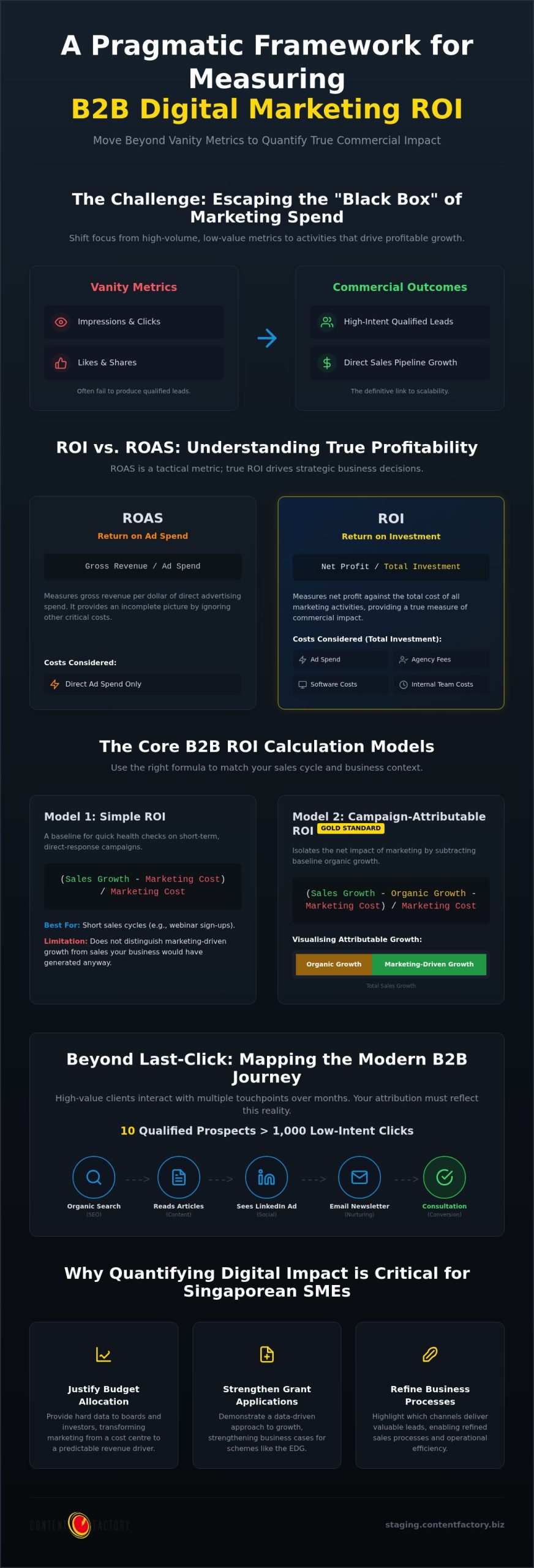
For mid-market and SME B2B firms, digital marketing ROI is the ultimate measure of efficiency. It is the bridge between marketing expenditure and commercial scalability, defined as the net profit generated from digital activities against the total cost of that investment. This calculation forces a shift away from misleading vanity metrics—the likes, shares, and impressions that consume resources but often fail to produce qualified leads.
The focus must move from short-term campaign tracking to aligning marketing efforts with long-term Customer Lifetime Value (CLV). A high-value client relationship that develops over a 12-month sales cycle is the true prize, and your measurement model must be sophisticated enough to capture that journey. Ultimately, B2B Digital Marketing ROI is the definitive link between marketing spend and commercial scalability.
The Difference Between ROI and ROAS
Return on Ad Spend (ROAS) is a common but often misleading metric for professional services and high-value B2B firms. ROAS simply measures gross revenue generated for every dollar of advertising spend. It fails to account for the total cost of the marketing effort, creating an inflated and incomplete picture of profitability.
To calculate true ROI, you must account for the ‘Total Cost’ of your investment. This includes not only direct ad spend but also agency fees, marketing software subscriptions (e.g., CRM, automation tools), content production costs, and the hourly cost of your internal marketing team. Transitioning from tactical ROAS tracking to strategic ROI analysis is fundamental to understanding the real commercial impact of your digital strategy.
Why Singaporean SMEs Must Quantify Digital Impact
For Singaporean SMEs and mid-market companies, the ability to quantify digital impact is critical for several reasons. Firstly, it provides the hard data needed to justify budget allocation for high-intent activities like Search Engine Optimisation (SEO) and performance marketing to the board or investors. A clear ROI calculation transforms marketing from a cost centre into a predictable driver of revenue.
Secondly, measurable outcomes are often a key component when applying for government support schemes like the Enterprise Development Grant (EDG). Demonstrating a data-driven approach to growth strengthens your business case. Finally, accurate ROI data informs business process reengineering, highlighting which channels deliver the most valuable leads and enabling you to refine sales processes and improve operational efficiency.
The Core Formulas: Calculating Simple vs. Attributable ROI
To accurately measure performance, you need the right formula for the right context. While a simple ROI calculation can offer a quick snapshot, a more nuanced, attributable model is required to isolate the true impact of your marketing campaigns in a complex B2B environment. This involves factoring in your organic sales baseline to avoid overestimating marketing’s contribution to growth.
Integrating Customer Acquisition Cost (CAC) into these equations further sharpens your understanding of profitability. By calculating how much it costs to acquire a new customer through specific channels, you can make more informed decisions about where to allocate your budget for maximum returns.
The Simple ROI Calculation Framework
The Simple ROI formula provides a baseline for quick health checks on short-term campaigns or direct-response advertising where the sales cycle is short and attribution is clear.
- Formula: (Sales Growth – Marketing Cost) / Marketing Cost
You would use this, for example, to assess a two-week LinkedIn Lead Gen Form campaign promoting a webinar. Its main limitation, however, is its inability to function in a multi-touch B2B environment. It does not account for leads influenced by multiple channels over several months or distinguish marketing-driven growth from the sales your business would have generated anyway.
Campaign-Attributable ROI for Professional Services
For businesses with longer sales cycles, such as management consultancies or industrial firms, the Campaign-Attributable ROI formula is the gold standard. It isolates the net impact of your marketing efforts by subtracting your baseline organic growth.
- Formula: (Sales Growth – Organic Growth – Marketing Cost) / Marketing Cost
To use this formula, you must first identify your ‘organic baseline’—the average sales growth you achieve without specific marketing campaigns, derived from historical data. By subtracting this baseline, you ensure you are only measuring the incremental revenue directly attributable to your marketing investment. This level of accuracy is essential for making high-stakes strategic decisions.
The B2B Attribution Challenge: Quality Over Quantity
In high-value B2B lead generation, ‘Last-Click’ attribution is obsolete. This model, which gives 100% of the credit for a conversion to the final touchpoint, ignores the complex, multi-stage journey a potential client takes. A prospect might first discover your firm through an organic search (SEO), read three of your articles over two months, see a LinkedIn ad, and only then click a link in an email newsletter to request a consultation.
The goal is to attract ‘High-Intent’ leads, where 10 qualified prospects are far more valuable than 1,000 low-intent clicks. Mapping this digital journey, from the initial discovery on a search engine to the final conversion tracked in your CRM, is central to understanding true ROI. This is how you link the performance of your B2B performance marketing in Singapore directly to signed contracts.
Multi-Touch Attribution Models for Mid-Market Firms
To solve the attribution puzzle, mid-market firms can adopt several models, each suited to different sales cycles. A ‘First-Touch’ model gives all credit to the initial discovery channel, useful for understanding top-of-funnel brand awareness. A ‘Linear’ model assigns equal credit to every touchpoint, while a ‘Time-Decay’ model gives more weight to interactions that happen closer to the conversion.
Choosing the right model depends on your business. Content marketing, for example, plays a crucial role in ‘warming’ leads long before they are ready to engage with sales. Using tactics from a focused B2B lead generation agency in Singapore can help structure these touchpoints to shorten the attribution window and accelerate the sales cycle.
Measuring Lead Quality and SQL Conversion Rates
A critical step in measuring ROI is defining the difference between a Marketing Qualified Lead (MQL) and a Sales Qualified Lead (SQL). An MQL is a lead that has engaged with marketing content (e.g., downloaded a whitepaper) but is not yet ready for a sales conversation. An SQL is a lead that has been vetted and deemed ready for direct sales follow-up, often by meeting specific criteria like budget, authority, need, and timeline (BANT).
The ultimate metric for B2B digital maturity is the ‘Lead-to-Revenue’ ratio, which tracks the entire journey from initial lead to closed deal. Analysis consistently shows that high-intent leads generated through targeted SEO typically yield a significantly higher ROI than those from generic display advertising, as they capture users actively searching for a solution.
Step-by-Step: Implementing a Measurement Framework
Creating a reliable system for measuring ROI on digital marketing requires a structured, phased approach. It begins with establishing a clean data foundation before launching new initiatives and culminates in a cycle of regular auditing and refinement. This framework ensures that your data is accurate, integrated, and actionable.
- Phase 1: Establish a Data-Clean Baseline. Before launching any new campaigns, analyse at least six months of historical sales and marketing data. This allows you to determine your organic growth rate and set realistic benchmarks for future performance.
- Phase 2: Integrate Digital Platforms with a CRM. Your digital advertising platforms (Google Ads, LinkedIn Ads), analytics tools (GA4), and website must be fully integrated with a robust CRM like Salesforce or HubSpot. This creates a single source of truth for tracking a lead from first click to final sale.
- Phase 3: Set Up ‘Key Events’ in GA4. Move beyond tracking simple page views. Configure Google Analytics 4 to track high-value commercial actions, such as form submissions for consultations, pricing page visits, or downloads of technical specification sheets. These are strong indicators of commercial intent.
- Phase 4: Regular Auditing and Refinement. ROI measurement is not a one-time task. Schedule monthly or quarterly audits to review lead-to-close data. Use these insights to reallocate spend away from underperforming channels and double down on those delivering the highest quality leads.
Setting Up the Technical Infrastructure
A robust technical infrastructure is the bedrock of accurate ROI measurement. This involves implementing server-side tracking to mitigate data loss from ad-blockers and privacy features like Apple’s ITP, ensuring a more complete picture of user behaviour. Consistent use of UTM parameters across all campaigns is non-negotiable; it allows you to precisely track the source, medium, and campaign that generated each lead.
Crucially, your organisation must commit to a single ‘Source of Truth’ for all sales and marketing data. Whether this is your CRM or a dedicated business intelligence platform, all teams must work from the same integrated dataset to ensure alignment and prevent reporting discrepancies.
Defining Your ROI Benchmarks for 2026
While benchmarks vary by industry, a common target in the Singaporean professional services sector is a 5:1 ratio (S$5 in revenue for every S$1 in marketing cost). This is often considered the standard for profitable, scalable growth. However, these benchmarks must be adjusted based on your strategic objectives.
A firm in a market entry phase may accept a lower initial ROI (e.g., 2:1 or 3:1) as it invests heavily in building brand awareness and market share. In contrast, a firm in a market consolidation phase should expect a higher, more optimised ROI (e.g., 7:1 or more) as it leverages established brand equity and refined processes.
Driving Commercial Growth Through Strategic ROI Analysis
Effective ROI measurement is not a historical reporting exercise; it is a forward-looking strategic tool. The data you gather should directly fuel broader business decisions, from budget allocation and channel selection to product positioning and market development. It provides the empirical evidence needed to build a resilient, data-driven marketing function that adapts to changing market dynamics and consistently delivers commercial value.
By transforming raw data into strategic insights, you can build a scalable lead generation engine that demonstrably pays for itself through measurable returns. This positions marketing as a core driver of the company’s growth agenda, armed with the data to make compelling cases for strategic investment.
From Data to Decision: Optimising Your Digital Marketing Mix
The primary output of ROI analysis is actionable intelligence. Monthly reports should be used to pivot from low-performing channels to those that deliver high-intent leads. For example, if data shows that high-intent SEO generates SQLs at one-third the cost of LinkedIn display ads, you have a clear mandate to reallocate your budget.
These insights also inform your content strategy. By analysing which articles, whitepapers, or webinars are associated with the most valuable sales opportunities, you can focus your resources on creating content that directly addresses the pain points of your most profitable customer segments. Furthermore, strong ROI data can build a compelling business case for investing in marketing automation platforms that improve lead nurturing and sales alignment, further enhancing efficiency.
Partnering for Performance-Led Growth
For mid-market firms with complex sales cycles, partnering with a specialist consultancy like Momentum One can provide the expertise needed to implement and manage a sophisticated ROI measurement framework. Unlike a generic agency focused on top-of-funnel metrics, a strategic partner understands how to connect digital activities to long-term revenue and can help audit your marketing spend to ensure it aligns with core commercial objectives.
For organizations in specialized fields like healthcare, where branding and trust are paramount to the sales funnel, you can discover Future Marketing para Saúde to see how sector-specific visual identity strategies contribute to long-term commercial success.
The next step is to move from theory to execution. An audit of your current digital ROI can reveal critical gaps and opportunities, providing a clear roadmap for building a more accountable and performance-led marketing function.
ContentFactory provides the strategic framework and execution support to transform your digital marketing into a measurable engine for commercial growth. Led by a Singapore Certified Management Consultant, our approach is pragmatic and focused on delivering quantifiable results, from optimising your lead generation funnel to building board-ready reports that demonstrate clear ROI. This strategic approach may also be supported by government grants for eligible digital marketing projects.
Book a Strategic Consultation to begin building a data-driven marketing strategy that justifies every dollar of your investment.

Article by
Mayuresh Godse
Mayuresh Godse is a Singapore Certified Management Consultant and Business Strategist specializing in Sustainability, ESG, AI-driven Digital Transformation, and business growth. Based in Singapore, he writes about Sustainability, Digital Innovation, Business Strategy, and Content Marketing for global audiences.
Disclaimer
This article is provided by ContentFactory for general information only and is not legal, tax, accounting or financial advice. Regulations and government scheme criteria change; grant eligibility and quantum are set by the relevant Singapore agencies and assessed case by case, with no outcome guaranteed. Verify current requirements before acting.
One thing worth checking on the tool side: if the disclaimer is switched on globally, the grant caveat already written into your Global Writing Instructions will appear as well, so grant articles will carry the same point twice. Remove the required-disclaimer section from the instructions file if you enable this one.