

If your SME is treating ESG as a generic checklist, you’re likely wasting a significant portion of your limited sustainability budget on data that neither regulators nor your customers actually value. Most business owners feel overwhelmed by the sheer density of frameworks like GRI and ISSB; they fear that inaccurate reporting will lead to greenwashing risks. It’s a valid concern, especially when you have limited manpower to spare for non-core operations.
You probably recognise that sustainability is no longer optional if you want to remain in the supply chains of listed companies or large multinationals. However, you shouldn’t have to guess which metrics matter. By conducting a structured materiality assessment for SMEs, you can filter out the noise and focus exclusively on the ESG topics that drive financial resilience and operational efficiency.
This guide provides a pragmatic roadmap to transform compliance from a burden into a strategic asset. You’ll learn how to create a prioritised list of ESG topics to track, ensuring your business remains eligible for sustainability-related support like the Enterprise Development Grant (EDG). We’ll move beyond theory to focus on the execution steps required to secure your position in the 2026 market.
Key Takeaways
- Learn why a materiality assessment for SMEs is the essential strategic filter to prevent resource waste on irrelevant ESG metrics.
- Understand the concept of double materiality to identify how environmental shifts create financial risks and operational opportunities for your business.
- Discover a lean four-step framework to identify material topics and engage stakeholders without overwhelming your internal team.
- See how a robust assessment strengthens your application for the Enterprise Development Grant (EDG) and secures your position in global supply chains.
- Transition from static sustainability reporting to a results-led execution strategy that drives measurable SME growth and resilience.
Beyond Compliance: Why Materiality is the Strategic North Star for Your SME
Materiality is the process of identifying Environmental, Social, and Governance (ESG) issues that significantly impact your business value and stakeholder trust. While it originates from the foundational concept of materiality in financial auditing, its application in sustainability is far more strategic. For a Singaporean SME, it represents the difference between a performative report and a resilient business model. You don’t have the luxury of tracking every possible ESG metric; you need radical prioritisation to protect your margins.
The regulatory environment in Singapore is shifting rapidly toward mandatory transparency. While mandatory climate-related disclosures for large non-listed companies start in FY2027, the pressure on suppliers is already immediate. Large corporations face mandatory Scope 1 and Scope 2 reporting from FY2025. Because Scope 3 emissions account for roughly 75% of a typical company’s total footprint, these giants are now demanding granular data from their SME partners. A materiality assessment for SMEs acts as a strategic filter that aligns your ESG resource allocation with the specific operational and financial realities of your business.
The Business Case: Market Access and Investor Readiness
Multinational corporations (MNCs) increasingly use ESG performance as a pre-qualification criterion for their procurement cycles. If you cannot demonstrate that you’ve identified and managed your material risks, you risk being excluded from high-value supply chains. Beyond customer retention, a clear materiality profile is essential for accessing green financing. Local banks frequently offer sustainability-linked loans with lower interest rates in S$ for firms that meet specific ESG benchmarks.
A robust assessment also serves as a prerequisite for regional expansion. As you look toward ASEAN markets, demonstrating a clear understanding of your environmental and social impact positions you as a sophisticated partner. It moves the conversation from “why should we work with you?” to “how can we scale together?”.
Avoiding the Data Trap: Why Less is More for Mid-Market Firms
Many mid-market firms fall into the trap of reporting fatigue by trying to mirror complex MNC frameworks in their entirety. This leads to inaccurate data and wasted manpower. Instead, you should focus on the five to seven material topics that drive 80% of your business impact. This ensures your team stays focused on execution rather than just documentation.
By narrowing your focus, you build a high-integrity data set that is actually useful for decision-making. This focused approach provides the essential baseline for future carbon accounting and emissions tracking. It’s the first step in a comprehensive ESG readiness and gap analysis, ensuring your organisation isn’t buried in spreadsheets that don’t move the needle.
Decoding Double Materiality: Impact vs Financial Relevance for Your Business
Double materiality is a two-way street. It requires you to look at sustainability through two distinct lenses: how ESG factors affect your financial performance and how your operations affect people and the planet. While the Corporate Sustainability Reporting Directive (CSRD) has popularised this concept globally, it’s increasingly becoming the standard for Singaporean firms aligning with ISSB (IFRS S1 and S2) frameworks. A materiality assessment for SMEs that ignores either side of this coin leaves your business exposed to significant strategic blind spots.
For private firms in Singapore, aligning with ISSB standards provides a globally recognised baseline for climate-related financial disclosures. This isn’t just about compliance; it’s about demonstrating to lenders and investors that you’ve quantified the environmental variables that could impact your future cash flows. By adopting this dual-lens approach, you move beyond “doing good” and start focusing on “doing well” through rigorous risk management.
Financial Materiality: Protecting Your Bottom Line
Financial materiality focuses on the “outside-in” perspective. It’s about identifying climate-related risks that could disrupt your specific supply chain or increase your insurance premiums. If your primary logistics hub is in a flood-prone area, that’s a material financial risk. Conversely, it highlights tangible opportunities. Energy efficiency isn’t just a sustainability goal; it’s a method to reduce your S$ utility spend and improve your operating margin. Linking these factors to your balance sheet ensures long-term scalability and risk mitigation.
Impact Materiality: Meeting Stakeholder Expectations
This is the “inside-out” view. It maps your environmental and social footprint across the entire value chain. In 2026, high-intent customers and top-tier talent prioritise transparency. They want to see documented labour practices and waste management protocols. Impact data helps you differentiate your business in competitive B2B tenders where MNCs are actively looking for sustainable partners. If you’re struggling to define which impacts are most relevant to your industry, you can consult with our ESG experts to refine your scope.
Ultimately, impact materiality protects your brand reputation. In an era where greenwashing accusations can result in legal and commercial fallout, having verified impact data is your best defence. It proves that your sustainability claims are backed by a methodical assessment of your actual footprint.
A Lean 4-Step Framework for Conducting Your First Assessment
In specific industries, sector-led initiatives can provide the necessary framework for this transparency; for instance, the Australian horticulture sector utilizes Fair Farms to support growers with the HR resources and membership standards required to validate ethical labour practices for global buyers.
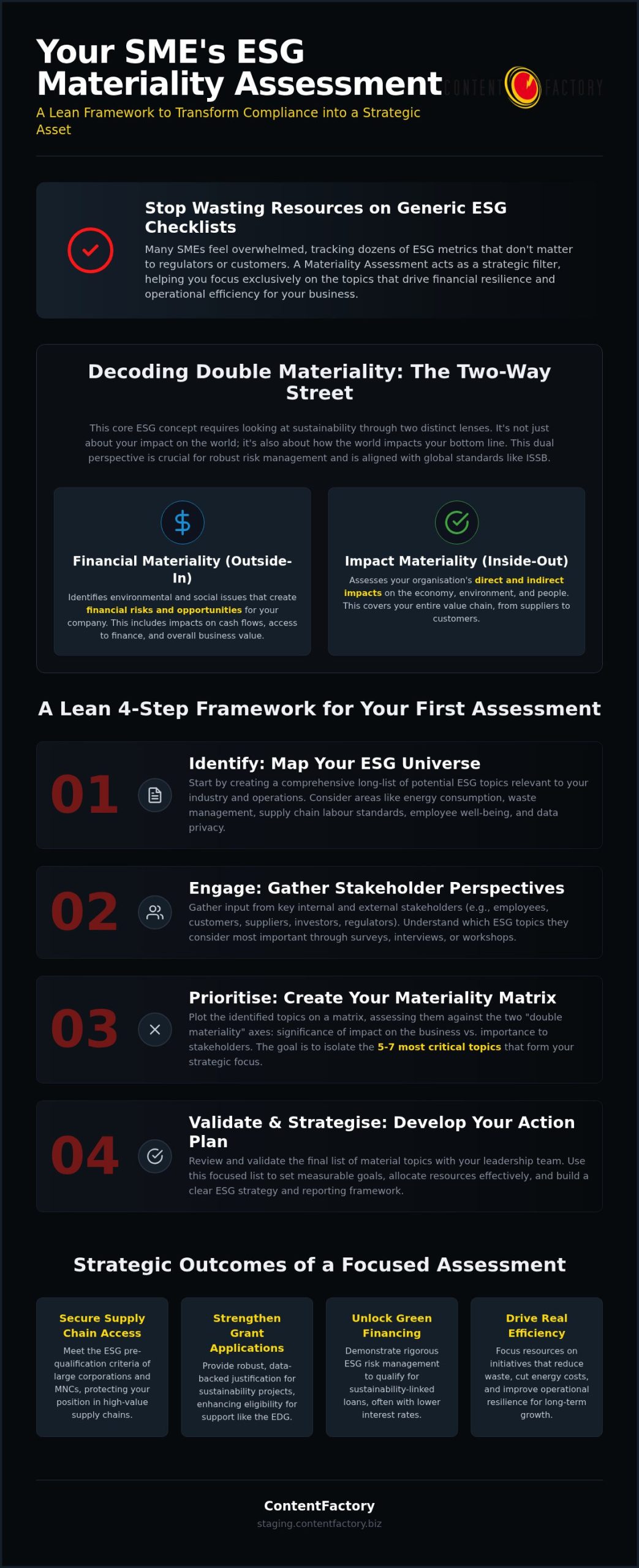
Executing a materiality assessment for SMEs doesn’t require the multi-month timelines or six-figure budgets typical of global firms. It requires a methodical, four-phase approach that prioritises speed and accuracy. By focusing on high-impact data points, you can move from a longlist of potential issues to a finalised strategic roadmap in weeks. This process ensures your sustainability efforts are grounded in operational reality rather than abstract theory.
Phase 1 begins with topic identification. Instead of starting from a blank page, curate a longlist of ESG topics based on industry benchmarks like GRI and SASB. Look at the specific sustainability disclosures already being made by your largest customers and competitors. Phase 2 moves into engagement, where you gather the perspectives needed to weight these topics according to their importance to your business and your stakeholders.
Efficient Stakeholder Engagement for Small Teams
You don’t need expensive, broad-based surveys to understand what matters to your ecosystem. Instead, conduct targeted interviews with key department heads and use secondary research to map the expectations of silent stakeholders like ACRA or your primary lenders. Leverage existing customer feedback and employee town hall notes to extract ESG insights without launching new, time-consuming initiatives. This streamlined engagement ensures you capture essential external and internal viewpoints while respecting your team’s bandwidth.
Building the SME Materiality Matrix
Phase 3 is the scoring and prioritisation phase. You must plot your findings on a matrix that compares “Importance to Stakeholders” against “Impact on Business Success.” This visual tool helps you define a clear threshold for what becomes a reportable topic and what can be safely ignored. You should use the matrix to justify cutting irrelevant ESG initiatives that drain resources without providing commercial or regulatory value. Anything in the top-right quadrant becomes your core focus for Phase 4: validation and integration.
Phase 4 involves presenting your prioritised list to your leadership team to ensure these topics align with your 2026 growth objectives. Once validated, these metrics are integrated into your management reporting and operational KPIs. This transition ensures your assessment isn’t just a compliance document but an execution engine that drives measurable business resilience.
Leveraging Your Assessment for Grants and Market Entry
A materiality assessment for SMEs isn’t just a static document; it’s a foundational asset for securing government support and scaling across borders. By identifying the ESG topics that truly matter, you create a defensible business case for strategic investment. This process is the critical first stage of an ESG readiness and gap analysis, providing the precise data needed to justify structural changes to your operations. It ensures your sustainability journey is funded by results, not just good intentions.
The EDG Advantage: Offsetting Assessment Costs
The Enterprise Development Grant (EDG) remains a primary vehicle for Singaporean firms to offset the costs of sustainability transformation. For qualifying sustainability-related projects, the EDG provides an enhanced level of support of up to 70% of eligible costs. To maximise your chances of a successful application, you should partner with a Singapore Certified Management Consultant (SCMC). These certified professionals ensure your project aligns with EnterpriseSG’s rigorous standards for capability building and innovation. Grant quantum, support levels and eligibility criteria are set by the relevant Singapore government agencies and are subject to change. Eligibility is assessed case by case.
Beyond funding, the assessment highlights operational inefficiencies that are often hidden in daily workflows. When you identify material issues like excessive waste or high energy consumption, you naturally uncover opportunities for business process reengineering. Sustainability and operational efficiency are two sides of the same coin. Streamlining your processes to meet ESG goals often results in direct cost savings and improved resource scalability, making your business more resilient to external market shocks.
ESG as a Market Entry Differentiator
Expanding into ASEAN markets requires more than just capital; it requires trust and documented compliance. Regional partners and regulators are increasingly looking for suppliers who can prove their sustainability credentials through structured data. Using your materiality report as a transparency tool allows you to build immediate credibility with cross-border stakeholders. It ensures you meet the ESG compliance for Singapore suppliers that large regional buyers now demand as a mandatory baseline for high-value contracts.
Aligning with international standards like GRI or ISSB during your assessment smooths the transition for cross-border operations. It demonstrates that your SME operates with the sophistication of a global player, reducing the friction of distributor due diligence and entity incorporation. By leading with a materiality-first approach, you position your brand as a preferred partner in the regional green economy.
Executing ESG Transformation: ContentFactory’s Results-Led Advisory
ContentFactory operates as an execution engine for SMEs that need to bridge the gap between regulatory pressure and operational reality. We don’t just deliver a static report; we act as a high-level strategic partner that integrates ESG into your core business functions. A materiality assessment for SMEs is the essential starting point, but the real value lies in our “Vision versus Execution” framework. This approach ensures that the strategic goals identified in your assessment are immediately followed by practical methods of achievement, moving your business from compliance to competitive advantage.
Our integrated ESG service suite covers the entire sustainability lifecycle. From initial readiness and gap analysis to deep-tier carbon accounting and multi-framework reporting, we handle the technical complexity so your team can focus on growth. We understand that mid-market firms in Singapore face unique pressures, including supply chain transparency and regional expansion. Our advisory is designed to meet these specific needs, ensuring your ESG transformation is both scalable and resilient.
Why Senior-Led Expertise Outperforms Global Firms for SMEs
Global multi-national firms often apply one-size-fits-all methodologies that aren’t suited for the agility required by mid-market companies. You need a localised specialist who understands the intricacies of the Singaporean business ecosystem and government frameworks. ContentFactory provides direct access to senior advisors like Mayuresh Godse, who brings over 25 years of experience in management consulting and digital transformation. This hands-on extension of your leadership team ensures that your ESG strategy is both sophisticated and practical.
We prioritise tangible outcomes over theoretical advisory. By avoiding the detached approach of larger consultancies, we help you implement changes that actually improve your operating margin and market position. Our agility allows us to move quickly from identifying a business challenge to presenting a comprehensive, multi-faceted solution that fits your specific industry context and 2026 growth objectives.
Next Steps: From Assessment to ESG Capability Building
Once your material topics are identified, the focus must shift to internal integration. ContentFactory helps your team move from knowing to doing through practical workshops and ESG capability building programmes. We provide the technical expertise required for ongoing carbon accounting and multi-framework sustainability reporting, ensuring your data remains audit-ready. This integrated approach ensures that sustainability becomes a driver of efficiency rather than a secondary administrative task.
Every paragraph in our advisory roadmap is designed to move your organisation toward measurable growth. We eliminate the wasted space found in traditional consulting, focusing instead on the integration of various business functions into a single, synchronized system. Book a 30-minute discovery call to secure your ESG future and discuss how we can accelerate your sustainability roadmap.
Securing Your SME’s Strategic Position for 2026
Transitioning from generic sustainability reporting to a targeted materiality assessment for SMEs ensures your resources are focused on the ESG risks and opportunities that drive actual business value. You’ve seen how a dual-lens approach to materiality safeguards your financial resilience while opening doors to high-value MNC supply chains and regional ASEAN markets. By applying a lean framework, you can move beyond documentation to execute a strategy that prioritises operational efficiency.
ContentFactory acts as your execution partner in this transformation. Led by Singapore Certified Management Consultants (SCMC), we bring specialised expertise across manufacturing, technology, logistics, and retail. Our proven track record in EDG grant advisory helps you navigate the technical requirements of sustainability transformation with pragmatic, results-led guidance. We focus on the “how” of implementation, ensuring your sustainability journey is grounded in tangible outcomes and measurable growth.
Grant quantum, support levels and eligibility criteria are set by the relevant Singapore government agencies and are subject to change. Eligibility is assessed case by case.
Building a sustainable business model is a journey of operational refinement. With the right strategic filter in place, your SME is well-positioned to lead in the 2026 economy.
Frequently Asked Questions
What is the primary difference between a materiality assessment for SMEs and large MNCs?
The primary difference is the scope and depth of prioritisation required to protect margins. While large MNCs manage hundreds of ESG data points across global divisions, a materiality assessment for SMEs focuses on the five to seven topics that drive 80% of business impact. This lean approach prevents resource waste and ensures that your sustainability efforts remain grounded in operational reality rather than theoretical reporting.
How long does a typical materiality assessment take for a mid-sized firm?
A typical assessment for a mid-market firm takes between four and eight weeks to execute. This timeline includes the initial identification of industry-relevant topics, targeted stakeholder engagement, and the finalisation of a prioritised matrix. By following a structured framework, you can move from a longlist of ESG issues to an actionable strategic roadmap without disrupting your core business operations or overextending your internal manpower.
Can our SME get grant funding like the EDG to cover the cost of an ESG assessment?
Eligible Singaporean SMEs can access the Enterprise Development Grant (EDG) to offset the costs of ESG assessments. The grant provides up to 70% funding for qualifying sustainability projects that build core capabilities or innovation. Grant quantum, support levels and eligibility criteria are set by the relevant Singapore government agencies and are subject to change. Eligibility is assessed case by case based on the specific project scope.
Is a materiality assessment mandatory for SMEs in Singapore in 2026?
Direct mandatory reporting for all SMEs is not yet in effect, but transparency is a commercial requirement for those in multinational supply chains. Listed companies in Singapore face mandatory Scope 1 and 2 reporting from FY2025, which forces them to demand ESG data from their SME suppliers. Large non-listed companies must follow suit by FY2027, making a formal assessment essential for maintaining market access and contract eligibility.
How often should an SME update its materiality matrix?
You should update your materiality matrix annually to reflect shifts in regulatory requirements and stakeholder expectations. A regular review ensures your ESG strategy remains aligned with your business model, especially during periods of regional expansion or digital transformation. If your business undergoes a major pivot, such as entering a new ASEAN market or adopting new manufacturing technologies, an immediate re-assessment is necessary to capture emerging risks and opportunities.
What happens if we skip the stakeholder engagement phase of the assessment?
Skipping the stakeholder engagement phase leaves your business exposed to significant strategic blind spots and reputation risks. Without gathering perspectives from customers, lenders, and employees, your assessment becomes a purely internal exercise that may ignore critical market shifts. Engagement provides the external validation needed to ensure your ESG efforts meet the pre-qualification criteria of MNC buyers and the standards of Singaporean financial institutions.
How does materiality link to Scope 3 emissions reporting?
Materiality determines whether Scope 3 emissions are a significant enough risk to warrant detailed tracking and reporting. Because Scope 3 often accounts for roughly 75% of a firm’s total footprint, a materiality assessment for SMEs helps you decide where to focus your carbon accounting efforts. It ensures you don’t waste budget on granular value chain data unless it’s a material requirement for your primary customers or regulators.
Do we need specialised software to conduct a materiality assessment?
You don’t need specialised software to conduct an effective assessment; you need strategic advisory grounded in execution. While software can store data, it cannot replace the intellectual rigour required to align ESG topics with your financial resilience and business process reengineering goals. Working with a senior-led consultancy ensures your assessment is tailored to your specific industry context and provides a practical roadmap for tangible growth.
Article by
Mayuresh Godse
Mayuresh Godse is a Singapore Certified Management Consultant and Business Strategist specializing in Sustainability, ESG, AI-driven Digital Transformation, and business growth. Based in Singapore, he writes about Sustainability, Digital Innovation, Business Strategy, and Content Marketing for global audiences.
Disclaimer
This article is provided by ContentFactory for general information only and is not legal, tax, accounting or financial advice. Regulations and government scheme criteria change; grant eligibility and quantum are set by the relevant Singapore agencies and assessed case by case, with no outcome guaranteed. Verify current requirements before acting.
One thing worth checking on the tool side: if the disclaimer is switched on globally, the grant caveat already written into your Global Writing Instructions will appear as well, so grant articles will carry the same point twice. Remove the required-disclaimer section from the instructions file if you enable this one.