

Sustainability reporting in Singapore has shifted from a voluntary “comply-or-explain” model to a mandatory framework requiring a structured ISSB standards compliance advisory strategy. All SGX-listed companies must report Scope 1 and 2 emissions from FY 2025, while large non-listed firms with at least S$1 billion in revenue must comply by FY 2030. You likely feel the pressure of these ACRA and SGX timelines, especially when faced with the complexities of Scope 3 data collection and the 2029 deadline for mandatory assurance. Managing this transition while building internal data systems can feel like a daunting operational hurdle for even the most established leadership teams.
This guide helps you bridge the gap between your current reporting state and total regulatory readiness. You’ll learn how to navigate the specific requirements of IFRS S1 and S2 to build an audit-ready sustainability reporting framework for your organisation. The following sections provide a clear roadmap for aligning with SGX and ACRA mandates, ensuring your GHG accounting and risk management processes are robust enough to withstand external scrutiny. By the end of this analysis, you’ll have a pragmatic strategy to transform compliance into a driver of long-term resilience and investor confidence.
Key Takeaways
- Identify your organisation’s specific reporting timeline under the phased ACRA and SGX RegCo mandates for mandatory climate-related disclosures.
- Master the four-pillar structure of IFRS S1 and S2 to ensure your governance and risk management strategies align with global financial-grade standards.
- Bridge the gap between legacy voluntary frameworks and mandatory requirements by integrating TCFD and SASB standards within the ISSB baseline.
- Transition from manual spreadsheets to robust internal data controls to meet upcoming mandatory assurance requirements for Scope 1 and 2 emissions.
- Leverage an ISSB standards compliance advisory to operationalise your sustainability transformation and build a reporting framework that is truly audit-ready.
Navigating the Mandatory Shift to ISSB Standards in Singapore
The International Sustainability Standards Board (ISSB) establishes the first truly global baseline for sustainability-related financial disclosures. This framework provides a rigorous methodology for organisations to report how climate risks impact their financial health and future viability. These standards represent a strategic consolidation of the SASB and TCFD frameworks, moving away from fragmented voluntary reporting toward a unified, high-integrity system. In Singapore, ACRA and SGX RegCo have formalised this transition through mandatory climate-related disclosure requirements. Navigating these changes requires a structured ISSB standards compliance advisory approach to avoid reporting gaps that could trigger regulatory or investor scrutiny.
The Regulatory Timeline for Singapore Firms
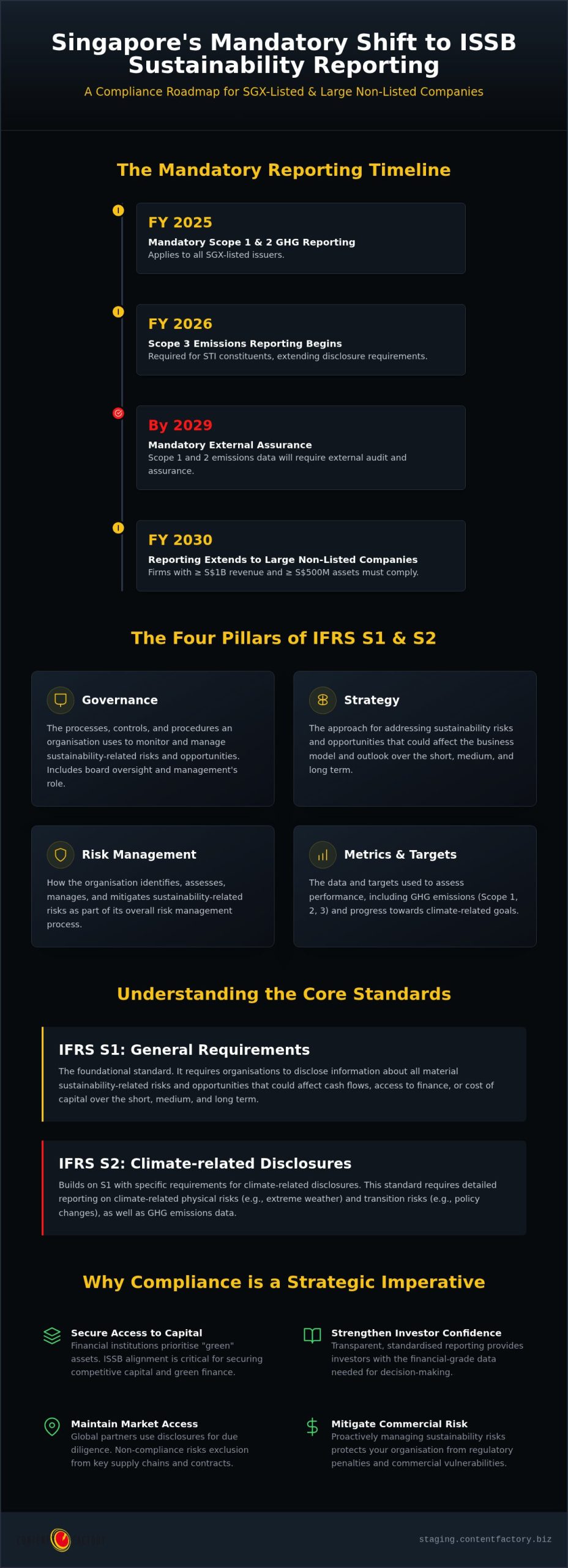
Singapore’s implementation follows a disciplined roadmap designed to build institutional capability across the private sector. All SGX-listed issuers must report Scope 1 and Scope 2 GHG emissions starting from their financial year beginning on or after 1 January 2025. STI constituents must then expand their disclosures to include Scope 3 emissions by FY 2026. Large non-listed companies with annual revenue of S$1 billion or more and assets of S$500 million or more must begin reporting by FY 2030. While SMEs are currently exempt from direct mandates, they’re increasingly pulled into the compliance orbit as larger clients demand granular emissions data to satisfy their own Scope 3 reporting duties. For more information on verifying supplier compliance, visit The Inspection Company.
Sustainability reporting has evolved from a corporate social responsibility exercise into a core requirement for market access. Financial institutions across ASEAN are prioritising “green” assets, meaning ISSB alignment directly impacts your ability to secure competitive capital and green finance. Seeking an ISSB standards compliance advisory ensures that your reporting framework meets the specific expectations of these financial stakeholders. Regional trade partners now use these disclosures as a filter for distributor due diligence; if you can’t provide transparent data, you risk being designed out of global supply chains. Achieving an audit-ready state through an ESG readiness and gap analysis protects your market position and ensures your organisation remains resilient against evolving trade barriers. Non-compliance is no longer just a regulatory risk; it’s a commercial vulnerability that can lead to exclusion from high-value contracts.
Core Requirements of IFRS S1 and IFRS S2
The Core Requirements of IFRS S1 and IFRS S2 are built upon a universal four-pillar structure: Governance, Strategy, Risk Management, and Metrics and Targets. This architecture ensures that sustainability disclosures are not isolated narratives but are integrated into the organisation’s core financial reporting. Unlike legacy voluntary regimes, ISSB demands “connectivity,” requiring firms to demonstrate how sustainability risks directly influence the figures presented in their financial statements. This investor-centric approach prioritises materiality, focusing exclusively on information that could reasonably be expected to influence primary users’ decisions regarding resource allocation.
IFRS S1: General Sustainability-Related Disclosures
IFRS S1 serves as the foundational standard, requiring you to disclose all material sustainability-related risks and opportunities that could affect your business’s cash flows or access to finance over the short, medium, and long term. Success depends on a rigorous internal materiality assessment process that identifies which issues are financially significant to your specific operations. You must move beyond qualitative descriptions and provide documented evidence of your governance oversight. This includes detailing how the board monitors sustainability targets and the specific roles management plays in assessing these risks. If your current documentation lacks this level of granular detail, you can consult our experts to refine your internal reporting structures.
IFRS S2: Climate-Related Data and Metrics
While S1 covers general risks, IFRS S2 focuses specifically on climate-related disclosures, incorporating the mandatory reporting of Scope 1, Scope 2, and eventually Scope 3 GHG emissions. Beyond emissions data, S2 requires two critical types of assessments to test business resilience:
- Physical Risk Assessments: Analysing the impact of acute events like floods or chronic shifts like rising sea levels on your physical assets and supply chain.
- Transition Risk Assessments: Evaluating the financial implications of moving toward a lower-carbon economy, including policy changes, technological shifts, and evolving market preferences.
A key requirement under S2 is scenario analysis. You must test your business resilience against different climate futures, such as a 1.5°C or 2°C warming pathway. This isn’t just a compliance exercise; it’s a strategic stress test designed to reveal vulnerabilities in your long-term operating model. Engaging an ISSB standards compliance advisory helps you select the right climate models and data sets to make these analyses both accurate and audit-ready.
By aligning your reporting with these core requirements, you ensure your organisation meets the high-integrity baseline expected by SGX RegCo and ACRA. The transition from general reporting to financial-grade data is a significant shift that demands a systematic overhaul of how you capture and verify sustainability information. For example, adopting managed, zero-emission lighting from Eco Light Services demonstrates how businesses can improve energy efficiency while aligning with these standards. Implementing a structured ISSB standards compliance advisory framework allows you to operationalise these requirements effectively, ensuring your disclosures withstand the rigour of external assurance.
Most organisations currently reporting sustainability data rely on a patchwork of voluntary frameworks. ISSB effectively consolidates these into a single, high-fidelity baseline. However, the transition from voluntary disclosure to mandatory financial-grade reporting reveals significant structural gaps. While the Global Reporting Initiative (GRI) focuses on a broad range of stakeholders, ISSB prioritises the information needs of investors. This shift requires a specialised ISSB standards compliance advisory to ensure your data meets the financial materiality threshold.
Firms using basic ESG templates often lack the quantitative rigour required for IFRS S1 and S2. Common deficiencies include missing Scope 3 data and a failure to link climate risks to specific line items in the balance sheet. There’s also the challenge of interoperability. While ISSB is the global baseline, companies with European operations must ensure their disclosures align with the European Sustainability Reporting Standards (ESRS). Achieving mandatory sustainability assurance readiness requires closing these gaps before your first mandatory reporting cycle.
Transitioning from TCFD to IFRS S2
IFRS S2 fully integrates the 11 recommendations of the Task Force on Climate-related Financial Disclosures (TCFD). If you already report under TCFD, your governance and risk management disclosures are likely compliant. However, ISSB demands more granular quantitative data. You must now provide specific metrics on carbon prices used in internal assessments and detailed capital expenditure plans related to climate transition. This move from qualitative narratives to hard financial data is the primary hurdle for most Singapore issuers. A TCFD reporting consultant Singapore helps you map your existing TCFD disclosures to these more stringent requirements.
Consolidating SASB Industry Standards
IFRS S1 requires companies to consider SASB standards when identifying sustainability-related risks and opportunities. SASB provides 77 industry-specific standards that help you pinpoint the most relevant issues for your sector. Selecting the correct industry category is vital to ensure your disclosures are comparable with peers. This consolidation creates a unified global language for sustainability, allowing investors to benchmark performance across different jurisdictions with precision. It moves the conversation from general corporate activity to specific operational impacts that affect long-term valuation.
Building an Audit-Ready Data Infrastructure for Compliance
Transitioning to mandatory reporting requires a fundamental shift in how your organisation handles non-financial data. Legacy methods, particularly manual spreadsheet-based tracking, are insufficient for the rigour of mandatory assurance. These manual systems lack the version control, validation checks, and security protocols necessary to satisfy external auditors. An effective ISSB standards compliance advisory prioritises the development of a resilient data architecture that eliminates manual error and ensures consistency across reporting periods. Audit-readiness is the ability to provide a clear data trail from the initial source to the final disclosure.
Establishing internal controls over sustainability data mirrors the discipline found in financial accounting. You must document every data point’s origin, the methodology used for its calculation, and the personnel responsible for its verification. Leveraging digital ESG integration and automation allows you to pull data directly from source systems, reducing the risk of manipulation or oversight. This structural integration ensures that your sustainability disclosures are as reliable and verifiable as your financial statements.
Establishing a Carbon Accounting Framework
A robust GHG emissions calculation framework is the cornerstone of IFRS S2 compliance. This process involves categorising emissions into Scope 1 (direct), Scope 2 (indirect energy), and the more complex Scope 3 (value chain). You must use verified emission factors from recognised databases to ensure the accuracy of your carbon footprint. Automating data collection from utility bills and ERP systems provides a real-time view of your environmental impact, which is essential for setting and meeting credible decarbonisation targets. Without this automated layer, tracking the thousands of data points required for Scope 3 becomes an operational bottleneck.
Preparing for Mandatory Sustainability Assurance
Listed companies in Singapore must obtain external limited assurance for Scope 1 and 2 emissions starting in FY 2029; large non-listed firms follow in FY 2032. Limited assurance involves the auditor performing fewer procedures than a full audit, providing a “negative” conclusion that no material misstatements were found. Preparing for this requires meticulous documentation of your data collection processes and internal validation steps. Conducting an internal “dry run” or gap analysis helps identify weak points in your data trail before the formal audit begins. This proactive approach ensures your organisation is ready for the eventual shift toward reasonable assurance, which demands a higher level of evidence and precision.
Operationalising ISSB Compliance with ContentFactory
Moving from regulatory awareness to operational execution is the most critical phase of your sustainability journey. While the technicalities of IFRS S1 and S2 are complex, the solution shouldn’t be abstract. A professional ISSB standards compliance advisory provides the structural framework needed to turn these mandates into a competitive edge. At ContentFactory, we distance ourselves from theoretical consulting. We focus on tangible outcomes that protect your market access and investor confidence.
Our approach is grounded in efficiency. We act as a hands-on extension of your leadership team. We ensure that your sustainability transformation is integrated into your core business functions. This pragmatic focus allows you to navigate the transition without disrupting your daily operations.
Our Pragmatic ESG Advisory Framework
We begin by conducting a comprehensive ESG readiness and gap analysis. This process identifies the specific technical and data deficiencies within your current reporting structure. We don’t just point out gaps; we provide the roadmap to close them. Our framework prioritises the high-impact areas that ACRA and SGX RegCo scrutinise most closely.
Leadership upskilling is another core pillar of our framework. We deliver ESG capability building and training tailored for C-suite executives and board members. These workshops ensure your leadership team can confidently oversee sustainability risks and articulate your strategy to primary users. By aligning your governance with ISSB standards, you unlock measurable ROI through improved access to green finance and capital.
Bridging the Vision-to-Value Gap
Navigating multi-framework reporting is a significant challenge for firms with regional footprints. We help you harmonise GRI, SASB, and ISSB disclosures into a single, high-fidelity reporting system. This ensures you meet the diverse expectations of global investors while staying compliant with localised mandates. Our team also specialises in mandatory sustainability assurance readiness. We build the internal controls and data trails needed to pass third-party audits with ease.
Our expertise isn’t limited to Singapore. We provide deep market access advisory across ASEAN and India, helping you navigate cross-border compliance. This regional perspective is vital for firms looking to expand their presence while maintaining a unified sustainability narrative. Your practical takeaway for today is to initiate a formal ESG Readiness assessment. Identifying your data gaps now is the only way to ensure your organisation is truly audit-ready before the mandatory deadlines arrive.
Securing Your Competitive Advantage through Audit-Ready Compliance
The transition to IFRS S1 and S2 represents a fundamental shift in how Singapore firms must quantify and report sustainability risk. Establishing a robust ISSB standards compliance advisory strategy ensures you move beyond simple reporting to true operational transformation. By prioritising audit-ready data infrastructure and verified carbon accounting, your organisation protects its market access and strengthens investor confidence across ASEAN. This proactive approach allows your leadership team to manage climate-related risks as financial opportunities rather than just regulatory hurdles.
ContentFactory provides the specialised expertise required to navigate these ACRA and SGX RegCo mandates. Led by a Singapore Certified Management Consultant, we focus on delivering tangible outcomes for the mid-market and SME sectors. We specialise in ESG Readiness and Carbon Accounting, ensuring your reporting framework is prepared for mandatory sustainability assurance.
Proactive alignment today secures your competitive position in tomorrow’s global supply chains.
Frequently Asked Questions
What is the primary difference between IFRS S1 and IFRS S2?
IFRS S1 sets out general requirements for disclosing material sustainability-related risks and opportunities that affect an organisation’s cash flows and access to finance. In contrast, IFRS S2 focuses exclusively on climate-related disclosures, such as GHG emissions and physical risks. While both standards share the same four-pillar structure, S1 provides the foundational framework while S2 delivers the technical depth required for climate resilience. Most firms start their journey with an ISSB standards compliance advisory to map these specific requirements.
Are private SMEs in Singapore required to comply with ISSB standards?
Direct mandates currently apply to SGX-listed issuers and large non-listed companies with annual revenue of at least S$1 billion. Private SMEs aren’t legally required to file ISSB-aligned reports at this stage. However, many SMEs must provide climate data to their larger, listed clients who require this information for their own Scope 3 disclosures. Preparing early ensures your business remains a preferred supplier in global supply chains that prioritise transparent sustainability metrics and reliable data reporting.
How does ISSB compliance impact my company’s ability to secure bank loans?
Financial institutions in Singapore are rapidly integrating ESG metrics into their credit risk assessments. ISSB compliance signals to lenders that your business has a clear strategy for managing climate risks, which often leads to better access to green finance. Firms that demonstrate alignment with these global standards can often negotiate more favourable interest rates. Conversely, non-compliant organisations may face higher borrowing costs or exclusion from certain sustainable lending programmes as banks tighten their ESG criteria.
Can we use our existing GRI report to meet ISSB requirements?
You can leverage your existing GRI data, but it’s rarely sufficient for full ISSB alignment. GRI focuses on a broad range of social and environmental impacts on stakeholders, whereas ISSB prioritises financial materiality for investors. Most GRI reports lack the rigorous climate scenario analysis and the direct connectivity to financial statements required by IFRS S2. A comprehensive ISSB standards compliance advisory helps you bridge these gaps by refining your materiality assessment and validating your data collection processes.
What are the common pitfalls in Scope 3 emissions reporting for SG firms?
The most frequent challenge is the lack of primary data from upstream and downstream partners. Many Singaporean firms rely on generic industry averages which lack the precision required for financial-grade reporting. Manual data entry in spreadsheets also introduces significant error risks that can compromise audit-readiness. Without automated systems to track value chain emissions, organisations struggle to produce the verifiable data trails that external assurance providers now demand for mandatory climate disclosures under the new standards.
How much time does a typical ISSB readiness assessment take?
The duration of a readiness assessment varies based on your organisation’s current data maturity and the complexity of your operations. A typical engagement often spans several weeks to a few months. This period involves a thorough gap analysis of your existing reporting, a materiality assessment, and the design of a data collection roadmap. Starting this process early allows your team to build the necessary internal capabilities without the pressure of an immediate regulatory deadline or supply chain audit.
Is external assurance mandatory for ISSB reports in Singapore?
External limited assurance is mandatory for Scope 1 and Scope 2 emissions on a phased timeline. All listed companies must obtain this assurance starting in FY 2029. Large non-listed companies that meet the revenue and asset thresholds must comply starting in FY 2032. This requirement ensures that the reported data is reliable and accurate. Preparing for this shift early involves establishing robust internal controls and clear documentation to satisfy third-party auditors during the formal assurance process.
Which Singapore government agencies are overseeing ISSB adoption?
The Accounting and Corporate Regulatory Authority (ACRA) and the Singapore Exchange Regulation (SGX RegCo) are the primary bodies overseeing the implementation of these standards. ACRA manages the requirements for large non-listed companies; SGX RegCo handles the mandates for listed issuers. These agencies work in tandem to ensure Singapore’s reporting framework aligns with the global baseline set by the International Sustainability Standards Board, maintaining the nation’s status as a leading green finance and sustainability hub. Organisations seeking to align their existing climate disclosure practices with the new mandatory requirements can benefit from working with a TCFD reporting consultant Singapore to ensure a seamless transition to ISSB-aligned reporting.
Article by
Mayuresh Godse
Mayuresh Godse is a Singapore Certified Management Consultant and Business Strategist specializing in Sustainability, ESG, AI-driven Digital Transformation, and business growth. Based in Singapore, he writes about Sustainability, Digital Innovation, Business Strategy, and Content Marketing for global audiences.
Disclaimer
This article is provided by ContentFactory for general information only and is not legal, tax, accounting or financial advice. Regulations and government scheme criteria change; grant eligibility and quantum are set by the relevant Singapore agencies and assessed case by case, with no outcome guaranteed. Verify current requirements before acting.
One thing worth checking on the tool side: if the disclaimer is switched on globally, the grant caveat already written into your Global Writing Instructions will appear as well, so grant articles will carry the same point twice. Remove the required-disclaimer section from the instructions file if you enable this one.