

An ESG plan that never changes a business decision is just another document. The challenge in integrating ESG into corporate strategy isn’t writing commitments. It’s identifying which issues matter to your business and deciding how they should inform investment, risk and operational choices.
This can be difficult when ESG activity sits apart from commercial priorities, or when teams don’t know who owns the work or how progress will be reviewed. In Singapore, phased ISSB-aligned climate disclosure requirements for SGX-listed companies have added urgency. But a useful ESG strategy is more than a reporting response. It should help your organisation set priorities and act on them.
This guide explains how to connect ESG priorities to business objectives and risk considerations, assign ownership to the teams best placed to deliver, and choose measures that support regular review. It also shows how to turn high-level commitments into an actionable plan that informs day-to-day decisions.
Key Takeaways
- Integrating ESG into corporate strategy means using relevant ESG factors to inform business choices, not treating them as a separate reporting task.
- Test each ESG priority against your organisation’s objectives, risks and resource decisions before deciding where to focus.
- Recognise trade-offs and prioritise actions that fit your organisation’s context and commercial direction.
- Build an execution roadmap with named owners, practical measures and data your teams can maintain.
- Review progress and help teams understand their responsibilities as your strategy evolves.
Why integrating ESG into corporate strategy matters to business leaders
You’re expected to manage commercial performance and operational demands while responding to growing ESG expectations. If ESG sits in a separate workstream, leaders may struggle to see which issues matter to the business, what decisions they affect and who should act. Integrating ESG into corporate strategy means considering relevant environmental, social and governance factors as part of business planning and decision-making, not treating them only as a reporting task.
That distinction changes what gets attention. A business might track energy use for disclosure. Strategy-led integration also asks whether energy exposure should influence operational priorities, risk discussions or investment choices. The answer depends on your organisation’s context, available information and strategic direction.
For a concise overview of the concept, see Environmental, social, and governance (ESG). The business task is to identify which topics are relevant to your organisation and connect them to decisions leaders already make.
To explore how ESG strategy can connect to business and investor priorities, watch this video:
What does integrating ESG into corporate strategy mean?
Integrating ESG into corporate strategy means linking relevant environmental, social and governance topics to organisational priorities, business choices and clear accountability. It doesn’t mean pursuing every possible ESG initiative. It means assessing which topics matter in your context, then deciding whether they should influence objectives, risk management or the allocation of resources.
For example, a manufacturer could assess whether energy use is relevant to its operating priorities, then decide how that issue should inform planning. The decision should reflect the business’s circumstances, not a generic checklist. A focused ESG readiness and gap analysis can help clarify which priorities warrant attention and where the organisation may need stronger processes or information.
Why ESG can remain disconnected from business strategy
ESG often becomes disconnected when initiatives sit with one team, ownership is unclear, or measures are collected without informing a decision. Leadership may receive updates without a clear view of what action is required, who is responsible or how progress relates to business priorities.
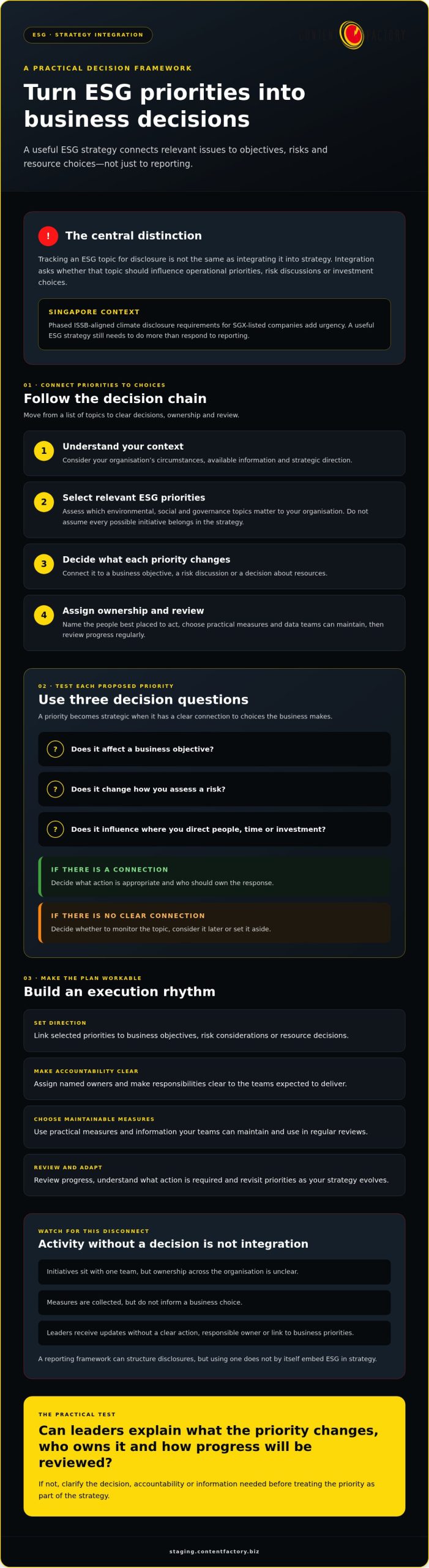
A reporting framework can help structure disclosures, but using one doesn’t by itself embed ESG in strategy. Relevant ESG factors can inform discussions about resilience, risk and long-term priorities, but they don’t guarantee a particular outcome. A practical test is whether leaders can explain which decisions a priority affects, who owns the response and what information will support review.
How ESG integration connects priorities to corporate decisions
Integrating ESG into corporate strategy means moving from a list of topics to a clear chain of decisions: understand your organisation’s context, select relevant priorities, decide what those priorities change, and assign people to act. Adding ESG language to an existing strategy document won’t create that connection. A priority becomes strategic when it influences an objective, risk discussion or resource decision.
For each proposed priority, ask: does it affect a business objective, change how we assess a risk, or influence where we direct people, time or investment? If the answer is no, decide whether it should be monitored, belongs in the strategy later, or can be set aside. This keeps ESG focused on decisions rather than activity for its own sake.
A guide to holistic ESG integration discusses connections between ESG, governance and risk management. For your organisation, the practical test is whether those connections appear in actual choices and responsibilities, not just in a document.
Connect ESG priorities to the organisation’s strategic choices
Start with your business model, operating context and strategic direction. Then consider which ESG topics could affect those priorities. Relevance varies by organisation, so use examples as prompts to investigate, not as universal requirements.
- Technology: If data protection is relevant to your business priorities, it could influence how you assess service risks or assign responsibility for handling data.
- Logistics: If fuel use matters to your operating model, it could inform decisions about route planning or vehicle use.
- Retail: If packaging waste is a relevant concern, it could shape choices about packaging specifications or supplier discussions.
In each case, make the link explicit: which strategic choice could change, who needs to contribute, and what information would help leaders decide? An ESG readiness and gap analysis can help assess priorities against your organisation’s context and current capabilities.
Make governance and accountability part of the strategy
Leadership should set direction, agree priorities and review whether they remain relevant. Operational owners should manage the actions and information they can influence. Define how issues will be escalated when they need a decision beyond the owner’s authority.
Assign responsibility to people who can influence the relevant choices, not simply to whoever prepares ESG information. Governance supports oversight and follow-through, but it doesn’t deliver the work by itself. If you’re unsure how to connect priorities with accountable execution, you can discuss your ESG integration needs.
Does integrating ESG into corporate strategy weaken commercial focus?
No. Integrating ESG into corporate strategy need not displace commercial priorities when leaders assess ESG actions using the same decision criteria as other business choices. The aim isn’t to pursue every initiative. It’s to understand whether a relevant ESG issue affects an objective, creates an exposure or needs stronger oversight, then decide what response fits the organisation.
There can be trade-offs. An action may require staff time, better information or changes to an established way of working. Those demands deserve scrutiny, as does the cost of leaving a relevant issue unaddressed. The right choice depends on your organisation’s objectives, constraints and available evidence, not on a promise of automatic returns.
Balance ESG priorities with commercial and operational realities
Before committing resources, ask whether the proposed action supports a strategic priority, addresses a relevant exposure or improves oversight. Then compare options with existing plans and operational capacity. This makes trade-offs visible and helps leaders distinguish decision-linked work from initiatives that add activity without a clear purpose.
For example, if a proposed action requires new data collection, consider who will maintain the information and how leaders will use it. If the business case or exposure isn’t yet clear, don’t force a commitment. Identify what you need to learn, take a proportionate next step and return to the decision when you have stronger evidence.
This approach also makes it easier to pause or revise work that no longer fits. ESG integration should inform commercial judgement, not override it. Deferring an action can be reasonable when the issue has limited strategic relevance or the organisation lacks enough information to act responsibly.
A focused ESG scope is more workable than treating every issue equally
Not every ESG topic warrants the same level of attention. Trying to address everything at once can spread ownership thinly and create reporting or data demands that teams can’t sustain. Start with a manageable set of priorities that connects clearly to the organisation’s direction. Keep other topics under observation where appropriate instead of treating them as immediate strategic commitments.
A disciplined scope gives leaders room to assess effort, assign responsibility and learn from implementation before expanding the work. It isn’t a way to dismiss difficult topics. It focuses capacity where the organisation has a clear reason to act, while leaving room to revisit priorities as circumstances change.
If you need a structured starting point, an ESG readiness assessment and gap analysis can help clarify relevant priorities and current capabilities. You can also discuss your ESG strategy priorities if you’re deciding where to focus first.
A practical roadmap for integrating ESG into corporate strategy
A workable roadmap turns strategic intent into decisions, responsibilities and review. Keep the sequence simple: clarify your strategy, select relevant ESG priorities, assign owners, define useful measures and review progress. Each step should lead to the next. If a priority has no connection to a business objective or decision, reconsider whether it belongs in the plan.
Turn strategic priorities into owned actions and measures
Start with your current strategy and identify where relevant ESG topics could affect an objective, risk or operating choice. For each priority, record an accountable role, a specific action, a measure and the decision that measure will inform. This creates a direct line between commitment and execution.
Choose measures that help leaders assess progress, not just count activity. The number of staff briefed, for example, records an action. Evidence that teams are applying an agreed process may be more useful when reviewing whether the action is working. The right measure depends on the priority and the decision you need to make.
Document assumptions behind each measure, any data limitations and dependencies on other teams or information. Be clear about what you can reliably track now and what needs to improve. Don’t present estimates or incomplete information as more precise than they are.
For a practical exercise, choose one priority and complete this sentence: “To support [objective], [role] will take [action], and leaders will review [measure] to decide [next step].” If you can’t fill in each part, clarify the objective, ownership or evidence before adding more commitments.
Build ESG review into existing leadership routines
Use planning and review meetings that already consider the relevant objectives, risks or operations. Add a focused discussion of agreed ESG actions: what has changed, what the measures show, what is blocked and whether a decision is needed. Set the review cadence to suit your organisation’s planning and operating cycle rather than applying a universal interval.
Reliable information matters. For ESG data workflows, clarify where information comes from, who checks it and how it reaches the people making decisions. Digital ESG integration and automation can support structured data processes, while the organisation remains responsible for the information it uses.
Reviews should lead to action. If evidence changes, an owner encounters a constraint or priorities shift, leaders can adjust the action, measure or resourcing. Record the decision and its rationale so teams know what changes and why.
How to sustain ESG integration as corporate strategy evolves
ESG priorities can lose momentum when business conditions change, responsibilities shift or the information leaders rely on becomes outdated. Sustaining integration means keeping three things aligned: clear ownership, relevant and usable ESG information, and regular leadership attention. Review whether priorities still fit the organisation’s direction, and update actions when evidence or operating context changes.
Keep ownership, data and capability aligned
Role clarity tells people who acts and who makes decisions. Usable data helps them track the issue. Staff capability enables teams to apply agreed processes consistently. If one part is missing, ESG work can stall: an owner may lack reliable information, or a measure may exist without anyone knowing how to use it.
Make responsibilities practical. Teams should understand what information they provide, how it is checked and when an issue should be escalated. For example, carbon accounting may require relevant operational data and clear responsibility for maintaining it. The specific data and process will depend on your organisation.
Where teams need support applying their responsibilities, ESG capability building and training can develop internal understanding and strengthen agreed processes. Revisit the guidance as roles, priorities or the information required for decisions change.
Know when specialist ESG support can help
Consider specialist support if leaders can’t agree which ESG priorities matter, responsibilities are fragmented, or teams struggle to turn commitments into actions and measures. These are practical signs that the organisation may need to clarify its readiness, strategy, information needs or internal capability.
ContentFactory supports SMEs and mid-market companies with ESG readiness, gap analysis and strategy, implementation, GHG emissions calculation and carbon accounting, and capability building. Its ESG work is led by Mayuresh Godse, a Singapore Certified Management Consultant with more than 25 years of consulting experience. The team has experience across manufacturing, technology, logistics and retail. This experience can inform the work, but priorities and delivery still need to be shaped around your organisation’s context.
To maintain progress, assign an owner to review whether each priority remains relevant, whether its information is still useful and whether teams can carry out the agreed actions. This makes oversight a way to adapt the work, rather than simply record it.
ContentFactory helps organisations connect ESG readiness and strategy with practical implementation and internal capability.
Make ESG part of how your business decides and acts
Integrating ESG into corporate strategy works when relevant priorities shape business choices, not just reporting. Start with issues that connect to your organisation’s direction, assign owners who can influence decisions, and use measures that help leaders review progress. Keep the approach practical by updating priorities and actions as evidence and business needs change.
You don’t need to solve every ESG issue at once. A focused plan with clear accountability and information your teams can maintain gives you a stronger basis for action. Check whether your priorities, responsibilities and review routines support the decisions your business needs to make.
ContentFactory supports ESG readiness, strategy, implementation and capability building. Its work is led by a Singapore Certified Management Consultant with 25+ years of consulting experience, with ESG experience across manufacturing, technology, logistics and retail.
With clear priorities and practical ownership, your organisation can make ESG a working part of its strategy and keep it aligned as the business evolves.
Frequently Asked Questions
How can a company integrate ESG into its business strategy?
Start by clarifying your organisation’s objectives and strategic direction. Identify ESG topics that could affect those priorities, then decide what choices or actions may need to change. Assign each action to an accountable role, define a useful measure and review progress through an appropriate leadership routine. For example, if energy use is relevant to an operating objective, specify who will assess it and what information would support decisions.
Can ESG integration support commercial decision-making?
Yes. ESG integration can give leaders additional relevant information when considering objectives, risks and resource decisions. It doesn’t guarantee better commercial performance or mean ESG considerations should override other business criteria. Compare proposed actions with your organisation’s priorities, operational constraints and available evidence. If information is incomplete, identify what needs checking before committing resources. This makes trade-offs explicit and helps leaders decide whether to proceed, adjust or defer.
Is ESG integration only about sustainability reporting?
No. Reporting may be one reason to gather ESG information, but integration also means using relevant information in strategy, risk discussions and operational decisions. A report can describe commitments and measures without changing how the organisation acts. To move beyond reporting, connect each priority to a decision, an owner and a review process. That helps teams see how their responsibilities contribute to the organisation’s chosen priorities.
What is the difference between ESG integration and an ESG strategy?
An ESG strategy sets out the organisation’s relevant priorities, intended direction and actions. ESG integration is the process of embedding those priorities into wider business planning, decision-making, ownership and review. A strategy may describe what the organisation intends to do; integration makes those intentions part of how teams and leaders operate. The two work together, but a written strategy alone doesn’t establish that ESG influences day-to-day decisions.
How should a company measure progress on ESG strategy?
Choose measures that show progress on a relevant priority and help leaders decide what to do next. Give each measure an owner, define its data source and record assumptions or limitations. Separate activity, such as completing a training session, from information that indicates whether an agreed process is being applied. Use measures your organisation can maintain responsibly, and review them at a cadence that fits its planning and operating routines.
When should a business seek help integrating ESG into corporate strategy?
Consider specialist support if your leaders can’t identify which ESG priorities matter, responsibilities are fragmented, or teams struggle to turn commitments into actions and useful measures. ContentFactory supports ESG readiness, gap analysis and strategy, implementation, carbon accounting and capability building. Its ESG work is led by a Singapore Certified Management Consultant with more than 25 years of consulting experience, including experience across manufacturing, technology, logistics and retail.
Book a Strategic Consultation

Article by
Mayuresh Godse
Mayuresh Godse is a Singapore Certified Management Consultant and Business Strategist specializing in Sustainability, ESG, AI-driven Digital Transformation, and business growth. Based in Singapore, he writes about Sustainability, Digital Innovation, Business Strategy, and Content Marketing for global audiences.
Disclaimer
This article is provided by ContentFactory for general information only and is not legal, tax, accounting or financial advice. Regulations and government scheme criteria change; grant eligibility and quantum are set by the relevant Singapore agencies and assessed case by case, with no outcome guaranteed. Verify current requirements before acting.
One thing worth checking on the tool side: if the disclaimer is switched on globally, the grant caveat already written into your Global Writing Instructions will appear as well, so grant articles will carry the same point twice. Remove the required-disclaimer section from the instructions file if you enable this one.