

Most mid-market firms treat sustainability as a compliance hurdle, yet for high-growth Singaporean enterprises, it’s actually the most effective tool for business process reengineering available in 2026. If you’re struggling to understand how to start ESG reporting amidst the “alphabet soup” of GRI, ISSB, and TCFD, you’re not alone. The complexity of managing Scopes 1 through 3 data across fragmented departments often leads to inconsistent results and the legitimate fear of failing SGX standards or facing greenwashing accusations.
We understand that the goal isn’t just to produce a glossy report; it’s to build a resilient, audit-ready framework that attracts better financing and secures premium contracts. This article provides a pragmatic roadmap to move your organization from regulatory confusion to a synchronized execution engine. You’ll learn to integrate carbon accounting into your daily operations and leverage strategic grants like the Enterprise Development Grant (EDG) to offset transformation costs. We’re moving past the “why” and focusing entirely on the “how,” ensuring your ESG strategy drives measurable commercial value and operational efficiency.
Key Takeaways
- Transition from voluntary disclosure to mandatory compliance by adopting unified ISSB standards to ensure global and SGX alignment.
- Execute a robust materiality assessment to identify financial and impact risks, establishing the non-negotiable foundation of your reporting framework.
- Master how to start ESG reporting through a structured five-step execution roadmap that builds internal capability and bridges operational gaps.
- Integrate Scopes 1-3 carbon accounting into core business processes to drive long-term operational resilience and tangible commercial value.
- Leverage the Enterprise Development Grant (EDG) and strategic grant advisory to significantly offset the costs of ESG readiness and materiality assessments.
The Strategic Shift: Why ESG Reporting is Mandatory in 2026
ESG reporting has evolved from a voluntary corporate social responsibility initiative into a rigorous, structured disclosure of Environmental, social, and corporate governance (ESG) performance. In 2026, the global landscape has solidified around the International Sustainability Standards Board (ISSB) framework. These standards, specifically IFRS S1 and S2, now serve as the global baseline for financial materiality, ensuring that sustainability data is as auditable and precise as financial statements. For Singaporean firms, this shift isn’t merely about compliance; it’s about maintaining access to capital.
The Move from Voluntary to Mandatory Disclosure
The regulatory trajectory for mid-market and large private companies in Singapore is accelerating. While mandatory requirements initially focused on listed entities, the national Climate Action Plan has expanded the scope to include significant private enterprises. Waiting for a formal mandate is a strategic risk that leaves your organization scrambling to build data infrastructure under duress. Proactive leaders are already investigating how to start ESG reporting to ensure their internal systems are resilient enough to handle the data demands of 2026 and beyond. Early adoption allows you to refine your collection methods before the pressure of legal penalties or audit failures becomes a reality.
ESG as a B2B Competitive Advantage
Robust reporting serves as a powerful differentiator in high-value B2B procurement tenders. Procurement officers now use ESG scores to de-risk their own supply chains, meaning your ability to disclose Scope 1 and 2 emissions directly impacts your win rate. This transparency also fuels B2B lead generation, as sustainability-conscious buyers actively seek out partners who can help them meet their own net-zero targets. The “ESG premium” in modern contract negotiations is the measurable uplift in contract value or duration awarded to partners who demonstrably mitigate environmental and social risks within their operations. By integrating these disclosures, you transform a reporting burden into a tool for commercial growth. For firms operating within government or MNC supply chains, understanding the full scope of ESG compliance for Singapore suppliers is now a prerequisite for maintaining and winning high-value contracts.
Defining What Matters: Materiality and Carbon Baselines
Determining what to measure is as critical as the measurement itself. A Materiality Assessment is the non-negotiable first step for any leadership team figuring out how to start ESG reporting. This process filters the vast landscape of sustainability issues down to the specific factors that influence your financial performance and your external impact. This concept, known as Double Materiality, ensures your resources are directed toward risks that could disrupt your operations or reputation. While global standards vary, the SEC proposal on ESG disclosures highlights the growing international consensus that climate-related risks are inherently material to investors. To ensure your data withstands audit scrutiny, consider engaging an ESG readiness assessment partner to validate your initial materiality findings.
Conducting Your First Materiality Assessment
Materiality is not a static checkbox. It is a dynamic evaluation of how environmental and social factors intersect with your specific business model. You must identify and prioritize ESG issues that affect your industry, such as water scarcity for manufacturers or data privacy for tech firms. This requires deep stakeholder engagement. You need to gather internal perspectives from operations and finance while balancing them against external expectations from investors, customers, and regulators. The final output is a materiality matrix. This visual tool guides your reporting focus, ensuring you disclose what truly moves the needle rather than burying stakeholders in irrelevant data.
Carbon Accounting: Tracking Scopes 1, 2, and 3
Selecting the Right Framework: GRI, ISSB, and TCFD
Frameworks are the standardized “languages” that translate raw sustainability data into a format that investors, regulators, and customers can interpret. For a firm determining how to start ESG reporting, the choice of framework dictates the narrative of your performance. The Global Reporting Initiative (GRI) remains the standard for impact reporting, focusing on how your business affects the economy, environment, and people. In contrast, the International Sustainability Standards Board (ISSB) has emerged as the global baseline for financial materiality, designed to inform investment decisions. Meanwhile, the Task Force on Climate-related Financial Disclosures (TCFD) provides the specific architecture for managing climate-related financial risks, a requirement that has become standard for SGX-listed entities and is trickling down to private firms.
Choosing the Framework That Fits Your Business
SMEs must prioritize frameworks based on their growth trajectory. If your primary objective is regional expansion within Southeast Asia, the GRI’s impact-focused approach often aligns better with local procurement requirements. However, if you’re seeking global capital or aiming for an IPO, the ISSB standards are essential. Many successful firms adopt a multi-framework approach to satisfy diverse stakeholder needs, using TCFD for climate risk and GRI for social impact. To streamline this process, referencing a 6-step ESG implementation guide can help you align internal KPIs with these external framework requirements. Investing in ESG capability building ensures your team understands these technical nuances before the first report is drafted.
The social pillar of ESG often includes initiatives for employee health and wellness; as organizations use digital platforms to enhance these programs, they can discover Beauty Supplements as a resource for health-conscious corporate culture.
The Convergence of Global Standards
The 2026 landscape is defined by “interoperability.” Regulators are increasingly aligning different standards to reduce the reporting burden on companies. ISSB S1 and S2 have effectively absorbed the TCFD recommendations, becoming the mandatory baseline for many jurisdictions. For Singaporean SMEs, the focus should be on “readiness” rather than full-scale compliance on day one. Learning how to start ESG reporting with a focus on data flexibility ensures your reporting remains relevant regardless of which specific framework becomes dominant in your sector. By focusing on high-quality, verifiable data now, you protect your firm against future regulatory shifts.
The 5-Step Execution Roadmap for First-Time Reporters
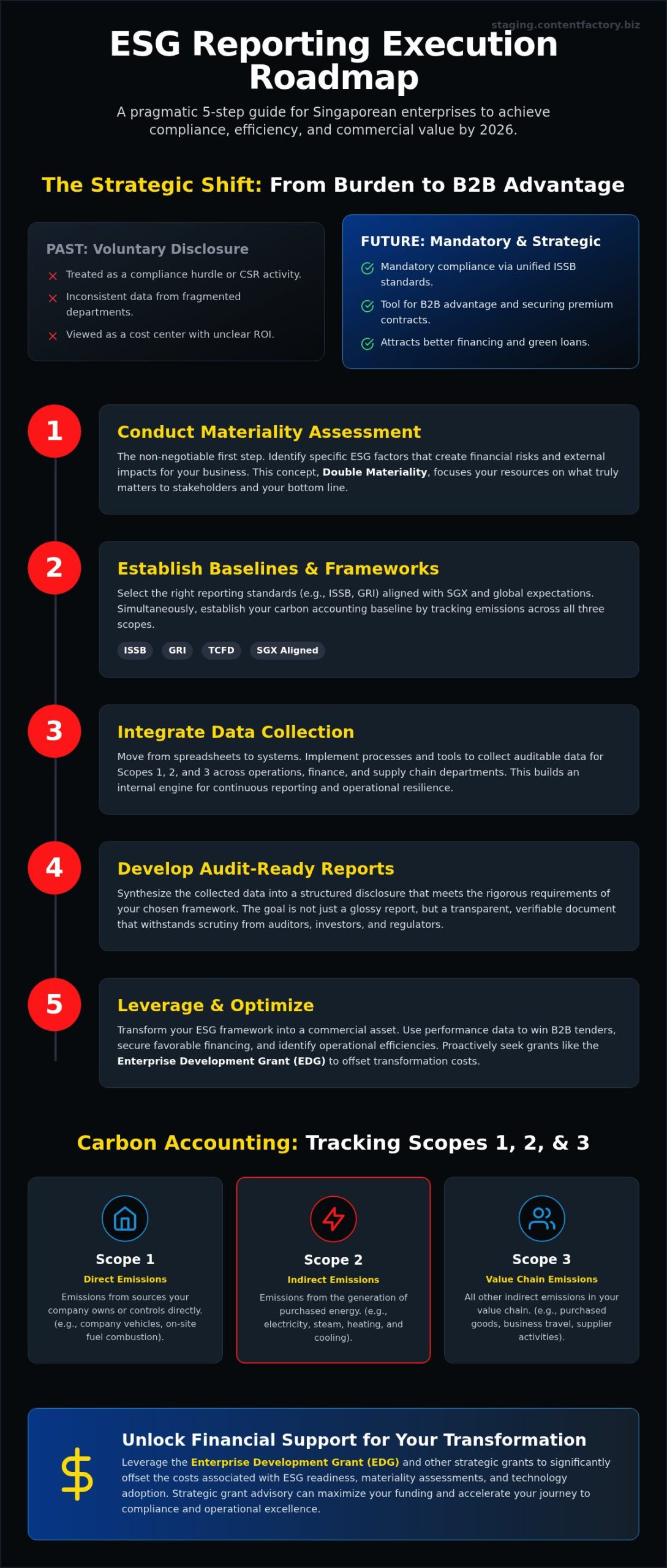
Moving from strategic alignment to operational execution requires a methodical approach. If you’re wondering how to start ESG reporting without disrupting your core business, you must treat the process as a standard project management cycle rather than an ad-hoc marketing task. This roadmap ensures your first report is both credible and commercially useful.
- Step 1: Steering Committee. Appoint a lead from the C-suite and representatives from HR, Finance, and Operations to ensure cross-functional buy-in.
- Step 2: Gap Analysis. Evaluate your current data maturity against the frameworks selected in the previous section to identify missing metrics.
- Step 3: Data Centralization. Aggregate metrics into a single source of truth, integrating carbon accounting into your existing financial modeling.
- Step 4: Balanced Drafting. Produce a narrative that highlights successes while transparently acknowledging material risks and areas for improvement.
- Step 5: External Assurance. Subject your data to third-party verification to build stakeholder trust and prepare for future mandatory audits.
Building Internal ESG Competency
ESG cannot live in a siloed marketing department. It requires a fundamental shift in how every employee views their operational impact. A Singapore Certified Management Consultant provides the necessary leadership to bridge the gap between high-level vision and tactical execution. Training your staff to recognize ESG data points in their daily activities ensures that data collection becomes a natural byproduct of business rather than a quarterly burden. This internal capability building is what allows a firm to scale its sustainability efforts without constantly relying on outside vendors.
The transition from manual, annual data collection to real-time sustainability monitoring is what separates market leaders from laggards. You need a rigorous audit trail for every claim made in your report to protect against greenwashing accusations. This involves implementing software or processes that track the origin of every carbon metric or social KPI back to its source. Audit-readiness is the ultimate goal of the reporting process. To secure your data infrastructure and ensure compliance, engage our multi-framework reporting advisory to align your systems with international standards.
Leveraging Grants for Your ESG Transformation
Sustainability transformation requires capital. In Singapore, the Enterprise Development Grant (EDG) serves as a critical mechanism to subsidize the costs of specialized advisory and technical implementation. Many business leaders researching how to start ESG reporting overlook the fact that the government actively supports the transition to sustainable business model from traditional operations. By leveraging these grants, you move from a cost-center mindset to one of strategic investment, utilizing external expertise to build a framework that drives long-term resilience.
ContentFactory acts as the execution engine for these projects. We don’t just provide theoretical advice; we navigate the complexities of grant applications and integrate sustainability into your core operational flow. Our role is to ensure that your materiality assessments and carbon accounting systems are both compliant and commercially optimized.
Securing the Enterprise Development Grant (EDG)
The EDG supports projects that help companies upgrade their business, innovate, or venture overseas. To qualify, your firm must be registered and operating in Singapore, with at least 30% local shareholding and a viable plan for growth. A common pitfall for SMEs is failing to articulate the “transformation” aspect of the project. Enterprise Singapore looks for initiatives that improve productivity or market competitiveness, not just simple compliance exercises. The grant is most effective when used for building internal capability in Scopes 1-3 carbon accounting or setting up multi-framework reporting systems. Professional grant advisory ensures your application highlights the measurable impact on your business process reengineering goals.
From Reporting to Business Optimization
Effective ESG reporting is essentially a business process reengineering exercise. When you measure your environmental footprint, you identify operational waste and inefficiencies that were previously hidden in your supply chain. This data improves the accuracy of your financial modeling and risk management, allowing for better-informed capital allocation. Beyond internal gains, aligning with global standards is now a prerequisite for ASEAN market entry, where regional partners increasingly demand verified sustainability credentials. For a deeper dive into the initial steps of this journey, read our ESG Readiness Assessment: A Results-Led Guide for SG Firms. By treating reporting as a tool for optimization, you ensure your SME is prepared for the rigorous procurement standards of 2026.
Transforming Compliance into Commercial Resilience
The transition to mandatory sustainability disclosure in 2026 isn’t just a regulatory hurdle; it’s a strategic opportunity to reengineer your business for long-term scalability. By establishing a robust materiality matrix and mastering Scopes 1 to 3 carbon accounting, you position your firm to secure better financing and win high-value B2B contracts. Understanding how to start ESG reporting now ensures your operations remain audit-ready before global mandates tighten even further.
Success requires an execution partner that understands the intricacies of the Singaporean business ecosystem. ContentFactory acts as your strategic engine, led by Singapore Certified Management Consultants with a proven track record in EDG grant advisory. We specialize in building internal capability and managing complex carbon accounting to ensure your reporting drives tangible value. Don’t let regulatory complexity stall your growth. Secure your ESG Readiness Assessment with ContentFactory today and lead your sector with transparency and efficiency.
Frequently Asked Questions
How long does it take to produce the first ESG report?
Producing the first report usually takes between six and nine months. This timeline accounts for the initial materiality assessment, multi-departmental data collection, and the final drafting phase. Starting the process early is essential to ensure your internal data infrastructure is robust enough to meet the 2026 standards for auditability, transparency, and commercial resilience.
Is ESG reporting mandatory for non-listed SMEs in Singapore in 2026?
Mandatory climate reporting currently applies to listed companies and very large non-listed entities in Singapore. However, most mid-market firms find that learning how to start ESG reporting is necessary to remain in the supply chains of multinational corporations. These MNCs now demand granular sustainability data from all B2B partners to meet their own regulatory and net-zero obligations.
What is the difference between a sustainability report and an ESG report?
While sustainability reports often focus on general corporate citizenship, ESG reports are technical disclosures designed for financial stakeholders. ESG reporting prioritizes measurable data and risk management under frameworks like ISSB. This shift from narrative to metrics ensures that your sustainability performance is comparable, auditable, and directly linked to your firm’s long-term commercial resilience.
Can we use the Enterprise Development Grant (EDG) for ESG reporting?
The Enterprise Development Grant (EDG) is a viable resource for funding sustainability transformation projects. It specifically supports consultancy for materiality assessments and the implementation of carbon accounting systems. Leveraging this grant allows Singaporean enterprises to secure expert guidance while significantly reducing the financial burden of their first reporting cycle and ensuring alignment with global standards.
What are the most common mistakes in first-time ESG reporting?
Many first-time reporters fail by treating ESG as a marketing exercise rather than a business process. Common errors include a lack of data governance and neglecting double materiality perspectives. Without a clear audit trail for every claim, firms risk greenwashing allegations that can damage their reputation with investors, banks, and high-value B2B procurement partners. Reviewing a dedicated ESG compliance checklist for Singapore suppliers can help first-time reporters identify and close critical gaps before their initial submission.
How much does it cost to start ESG reporting for a mid-market firm?
The investment required depends on the depth of your materiality assessment and the scale of your carbon accounting needs. Mid-market firms should budget for professional consultancy, internal capability building, and reporting software. Many Singaporean companies effectively offset these initial costs by securing strategic grant advisory to maximize their Enterprise Development Grant (EDG) funding.
What is Scope 3 carbon accounting and why is it difficult?
Scope 3 emissions represent the carbon footprint of your entire value chain, including suppliers and end-users. This is the most challenging metric because you don’t have direct control over the data source. Success requires deep stakeholder engagement and the integration of professional carbon accounting tools to estimate impact where primary data from external vendors is currently unavailable. For firms ready to move beyond measurement into structural change, following a strategic transition to sustainable business model roadmap ensures that Scope 3 data collection becomes embedded in your core operations rather than remaining an annual reporting burden.
Article by
Mayuresh Godse
Mayuresh Godse is a Singapore Certified Management Consultant and Business Strategist specializing in Sustainability, ESG, AI-driven Digital Transformation, and business growth. Based in Singapore, he writes about Sustainability, Digital Innovation, Business Strategy, and Content Marketing for global audiences.
Disclaimer
This article is provided by ContentFactory for general information only and is not legal, tax, accounting or financial advice. Regulations and government scheme criteria change; grant eligibility and quantum are set by the relevant Singapore agencies and assessed case by case, with no outcome guaranteed. Verify current requirements before acting.
One thing worth checking on the tool side: if the disclaimer is switched on globally, the grant caveat already written into your Global Writing Instructions will appear as well, so grant articles will carry the same point twice. Remove the required-disclaimer section from the instructions file if you enable this one.