

Choosing the wrong sustainability standard is no longer just a clerical oversight. It’s a strategic risk that can decouple your business from global supply chains and invite unnecessary regulatory scrutiny. You’re likely struggling to reconcile the immediate mandates from SGX and ACRA with the diverse reporting expectations of your multinational clients. The persistent confusion surrounding GRI, SASB, and the newer ISSB standards makes it difficult to commit to a single path without fearing a lack of internal expertise or future obsolescence.
Understanding how to choose an ESG reporting framework requires a shift from abstract theory to disciplined execution. This guide provides a pragmatic framework for Singapore-based firms to navigate the reporting landscape and select the standard that aligns with both stakeholder demands and current regulatory mandates. We’ll examine the specific requirements for different business sizes, including the updated 2026 ACRA timelines, and provide a clear decision-making path for your leadership team. By the end, you’ll have a reporting structure that doesn’t just satisfy a compliance checklist but builds genuine trust with international partners and ensures long-term operational resilience.
Key Takeaways
- Align your reporting with the 2026 SGX and ACRA mandates to ensure compliance with Singapore’s evolving climate disclosure roadmap.
- Discover how to choose an ESG reporting framework that satisfies the specific data demands of multinational clients and international partners.
- Utilise a formal Materiality Assessment to prioritise the sustainability metrics that impact your financial performance and stakeholder trust.
- Evaluate your internal data maturity and carbon accounting readiness to bridge the gap between current capabilities and mandatory reporting standards.
- Implement a structured four-step process to transition from framework selection to an operationalised, audit-ready sustainability programme.
Navigating the ESG Reporting Landscape in Singapore
An ESG reporting framework is a standardised system designed to help your organisation measure, disclose, and manage its non-financial risks and opportunities. It translates environmental impact, social responsibility, and governance health into a data language that stakeholders and regulators understand. Deciding how to choose an ESG reporting framework is no longer a peripheral concern for mid-market firms; it is a core requirement for maintaining market access in a tightening regulatory environment. The primary triggers for this shift include mandatory ACRA filings, stringent supply chain requirements from multinational clients, and the growing necessity of demonstrating sustainability to access green finance.
While the persistent “alphabet soup” of standards (GRI, SASB, ISSB) often leads to analysis paralysis, a pragmatic approach focuses on tangible outcomes. Rather than attempting to satisfy every global index simultaneously, you must prioritise the standards that your specific stakeholders value most. This ensures your reporting efforts drive actual business value instead of just generating voluminous slide decks.
The 2026 Reporting Mandate for Singapore Firms
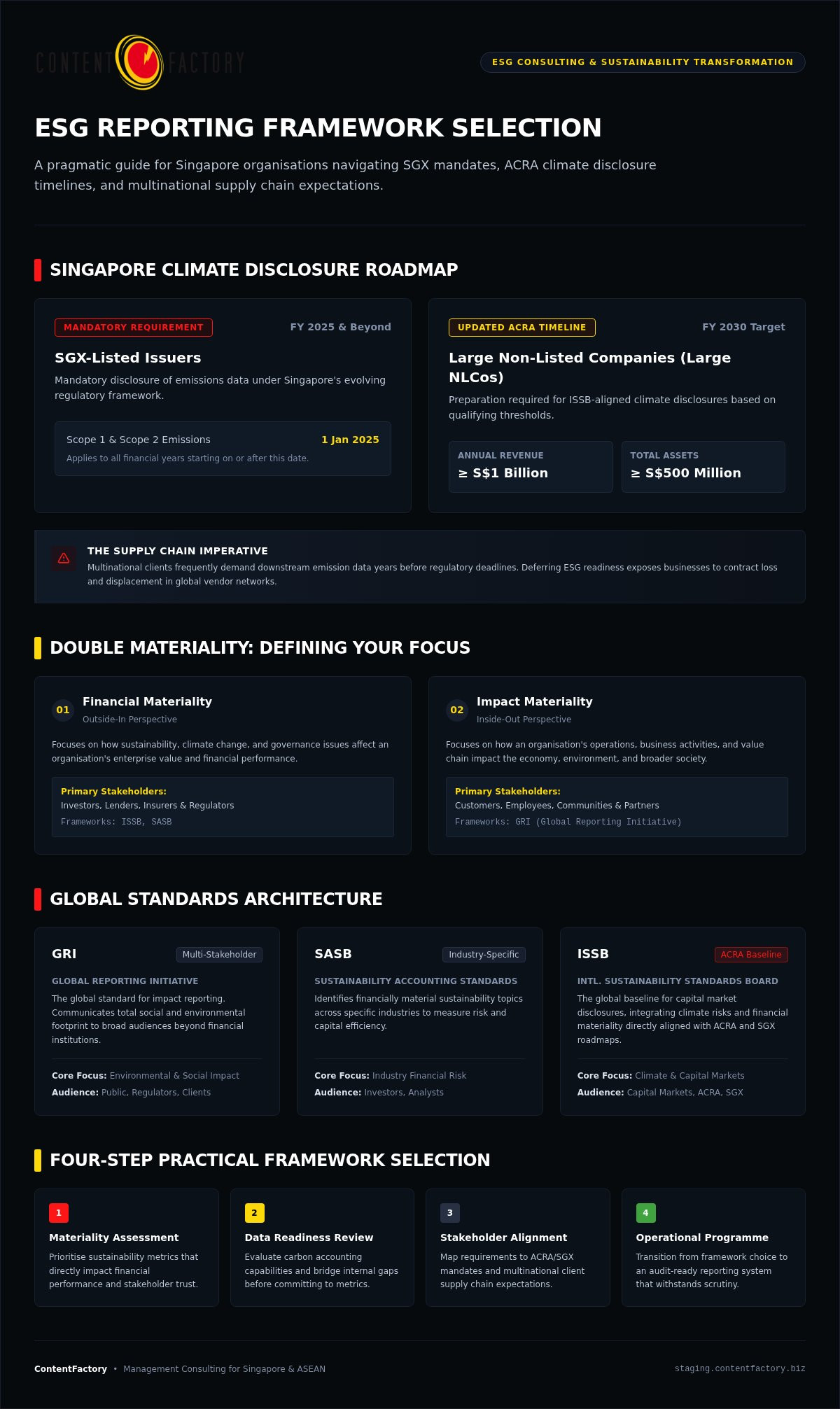
SGX-listed issuers are already facing escalated requirements. All listed companies must report Scope 1 and Scope 2 emissions for financial years starting on or after 1 January 2025. For non-listed entities, ACRA recently updated the timeline for Large Non-Listed Companies (Large NLCos). Those with annual revenue of at least S$1 billion and total assets of at least S$500 million must prepare for ISSB-aligned disclosures by FY2030. While some deadlines for private firms have been deferred, waiting for mandatory dates puts your supply chain position at risk. Multinational clients often demand downstream emission data years before regulators do, making early ESG Readiness a competitive necessity to retain high-value contracts.
Why Framework Standardisation Matters
Without a structured approach, disclosures often descend into marketing fluff that invites “greenwashing” allegations. Standardised sustainability reporting frameworks provide the rigour needed to build investor trust and ensure data comparability across your industry. Choosing a recognised framework moves your business from ad-hoc responses to a cohesive sustainability roadmap. This alignment prevents internal teams from wasting resources on irrelevant metrics. It ensures your data stands up to external scrutiny, which is essential as mandatory assurance requirements approach. A results-led selection process identifies the framework that best captures your organisation’s specific impact and financial resilience.
Comparing Global Standards: How to Choose an ESG Reporting Framework
Framework selection is not a one-size-fits-all exercise. It is a strategic alignment between your organisation’s data maturity and the specific information needs of your most influential stakeholders. Deciding how to choose an ESG reporting framework begins with identifying who will consume your report. Investors typically demand financial materiality, while customers, employees, and regulators often look for broader impact data. This distinction is captured in the concept of “Double Materiality,” which requires businesses to report both on how sustainability issues affect their financial value and how their operations impact the environment and society.
Industry-specific requirements also dictate your path. A manufacturing firm in Singapore facing intense scrutiny over carbon emissions will prioritise different metrics than a services-led SME. To ensure your selection is grounded in operational reality, you should first conduct an ESG Readiness Assessment. This process identifies existing data gaps and ensures the framework you select is actually implementable within your current resource constraints. Practicality must lead the process. Reporting on metrics you cannot accurately measure only increases your exposure to liability.
GRI vs. SASB and ISSB: Understanding the Difference
The Global Reporting Initiative (GRI) remains the primary standard for multi-stakeholder impact reporting. It is designed for organisations that need to communicate their social and environmental footprint to a broad audience beyond just the financial community. In contrast, the Sustainability Accounting Standards Board (SASB) and the International Sustainability Standards Board (ISSB) focus specifically on investor-grade financial materiality. SASB provides 77 industry-specific standards that identify the subset of ESG issues most likely to impact a company’s financial performance. These frameworks are increasingly converging under the IFRS Foundation to create a unified global baseline for sustainability disclosures.
Regional and Specialised Frameworks (ESRS and BRSR)
Singapore firms acting as key suppliers to European multinationals must often align with the European Sustainability Reporting Standards (ESRS). These standards are more prescriptive than global alternatives and mandate comprehensive double materiality disclosures. Similarly, if your organisation has significant operations in India, you must monitor the Business Responsibility and Sustainability Reporting (BRSR) requirements. Integrating Task Force on Climate-related Financial Disclosures (TCFD) recommendations is also essential, as these principles form the backbone of Singapore’s climate reporting roadmap. Aligning these various demands requires a structured approach to prevent reporting fatigue. If you are unsure where to start, you can speak with our consultants to map your specific requirements.
Selection Criteria for SMEs and Mid-Market Organisations
Mid-market firms in Singapore cannot afford the sprawling reporting teams of global conglomerates. Therefore, how to choose an ESG reporting framework must be a decision based on resource efficiency and strategic necessity. You must evaluate your current data maturity, specifically your internal capability for carbon accounting. If your team lacks the expertise to calculate complex Scope 3 emissions, selecting a high-intensity framework immediately is a recipe for failure. Instead, prioritise a phased approach that starts with mandatory climate metrics and matures into broader social and governance disclosures.
Identify the reporting demands of your top-tier MNC customers. These partners often dictate the standards you must meet to remain on their preferred supplier lists. If your primary clients require GRI Standards for sustainability reporting, then your choice is largely made for you. Balance these external pressures against the internal cost of implementation, including the time required from senior leadership and the potential need for specialised expertise. Pragmatic firms select frameworks that align with their existing operational strengths while leaving room for future scalability.
Stakeholder Mapping and Materiality
Effective framework selection requires you to map your stakeholders and determine exactly what data they require. A bank assessing your organisation for a green loan has different priorities than a local regulator or a potential employee. Linking your choice to a formal Materiality Assessment ensures you only report on factors that truly impact your business resilience. This prevents the common mistake of “disclosure for disclosure’s sake,” which wastes precious operational hours on irrelevant metrics. Focus on the ESG factors that present the greatest risk or opportunity to your specific industry to ensure your report drives actual business value.
Data Availability and Systems Integration
Your ability to track Scope 1, 2, and 3 emissions is a critical filter in the process of how to choose an ESG reporting framework. Many organisations find that manual data collection is unsustainable, leading to errors and reporting fatigue. Leveraging Digital ESG Integration can simplify compliance by automating the flow of data from utility bills and operational data sources directly into your reporting templates. Look for frameworks with overlapping metrics to reduce the burden of double-entry. If you choose a framework that integrates seamlessly with your existing management processes, you’ll reduce the long-term cost of compliance while improving data accuracy and audit readiness.
A Four-Step Process for Practical Framework Selection
Determining how to choose an ESG reporting framework involves moving from theoretical data collection to a structured, audit-ready disclosure process. Many organisations fail because they jump into reporting without understanding their internal data limitations. A methodical selection process ensures that your chosen framework is both sustainable for your team and credible for your stakeholders. This four-step methodology focuses on execution and tangible business outcomes rather than abstract consulting theory.
Step 1: The Readiness Assessment
Before selecting a standard, you must audit your existing data points and internal governance structures. This involves identifying which business functions currently own relevant data, such as HR for social metrics or facilities management for utility consumption. Benchmarking against industry peers in Singapore helps identify standard practices and ensures you aren’t over-engineering your initial disclosures. A readiness assessment is the foundation of any credible ESG strategy. By conducting a thorough ESG Readiness and Gap Analysis, you identify specific reporting hurdles before they become compliance failures.
Step 2: Materiality and Stakeholder Engagement
Materiality is the filter that separates essential data from noise. You must engage both internal and external stakeholders to validate which sustainability issues actually impact your business resilience and stakeholder trust. This engagement leads to the creation of a materiality matrix, which visually maps priorities and guides your framework alignment. It’s vital to ensure your chosen framework covers Social (S) and Governance (G) factors in addition to Environmental (E) metrics. Many firms focus solely on carbon while ignoring the governance health and social impact that international partners increasingly demand.
Once your material topics are defined, the third step is to map these priorities against the specific requirements of GRI, SASB, or ISSB. This mapping exercise identifies the framework that offers the highest degree of overlap with your material issues, thereby reducing the total reporting burden. If your materiality assessment reveals a heavy focus on financial risk, ISSB standards may be the primary choice. If your stakeholders demand broader impact data, GRI remains the most effective tool for communication.
The final step is to develop a multi-year reporting roadmap that scales with your business growth. Start with baseline disclosures that meet immediate regulatory mandates and gradually integrate more complex metrics like Scope 3 emissions or biodiversity impacts. This phased approach prevents reporting fatigue and allows your internal team to build ESG capability over time. A clear roadmap ensures your reporting remains a strategic asset rather than a recurring administrative headache.
Operationalising Your Choice with ContentFactory
Selecting a standard is merely the starting line. The true value of sustainability lies in how your organisation translates these requirements into actionable data and improved operational performance. Understanding how to choose an ESG reporting framework is the first step in a broader strategic transformation. ContentFactory acts as your execution engine, moving your business beyond theoretical selection toward a state of audit-ready disclosure that satisfies the most demanding global partners.
From Strategy to Funded Execution
ContentFactory helps Singaporean firms bridge the gap between high-level sustainability visions and tangible business value. We integrate your framework selection into a broader roadmap that prioritises measurable outcomes over static, yearly reports. Our consultants work directly with your leadership to build internal ESG Capability, ensuring your team can manage complex data requirements independently. By focusing on operational efficiency, we turn compliance into a tool for cost reduction and resource optimisation. This pragmatic approach ensures that every disclosure serves a dual purpose: meeting regulatory mandates and driving group-wide resilience.
Supporting Your Regional Growth
Expanding across ASEAN and India requires a sophisticated understanding of localized sustainability standards and cross-border compliance. ContentFactory provides the regional expertise necessary to navigate these diverse regulatory ecosystems without duplicating your reporting efforts. We ensure your disclosures remain interoperable across different jurisdictions, allowing your organisation to maintain its competitive edge in international supply chains. Our methodology prepares you for Mandatory Sustainability Assurance from the outset, significantly reducing the friction and cost of future third-party audits. We position your ESG performance as a primary driver for market expansion and long-term investor trust.
ContentFactory specialises in ESG readiness, materiality assessments, and multi-framework reporting for mid-market organisations. We provide the senior-led guidance and technical expertise required to operationalise your sustainability strategy and ensure compliance with SGX and ACRA mandates. Our team focuses on delivering audit-ready execution that builds genuine stakeholder confidence and supports your long-term growth objectives.
Securing Your Strategic Advantage through ESG Excellence
Framework selection defines your organisation’s ability to compete in a climate-conscious global economy. It’s no longer just about compliance; it’s about data integrity and stakeholder trust. Success requires a shift from manual data capture to automated, audit-ready systems that satisfy both local regulators and multinational partners. Determining how to choose an ESG reporting framework is the critical first step toward building this operational resilience.
ContentFactory provides the senior-led expertise needed to navigate this transition with precision. Led by a Singapore Certified Management Consultant, we specialise in operationalising GRI, ISSB, and SASB frameworks through pragmatic, execution-focused roadmaps. We ensure your reporting doesn’t just meet the 2026 and 2030 ACRA mandates but serves as a genuine driver for regional growth and efficiency.
Your organisation is ready to move beyond static reports and toward measurable sustainability value. We look forward to helping you build a reporting structure that secures your market position for years to come.
Frequently Asked Questions
Which ESG framework is best for a small business in Singapore?
The best framework for a Singapore SME depends on your primary stakeholders. If your goal is to satisfy multinational clients or prepare for future ACRA mandates, the ISSB standards are the most pragmatic starting point. These focus on climate-related financial risks. However, if you need to demonstrate broader environmental and social impact to a wider community, the GRI Standards remain the global baseline for impact-focused reporting and stakeholder communication.
Is ESG reporting mandatory for private companies in Singapore by 2026?
Mandatory ESG reporting is not required for all private companies by 2026. ACRA recently deferred the deadline for Large Non-Listed Companies to financial years starting on or after 1 January 2030. These are entities with annual revenue of at least S$1 billion and total assets of at least S$500 million. While not legally required for smaller firms, many SMEs find reporting necessary to remain in the supply chains of listed partners.
What is the difference between a framework and a standard in ESG reporting?
A framework provides high-level principles and guidance on how information is structured, whereas a standard provides specific, detailed requirements for what should be disclosed. For example, TCFD is a framework that guides climate risk reporting, while the GRI Standards provide the exact metrics you must use. The ISSB now integrates these into a unified set of standards, simplifying the process of how to choose an ESG reporting framework for mid-market firms.
How long does it take to implement an ESG reporting framework?
A typical implementation cycle for a new reporting framework takes between 6 and 12 months. This timeline accounts for the initial readiness assessment, stakeholder engagement, and the primary data collection phase. If your organisation has low data maturity or complex supply chains, the process may take longer. Starting early is essential to ensure your systems are robust enough to produce audit-ready reports that satisfy international partners and lenders.
Can I use multiple ESG reporting frameworks at the same time?
You can and often should use multiple frameworks to meet different stakeholder expectations. This approach, known as multi-framework reporting, allows you to address investor needs through SASB or ISSB while using GRI for broader impact communication. ContentFactory specialises in harmonising these requirements to prevent reporting fatigue. By mapping overlapping metrics, you can produce a single, comprehensive report that satisfies various regulatory and commercial demands without duplicating your team’s workload.
What are the most common mistakes when choosing an ESG framework?
The most common mistake is selecting a framework before conducting a formal materiality assessment. Without this step, organisations often waste resources reporting on irrelevant metrics that don’t impact their business resilience. Other errors include ignoring Scope 3 emissions or failing to integrate ESG data into existing management systems. These mistakes lead to static reports that lack strategic value and fail to build genuine trust with banks and high-value multinational clients.
How does framework selection impact my ability to get a green loan?
Framework selection directly impacts your eligibility for sustainability-linked loans and green finance. Banks in Singapore require standardised, verifiable data to assess your sustainability performance against specific Key Performance Indicators. Using recognised standards like ISSB or GRI provides the transparency lenders need to offer preferential interest rates. A well-chosen framework demonstrates that your organisation has a disciplined approach to managing ESG risks, making you a more attractive borrower for regional banks.
Do I need external consultants to choose and implement a framework?
While you don’t strictly need consultants, most SMEs lack the internal expertise to manage carbon accounting and gap analysis efficiently. Engaging a partner like ContentFactory allows you to leverage senior-led expertise without the overhead of a permanent sustainability team. We provide the execution engine needed to operationalise your reporting roadmap. This ensures your framework implementation is pragmatic and aligned with your long-term commercial goals while building necessary internal capabilities.

Article by
Mayuresh Godse
Mayuresh Godse is a Singapore Certified Management Consultant and Business Strategist specializing in Sustainability, ESG, AI-driven Digital Transformation, and business growth. Based in Singapore, he writes about Sustainability, Digital Innovation, Business Strategy, and Content Marketing for global audiences.
Disclaimer
This article is provided by ContentFactory for general information only and is not legal, tax, accounting or financial advice. Regulations and government scheme criteria change; grant eligibility and quantum are set by the relevant Singapore agencies and assessed case by case, with no outcome guaranteed. Verify current requirements before acting.
One thing worth checking on the tool side: if the disclaimer is switched on globally, the grant caveat already written into your Global Writing Instructions will appear as well, so grant articles will carry the same point twice. Remove the required-disclaimer section from the instructions file if you enable this one.