

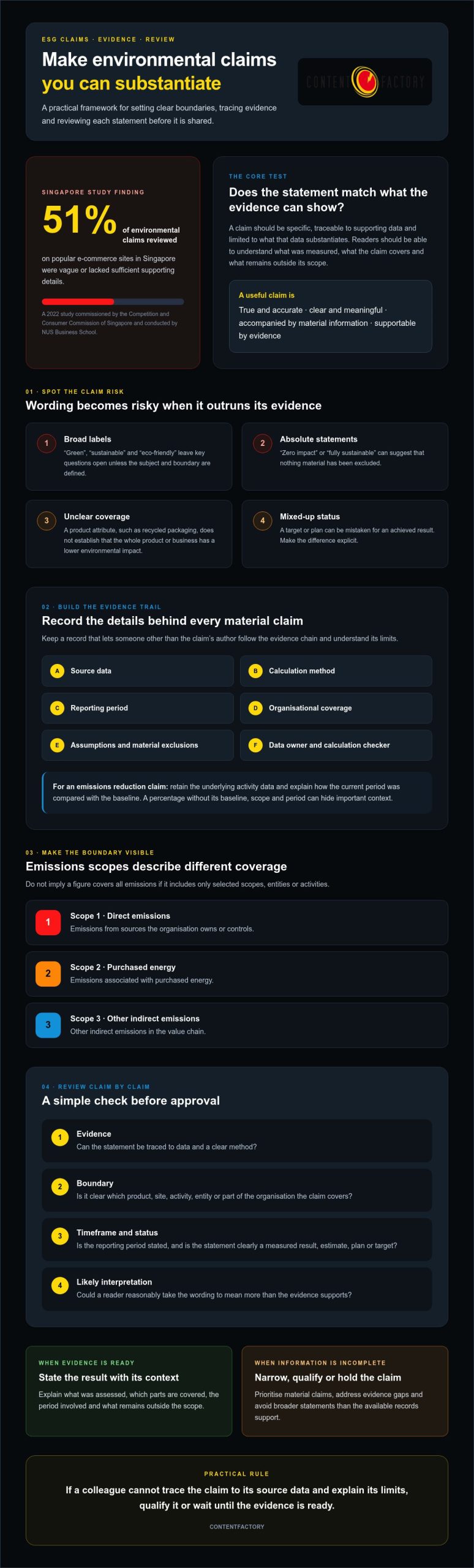
A sustainability claim can overstate progress even when the underlying data is sound. Often, the risk lies in what the claim leaves out: its boundary, time period or evidence. Understanding greenwashing risks and how to avoid them starts with a clear rule: make claims specific, traceable to supporting data and limited to what that data can substantiate. A 2022 study commissioned by the Competition and Consumer Commission of Singapore and conducted by NUS Business School found that 51% of environmental claims on popular e-commerce sites in Singapore were vague or lacked sufficient supporting details.
Broad wording and incomplete records can make claims difficult to verify. But staying silent about genuine progress is not the only alternative. Explain what was assessed, which parts of the business it covers and what remains outside the scope. This article sets out common ways claims can mislead and how to build a review process your organisation can maintain. You’ll learn how to define claim boundaries, connect statements to emissions and other ESG evidence, assign internal ownership and record approvals. The aim is practical: communicate progress clearly, with appropriate context and caveats.
Key Takeaways
- Understand greenwashing risks and how to avoid them by checking whether each environmental statement matches its supporting evidence.
- For every material claim, record the data source, calculation method, reporting period, scope and responsible owner.
- Distinguish measured results from targets, plans and estimates so readers can tell what has been achieved from what is intended.
- Review claims individually for evidence, boundaries, timeframe and likely interpretation before approving them.
- Prioritise material claims and address evidence gaps before making broader statements about your organisation’s environmental performance.
Greenwashing risks begin when environmental claims outrun the evidence
Your organisation may have genuine environmental progress to report, yet a claim can still create a misleading impression if its scope is unclear or its evidence is incomplete. Greenwashing is commonly used to describe communication that presents an organisation or activity as more environmentally beneficial than the available information supports. This is a descriptive term, not a legal definition. The practical question behind greenwashing risks and how to avoid them is whether each statement gives a fair account of what was measured, what it covers and what remains unknown.
The Competition and Consumer Commission of Singapore’s Guide on Quality-related Claims, published on 6 October 2025, sets out principles for quality-related claims. It says claims should be true and accurate, clear and meaningful, accompanied by material information, and supportable by evidence. Weak claims can erode credibility, confuse stakeholders and make it harder to explain how a statement was reached. This risk can arise from deliberate exaggeration, but it can also result from weak controls, imprecise wording or records that do not support the full claim.
Assess greenwashing risks and how to avoid them in environmental claims
Broad labels such as “green”, “sustainable” and “eco-friendly” leave important questions unanswered unless you define the subject and boundary. Does the claim relate to one product, one site, a particular activity or the whole organisation? A product attribute, such as recycled packaging, does not by itself establish that the entire product or business has a lower environmental impact.
Absolute statements need particular care. “Zero impact” or “fully sustainable” can imply that nothing material has been excluded. If a claim applies only to a specific stage, component or period, state that limitation where readers can see it. An unstated boundary may lead people to draw a broader conclusion than your evidence supports.
Why can well-intentioned organisations still get claims wrong?
Information may sit across teams, data sets and reporting periods. If records use different methods or boundaries, a confident-sounding statement can go further than the underlying figures allow. A target can also be mistaken for an achieved result. “We aim to reduce emissions” describes an ambition; it does not show that emissions have already fallen.
Incomplete information calls for narrower, clearer claims, not automatic silence. State what you measured, identify the period and scope, and distinguish confirmed results from estimates, plans or targets. As a first check, ask whether a colleague could trace each claim to its source data and explain its limits. If not, qualify the statement or hold it until the evidence is ready.
Evidence, boundaries and context determine whether an ESG claim holds up
A claim is only as reliable as its evidence and the boundary it describes. An environmental claim needs traceable evidence and a clearly stated boundary so readers can understand what was measured, over which period, and what was left out. This is a practical test for greenwashing risks and how to avoid them: can someone other than the claim’s author follow the evidence chain and reach the same conclusion?
How do you substantiate an environmental claim?
For each claim, keep a record that connects the statement to its source data, calculation method, reporting period, organisational coverage, assumptions and material exclusions. Identify who owns the source information and who checked the calculation. For an emissions reduction claim, retain the underlying activity data and explain how the current period was compared with the baseline. A percentage without its baseline, scope and period can hide important context.
If the claim concerns greenhouse gas emissions, use the relevant GHG Protocol standards and guidance to inform how emissions are accounted for. Scope 1 covers direct emissions from sources the organisation owns or controls; Scope 2 covers emissions associated with purchased energy; Scope 3 covers other indirect emissions in the value chain. Don’t imply that a figure covers all emissions if it includes only selected scopes, entities or activities. The chosen method and boundaries should match the claim.
The Federal Trade Commission’s Green Guides provide U.S. guidance on environmental claims. They are not Singapore requirements, but they can help you consider whether wording and evidence might create a misleading impression. For Singapore disclosures, use the reporting framework relevant to your organisation and describe its scope accurately.
How should you describe limits and uncertainty?
Make the status of each figure clear. A measured result comes from recorded data and a defined method. An estimate relies on assumptions. A target describes an intended outcome, while a plan sets out proposed actions. Keep these categories distinct in both statements and supporting records.
State material limitations plainly. If an emissions assessment covers one site but not the whole organisation, say so. If some activity data is estimated, identify that estimate and explain the material assumption behind it. Don’t present partial coverage as a complete organisational result.
- Keep source records, calculations and approval notes together.
- Document the reporting period, organisational boundary and exclusions.
- Revisit a claim when its data, method or scope changes.
If you need to strengthen the evidence behind environmental claims, discuss your ESG data and readiness needs.
Use a claim-by-claim review to separate credible statements from risky ones
A general review of your sustainability information can miss the specific wording that creates risk. Assess each proposed statement on its own, then compare it with the evidence, scope and timeframe behind it. This makes greenwashing risks and how to avoid them a practical review task, not a judgement about your organisation’s intent.
For each claim, record the exact wording, what it refers to, the evidence available, the relevant boundary and period, and what a reader might reasonably infer. Use these points as prompts for internal review, not as legal advice or a universal compliance test.
What questions should reviewers ask before approving a claim?
Start with the statement itself. What does it say has changed or improved, and does it apply to a product, site, business unit or the whole organisation? Check that the supporting records match that coverage and timeframe. Ask whether another reviewer could reproduce the calculation from the source information and understand its assumptions.
Then consider how the statement may be interpreted. Could a reader take the wording to mean that a wider environmental benefit has been demonstrated? If you assessed one component or activity, does the statement make that limited scope clear? A claim may relate to a measured attribute yet still imply more than the evidence establishes.
How can a team improve a weak claim?
Replace broad or absolute language with a specific description the evidence can support. For example, “Our packaging is sustainable” is too broad to show what was assessed. If records support it, a more precise illustrative statement might be: “The packaging for [specified product] contains [verified proportion] recycled material by weight.” The organisation would still need to define the product, evidence, period if relevant, and any material qualification. This example is illustrative, not a legal recommendation.
Keep important qualifications close to the claim rather than relying on a separate note that readers may miss. Use this comparison list during review:
- Claim: What exactly are you saying?
- Evidence: Which records and calculation support it?
- Boundary: Which activity, product, site or entity is included, and what is excluded?
- Timeframe: Which period does the statement describe?
- Interpretation: Could the wording imply a broader result than the evidence shows?
If evidence is missing, narrow the wording or defer the claim. Assign an owner to close the gap, identify the information needed and set a point to review the statement again. This stops an unsupported claim from being treated as established simply because it has been repeated.
Consistent review is easier when your organisation has clear ESG data ownership and defined claim boundaries. Keep the review record with the supporting information so future reviewers can see why the wording was approved and when it needs to be reassessed.
Build a repeatable process to prevent unsupported environmental claims
A claim review should follow the same steps each time, whether the statement concerns emissions, materials or another ESG result. A repeatable process helps identify weak evidence before approval and prompts a review when the underlying information changes.
Start with an inventory of current and proposed environmental claims. For each one, record the exact wording, intended coverage, reporting period, supporting evidence and owner. Then map the evidence, check the boundary and assumptions, consider how readers may understand the wording, and obtain approval through your organisation’s existing governance.
How should you organise evidence and approval?
Keep a claim register that points reviewers to source records and calculation files. Don’t rely on the statement alone. Assign clear responsibilities: a data owner maintains source information, a technical owner confirms calculations, a reviewer checks scope and wording, and an authorised approver signs off. One person may hold more than one role, but each responsibility should be clear.
Record the review date, decision, relevant qualifications and version of the approved wording. Retain earlier versions and note why a claim was revised or withdrawn. This gives your team a usable record of what was checked, not just a folder of supporting documents. You can align claim controls with wider ESG readiness and gap analysis work to make ownership and evidence gaps visible within your broader ESG practices.
When should an environmental claim be reviewed again?
Set a review point that fits the claim and your reporting cycle. Reassess it when source data or calculation methods change, when the organisational boundary shifts, or when new performance information makes the existing wording inaccurate. Before reusing a statement, check that it still matches current internal records.
For an emissions claim, confirm that the activity data, period and included sources remain consistent with the statement. If the supporting emissions evidence is not yet available, narrow or defer the claim while you address the gap. GHG emissions calculation and carbon accounting may be a relevant next step when your organisation needs to strengthen its emissions data and calculations.
Put the process to work on one high-visibility claim first. Trace the wording back to source records, confirm its scope and owner, and check that the approved version includes necessary qualifications. Use any gaps you uncover to improve the register and review steps before applying them to other claims.
Make greenwashing prevention part of practical ESG readiness
Claim controls work best as part of your wider ESG practices, not as a separate check performed only before a statement is published. Materiality helps you focus on the environmental topics that matter most to your organisation and stakeholders. Reliable data and clear internal ownership then provide a basis for describing progress accurately. This is the operational foundation for addressing greenwashing risks and how to avoid them.
What should an organisation prioritise first?
Start with the environmental claims that are most visible or most significant to stakeholders. Compare them with your material ESG topics and identify which have clear evidence, which need qualification and which should wait. You don’t need to review every possible statement at once. A focused first review can reveal where data ownership, records or calculation methods need attention.
Before expanding a claim, close the evidence gaps that affect its meaning. Then establish a review process that fits your organisation’s existing roles and data capabilities. For each priority claim, decide who maintains the information, who checks the supporting evidence and who approves the final wording. Keep the process proportionate, but make responsibilities explicit.
- Prioritise claims linked to material ESG topics and stakeholder concerns.
- Identify missing records, unclear boundaries or unassigned data ownership.
- Strengthen evidence and internal review before making broader statements.
How can external ESG support help without replacing internal ownership?
External support can help you assess ESG readiness, identify data and control gaps, strengthen emissions accounting, or build staff capability. It can also help teams clarify what information is needed to substantiate a claim and which limitations should be communicated. ESG capability building and training can help staff understand their responsibilities.
Support should strengthen your organisation’s ability to make informed decisions, not replace it. Your business remains responsible for the claims it approves and the evidence it relies on. Assign internal owners who can maintain source information, explain assumptions and flag when a statement needs review. That ownership keeps claim controls connected to day-to-day ESG data practices.
ContentFactory supports organisations with ESG readiness, gap analysis and strategy, GHG emissions calculation and carbon accounting, and ESG capability building. This work can help clarify evidence needs and internal responsibilities, while your organisation retains ownership of its claims and approvals.
Make credible environmental claims part of your ESG practice
Reducing greenwashing risks and how to avoid them comes down to disciplined evidence, clear boundaries and accountable review. For each material claim, confirm what it covers, what information supports it and whether the wording accurately distinguishes results from targets or estimates. Keep the evidence and approval record current as data or organisational circumstances change.
Start with the environmental claims that matter most to your stakeholders. Address evidence gaps and assign clear internal owners before broadening or strengthening statements. A practical review process doesn’t require perfect data from day one. It requires your organisation to be precise about what it knows, what it has measured and what remains uncertain.
ContentFactory supports ESG readiness, gap analysis, emissions accounting and capability building. Its ESG work is led by Mayuresh Godse, a Singapore Certified Management Consultant with 25+ years of consulting experience. Your organisation remains accountable for the claims it approves, with support focused on strengthening the evidence and internal capability behind them.
With clear ownership and a repeatable evidence process, your organisation can communicate progress with greater confidence and appropriate context.
Frequently Asked Questions
What is greenwashing in business?
Greenwashing describes environmental communication that gives a misleading or unsupported impression about a business, product or activity. A claim may mislead through broad wording, missing context or evidence that doesn’t support its full scope, whether or not the organisation intended to mislead. In Singapore, the CCCS Guide on Quality-related Claims says claims should be true and accurate, clear and meaningful, include material information, and be supportable by evidence.
How can a business avoid greenwashing?
To manage greenwashing risks and how to avoid them, review each environmental claim against its evidence before approval. Keep a record of the wording, data source, calculation method, scope, reporting period, assumptions and responsible owner. Distinguish achieved results from targets, plans and estimates. Ask an appropriate reviewer to consider how the claim may be understood, and update or withdraw it if the supporting information changes or no longer substantiates the statement.
Can a company make environmental claims if its data is incomplete?
Yes, if the statement accurately reflects what the available data covers and makes material limitations clear. Narrow the claim to the assessed activity, site, product or period. Label estimates and explain important assumptions rather than presenting estimated information as a measured result. If the evidence can’t support even a qualified statement, defer the claim until the relevant data is available and reviewed.
What evidence should support a sustainability claim?
Keep records that allow a reviewer to understand and check the claim. These typically include source data, the calculation method, the reporting period, organisational or product coverage, assumptions, exclusions and the person responsible for the information. For emissions claims, document which emissions sources and scopes are included. The evidence should match the wording: a figure covering one site shouldn’t be presented as a result for the whole organisation.
Are net-zero or carbon-neutral claims risky?
They can be, because readers may interpret them as broad statements about an organisation’s overall emissions or environmental impact. Define the boundary, timeframe and status of the claim, and distinguish a future target from an achieved result. Explain the basis for the statement, including any material exclusions or reliance on offsets. Requirements and guidance can vary between markets, so check the applicable framework before making or reusing such claims.
Who should review environmental claims in an organisation?
Assign clear roles for the people who own source data, prepare calculations, review evidence and approve final wording. Depending on your organisation, relevant staff may come from sustainability, operations, finance or other teams responsible for the underlying information. Use your existing governance to document decisions and sign-offs. Final approvers should be able to see the evidence, scope and limitations, rather than relying on an unsupported summary.
How often should a business review its environmental claims?
Set a review schedule that fits your data and reporting cycles, then revisit a claim whenever its basis changes. Triggers include updated source data, a revised calculation method, changes to organisational boundaries or new performance information. Review claims before reusing them, too. Check that the public wording still matches current internal records, and revise, qualify or withdraw it if the evidence no longer supports the statement.

Article by
Mayuresh Godse
Mayuresh Godse is a Singapore Certified Management Consultant and Business Strategist specializing in Sustainability, ESG, AI-driven Digital Transformation, and business growth. Based in Singapore, he writes about Sustainability, Digital Innovation, Business Strategy, and Content Marketing for global audiences.
Disclaimer
This article is provided by ContentFactory for general information only and is not legal, tax, accounting or financial advice. Regulations and government scheme criteria change; grant eligibility and quantum are set by the relevant Singapore agencies and assessed case by case, with no outcome guaranteed. Verify current requirements before acting.
One thing worth checking on the tool side: if the disclaimer is switched on globally, the grant caveat already written into your Global Writing Instructions will appear as well, so grant articles will carry the same point twice. Remove the required-disclaimer section from the instructions file if you enable this one.