

Is your sustainability report a strategic asset or just a collection of expensive guesswork? Most mid-market leaders recognise the necessity of compliance, yet they find their teams stalled by the technical gap between high-level theory and the granular reality of carbon accounting. You’ve likely felt the frustration of trying to reconcile conflicting frameworks like GRI and ISSB while your internal data remains fragmented and unauditable. Relying on external consultants for every data entry point is not just costly; it’s a structural risk to your operational resilience.
Strategic ESG capability building workshops solve this by transferring technical expertise directly into your organisation. You don’t need more awareness; you need the operational competence to manage Scope 1 through 3 emissions and satisfy the S$45 per tonne carbon tax requirements with precision. This guide provides a clear roadmap to transition your business from passive reporting to an efficient, audit-ready ESG function. You’ll discover how to structure internal skill development, streamline data management, and ensure your reporting stands up to the rigour of mandatory assurance.
Key Takeaways
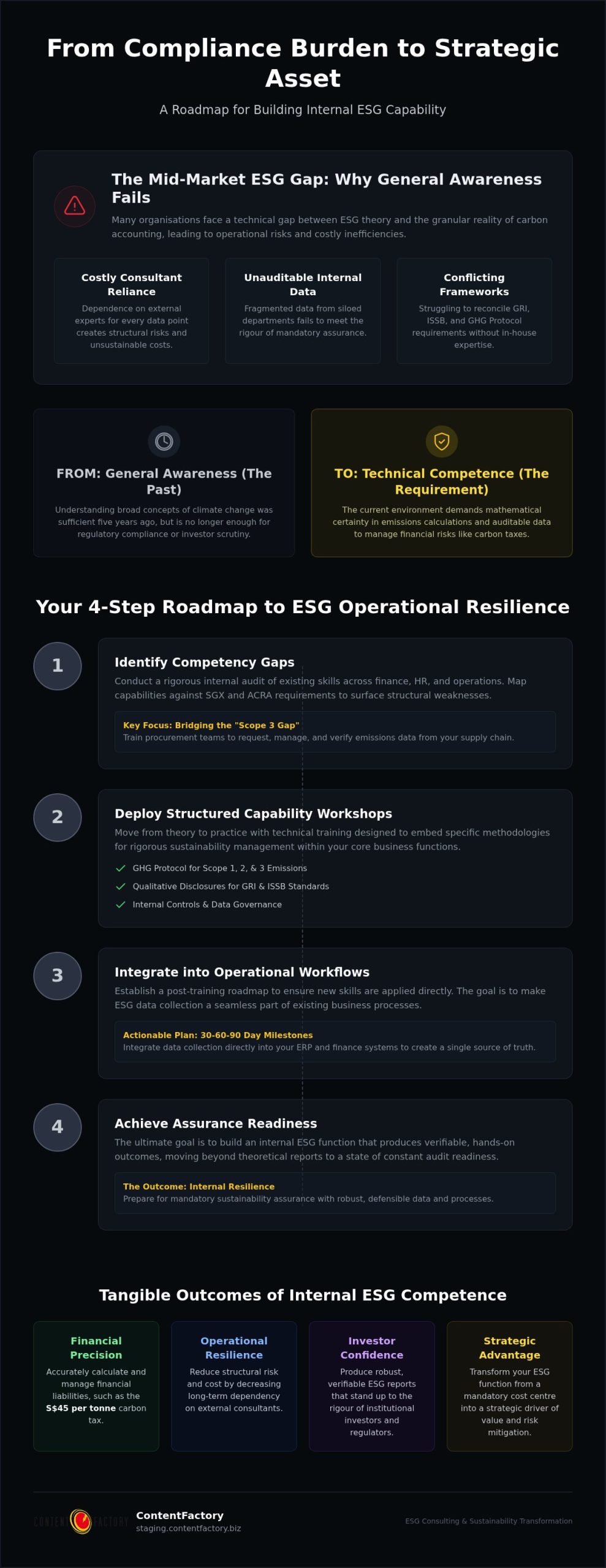
- Shift from general sustainability awareness to technical competence by focusing on specific reporting frameworks and robust data governance.
- Identify and bridge competency gaps across finance, HR, and operations to align internal talent with mandatory sustainability requirements.
- Utilise structured ESG capability building workshops to master the technical requirements of the GHG Protocol for Scope 1, 2, and 3 emissions.
- Establish a post-training roadmap with 30-60-90 day milestones to integrate ESG data collection directly into your existing ERP and finance systems.
- Build internal operational resilience and prepare for mandatory assurance readiness by moving from theoretical reports to verifiable, hands-on outcomes.
Defining ESG Capability Building for the Mid-Market
ESG capability building is the technical process of embedding sustainability expertise within your core business functions. It’s not a generic education initiative. It’s a strategic intervention designed to equip your internal teams with the specific methodologies required for rigorous Corporate sustainability management. For mid-market firms in Singapore, this means moving beyond the “why” of environmental impact and focusing on the technical “how” of data governance and financial alignment.
Effective ESG capability building workshops align your internal talent with ACRA and SGX requirements, ensuring that your reporting is both accurate and audit-ready. The primary objective is to reduce your long-term reliance on external consultants for recurring reporting cycles. By developing these skills in-house, you’re not just checking a compliance box; you’re building a resilient operational framework that can handle the complexities of mandatory sustainability assurance readiness without constant outside intervention.
Awareness vs. Technical Competence
General ESG awareness is no longer sufficient for regulatory compliance as we move into 2026. While understanding the broad concepts of climate change was acceptable five years ago, the current regulatory environment demands technical proficiency. You’ve moved past the stage of understanding why ESG matters to the stage where you must calculate Scope 1, 2, and 3 emissions with mathematical certainty. With the Singapore carbon tax set at S$45 per tonne for 2026 and 2027, the cost of data inaccuracy has tangible financial consequences.
Technical competence involves defining specific roles within your sustainability unit. This includes identifying who’s responsible for:
- Primary data collection from utility meters and fuel logs.
- Applying correct emission factors based on the GHG Protocol.
- Managing the internal control environment to prevent data gaps.
- Synthesising qualitative disclosures for GRI and ISSB standards.
Beyond environmental metrics, technical competence also extends to the ‘Social’ pillar of ESG, where specialized protocols are required for industrial health and safety. To see how these technical services are applied in high-stakes sectors, you can learn more about DL Safety.
The Role of Leadership in Capability Building
C-suite buy-in determines the ultimate success of internal ESG capability building and training. If the board views these workshops as a HR checkbox, the resulting data will lack the strategic depth required by institutional investors. Leadership must prioritise the integration of workshop outcomes with broader corporate strategy and financial goals. This ensures that the technical skills gained by the operations team translate into measurable growth and risk mitigation.
Directors must understand the legal and financial implications of ISSB and GRI disclosures. When leadership participates in the capability-building process, they’re better equipped to interpret ESG metrics as performance indicators rather than just compliance burdens. This top-down commitment creates a culture where data accuracy is valued, making the transition to operational readiness seamless and sustainable.
Identifying Competency Gaps in Your Sustainability Team
Most mid-market firms approach ESG by forming a committee of existing staff from various departments. While this ensures broad representation, it often reveals a fragmented understanding of technical requirements. You must conduct a rigorous internal audit of existing skills across finance, HR, and operations to surface where your team lacks the specific expertise required for mandatory reporting. Mapping these capabilities against SGX and ACRA requirements often reveals immediate structural weaknesses that software alone cannot fix.
The most significant hurdle for Singaporean businesses is the “Scope 3 gap.” This occurs where data collection from suppliers fails because your procurement team hasn’t been trained to request or verify emissions data. ESG capability building workshops provide the framework to bridge this gap, ensuring your team can produce audit-ready documentation that survives third-party assurance. If you’re unsure where your team stands, you can request a competency gap evaluation to identify high-risk areas before your next reporting cycle.
The Materiality Assessment Skill Set
Your team needs to master the materiality assessment for SMEs to avoid wasting resources on irrelevant metrics. This skill set involves identifying and prioritising ESG factors that directly impact financial performance and long-term resilience. It’s about more than just distributing a survey; it’s about engaging stakeholders effectively to validate materiality matrices. Without this technical ability, your sustainability report will lack the strategic depth required by institutional investors and lenders.
Data Governance and Internal Controls
There’s a wide gap between raw data collection and reporting-ready metrics. Internal protocols must be established to verify environmental and social data before it reaches the final report stage. Training staff to identify data anomalies early is critical for maintaining credibility. Much like the ESG Young Professional Training Program emphasises structured learning for impact, your internal programmes should focus on the verification of primary data sources and the application of correct emission factors. This ensures that every figure in your report is backed by a verifiable audit trail.
Critical Technical Modules for High-Impact ESG Workshops
High-impact ESG capability building workshops must move beyond high-level summaries to technical execution. They should be structured to mirror the rigour of ESG frameworks for public officials, where precision and accountability are paramount. For a mid-market firm, this means mastering the intersection of GRI, ISSB, and SASB standards within a single operational workflow. Rather than treating these as separate silos, your team must learn to collect data once and report it across multiple frameworks, ensuring consistency for both SGX filings and international investor inquiries.
Generic training fails to address the unique KPIs of sectors like manufacturing or logistics. High-impact modules focus on sector-specific metrics, such as energy intensity per unit of production or downstream transportation emissions. Incorporating sessions on mandatory sustainability assurance readiness is essential. This prepares your staff for the scrutiny of external audits. They learn how to maintain the evidence trails and control environments that auditors demand. This technical grounding ensures your sustainability report is a verifiable financial document rather than a marketing exercise.
Carbon Accounting and GHG Protocol Training
Your team cannot manage what they cannot measure. Workshops should provide hands-on training for carbon footprint calculation for business, focusing specifically on the GHG Protocol Corporate Standard. Participants must learn the mathematics of carbon equivalents and how to select appropriate emission factors for Scope 1, 2, and 3 activities. This involves setting clear organisational and operational boundaries to ensure no emissions are overlooked or double-counted. Mastering these calculations is a prerequisite for managing the financial impact of Singapore’s carbon tax trajectory.
Multi-Framework Reporting and Disclosure
Navigating the differences between GRI (impact materiality) and ISSB (financial materiality) is a core competency for modern sustainability teams. Training should focus on creating a unified data collection template that serves multiple frameworks simultaneously. This reduces administrative friction and ensures that your qualitative narratives are consistently backed by quantitative data. By structuring disclosures to meet both SGX requirements and international expectations, you move your organisation toward true operational readiness and reduce the risk of greenwashing allegations. Our multi framework sustainability reporting guide provides a detailed roadmap for consolidating GRI, ISSB, and ESRS requirements into a single, audit-ready disclosure system.
Transitioning from Theoretical Training to Operational ESG Workflows
Theoretical knowledge is only valuable when it’s applied to your specific operational realities. While ESG capability building workshops provide the technical foundation, the real work begins the day after training ends. You must avoid the common pitfall of treating training as an isolated event. Instead, use the technical momentum gained during these ESG capability building workshops to launch a structured 90-day implementation roadmap.
Establishing a permanent sustainability committee is the first step toward long-term operational readiness. This committee should include representatives from finance, procurement, and operations, with clear reporting lines to the C-suite. Their mandate is to move the organisation from annual, reactive reporting cycles to a model of continuous ESG performance monitoring. This shift allows you to identify and mitigate risks in real-time, ensuring your data remains audit-ready throughout the financial year. Your roadmap should include these specific milestones:
- 30 Days: Finalise the sustainability committee structure and assign data owners for each material ESG factor.
- 60 Days: Map data flows from primary sources to your central reporting system, identifying any remaining technical bottlenecks.
- 90 Days: Complete a full internal data audit to test the resilience of your new control environment.
Digital ESG Integration
Manual spreadsheets represent a significant risk to data integrity and auditability. They lack the robust version control and validation checks required for mandatory assurance. Digital ESG Integration and Automation is essential for scaling your sustainability efforts without ballooning administrative costs. By integrating ESG data collection directly into your existing ERP and finance systems, you ensure that environmental metrics are treated with the same rigour as financial data. Choosing the right digital tools empowers your newly trained team to focus on strategic analysis rather than manual data entry.
Change Management and Organisational Culture
Technical competence must be supported by a shift in organisational culture. You’ll likely encounter internal resistance to new data collection requirements, particularly from teams who view ESG as an additional administrative burden. Overcoming this requires clear communication regarding the value of ESG competence to the wider workforce. You should consider incentivising sustainability performance at the department level to align individual goals with corporate targets. When staff understand that data precision directly impacts the company’s S$45 per tonne carbon tax exposure, the transition to new workflows becomes a collective priority.
ESG Capability Building and Training with ContentFactory
ContentFactory provides pragmatic, senior-led workshops designed specifically for Singaporean mid-market firms and SMEs. These sessions are led by a Singapore Certified Management Consultant (SCMC) with over 25 years of experience, ensuring that every module is grounded in strategic management principles rather than abstract theory. Our primary objective is operationalising ESG within your organisation, moving your team beyond the standard theoretical slide decks toward measurable, audit-ready outcomes. We position our ESG capability building workshops as a dedicated extension of your leadership team, acting as an execution engine for your sustainability transformation.
Our firm helps you build deep internal competencies in carbon accounting, materiality assessments, and multi-framework reporting across GRI, ISSB, SASB, and ESRS standards. We recognize that mid-market firms face unique resource pressures, so we focus on the technical “doing” rather than just the “reporting.” By the end of our programme, your staff will have the skills to manage Scope 1, 2, and 3 emissions data with the same rigour applied to your financial accounts. This technical independence reduces your long-term reliance on external vendors and prepares your business for the scrutiny of mandatory sustainability assurance.
Workshops are tailored to your specific sector to ensure maximum relevance. In manufacturing, we prioritise energy intensity and waste management protocols. For logistics firms, we focus on downstream transportation emissions and fuel efficiency tracking. In the technology sector, we address data centre energy usage and electronic waste management. This sector-specific approach ensures that the KPIs and data collection methods taught are immediately applicable to your daily operational workflows, preventing the training fatigue often associated with generic ESG courses.
Bridging the Gap Between Vision and Value
ContentFactory ensures your team is technically ready for the upcoming regulatory shifts in 2026 and 2027. We bridge the gap between high-level corporate vision and the granular value found in operational efficiency. Working with an SCMC provides your organisation with expert-led stability, ensuring your ESG strategy aligns with both Singaporean government frameworks and global investor expectations. We don’t just teach you how to report; we teach you how to integrate these metrics into your core business processes to drive long-term resilience and growth.
ContentFactory supports your business through every stage of the sustainability journey, from initial readiness assessments to the technical execution of ESG Capability Building and Training programmes. We focus on creating a resilient internal control environment that satisfies the requirements of ACRA and SGX RegCo. For qualifying sustainability projects, you may be eligible for up to 70% funding support through the Enterprise Development Grant (EDG). Book a 30-minute discovery call to discuss your organisation’s technical training needs.
Grant quantum, support levels and eligibility criteria are set by the relevant Singapore government agencies and are subject to change. Eligibility is assessed case by case.
Operationalising Sustainability for Long-Term Resilience
Transitioning from theoretical ESG awareness to technical competence is a critical step in future-proofing your business. You’ve identified that bridging competency gaps and integrating data governance into your core workflows are essential for maintaining audit-ready reporting. By internalising these skills, you ensure that your organisation remains resilient in the face of Singapore’s evolving regulatory landscape and carbon tax trajectory.
ContentFactory delivers this transformation through senior-led ESG capability building workshops. Our programmes are directed by a Singapore Certified Management Consultant with 25 years of experience and a proven track record of helping local SMEs navigate complex reporting requirements. For qualifying sustainability projects, your organisation may access up to 70% funding support through the Enterprise Development Grant (EDG). We act as a pragmatic extension of your leadership team, turning compliance burdens into measurable operational value.
Your journey toward operational ESG readiness starts with a single technical intervention. Building these internal capabilities today will define your competitive advantage in the green economy of tomorrow.
Grant quantum, support levels and eligibility criteria are set by the relevant Singapore government agencies and are subject to change. Eligibility is assessed case by case.
Frequently Asked Questions
What is the primary goal of an ESG capability building workshop?
The primary goal is the technical operationalisation of sustainability within your business. Unlike general awareness training, these workshops focus on equipping your internal team with the specific skills needed to manage carbon accounting, materiality assessments, and multi-framework reporting independently. By the end of the programme, your staff should be able to produce audit-ready data that meets SGX and ACRA requirements. This reduces your long-term reliance on external consultants for recurring reporting cycles.
How long does it typically take to build internal ESG competence?
Building foundational ESG competence usually requires a structured 90-day implementation roadmap following the initial training. While the core technical modules in ESG capability building workshops can be delivered over several days, the internalisation of data governance and reporting workflows takes longer. You’ll spend the first 30 days assigning data owners, the next 30 days mapping data flows from primary sources, and the final 30 days conducting an internal audit to ensure your control environment is resilient.
Does our business need a dedicated ESG officer before attending a workshop?
No, you don’t need a dedicated ESG officer to start. Most mid-market firms begin by training a cross-functional committee that includes representatives from finance, operations, and procurement. This approach ensures that sustainability data is integrated into existing business systems rather than siloed in one department. The workshops provide the technical framework necessary for these existing staff members to manage sustainability metrics alongside their current roles, eventually helping you define if a dedicated head is required.
What is the difference between GRI and ISSB training in these workshops?
GRI training focuses on impact materiality, which measures how your organisation affects the economy, environment, and people. In contrast, ISSB training focuses on financial materiality, specifically how sustainability risks and opportunities impact your company’s financial value. ESG capability building workshops at ContentFactory teach your team to navigate both frameworks simultaneously. This multi-framework approach ensures your disclosures satisfy both the broad expectations of stakeholders and the specific climate-related requirements of international investors. For a comprehensive overview of how to align these standards without duplicating effort, refer to the SG multi-framework sustainability reporting guide for 2026.
Can these workshops help our firm prepare for external sustainability assurance?
Yes, these workshops are specifically designed to build mandatory sustainability assurance readiness. Training focuses on establishing a robust internal control environment and maintaining clear evidence trails for every disclosure. Your team learns how to verify primary data sources and apply correct emission factors according to the GHG Protocol. This technical rigour ensures that when external auditors review your report, the underlying data is verifiable, accurate, and survives the scrutiny of a third-party assurance engagement.
Are these workshops suitable for SMEs with limited sustainability budgets?
These workshops are highly suitable for SMEs because they prioritise technical independence over expensive, recurring consulting fees. By building internal competencies, you reduce the long-term costs associated with annual reporting cycles. Additionally, Singaporean SMEs may access up to 70% funding support for qualifying sustainability projects through the Enterprise Development Grant (EDG). This makes high-level strategic training accessible, allowing you to develop a professional sustainability function without the overhead of global multi-national firms.
How do we measure the ROI of ESG capability building?
You measure ROI through increased operational efficiency and reduced compliance risks. Concrete metrics include the reduction in man-hours spent on manual data collection and the avoidance of inaccuracies that could lead to higher carbon tax liabilities. With Singapore’s carbon tax set at S$45 per tonne for 2026 and 2027, precise data management is a direct cost-saving measure. Improved ESG ratings can lead to better access to sustainable finance and stronger relationships with institutional clients. Firms looking to strengthen their disclosure practices should also understand how GRI framework sustainability reporting can transform compliance obligations into a blueprint for operational resilience and stakeholder trust.
Grant quantum, support levels and eligibility criteria are set by the relevant Singapore government agencies and are subject to change. Eligibility is assessed case by case.
Article by
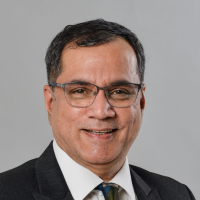
Mayuresh Godse
Mayuresh Godse is a Singapore Certified Management Consultant and Business Strategist specializing in Sustainability, ESG, AI-driven Digital Transformation, and business growth. Based in Singapore, he writes about Sustainability, Digital Innovation, Business Strategy, and Content Marketing for global audiences.
Disclaimer
This article is provided by ContentFactory for general information only and is not legal, tax, accounting or financial advice. Regulations and government scheme criteria change; grant eligibility and quantum are set by the relevant Singapore agencies and assessed case by case, with no outcome guaranteed. Verify current requirements before acting.
One thing worth checking on the tool side: if the disclaimer is switched on globally, the grant caveat already written into your Global Writing Instructions will appear as well, so grant articles will carry the same point twice. Remove the required-disclaimer section from the instructions file if you enable this one.