

You need to upgrade your business capabilities to compete in 2026, but the cost of transformation is a significant barrier. The Enterprise Development Grant (EDG) offers a solution, yet many business owners find the application process complex and the risk of rejection high. Successfully securing the grant requires more than form-filling; it demands a strategic approach to project scoping, financial justification, and meticulous documentation.
Master the complexities of the EDG with a pragmatic, results-led advisory approach that scales your business. This guide moves beyond administrative checklists to focus on architecting high-impact transformation projects that Enterprise Singapore is positioned to fund. We will break down the eligibility criteria, proposal development, and the critical claims process to help you leverage the grant as a strategic growth lever.
Navigating the Enterprise Development Grant (EDG) Landscape in 2026
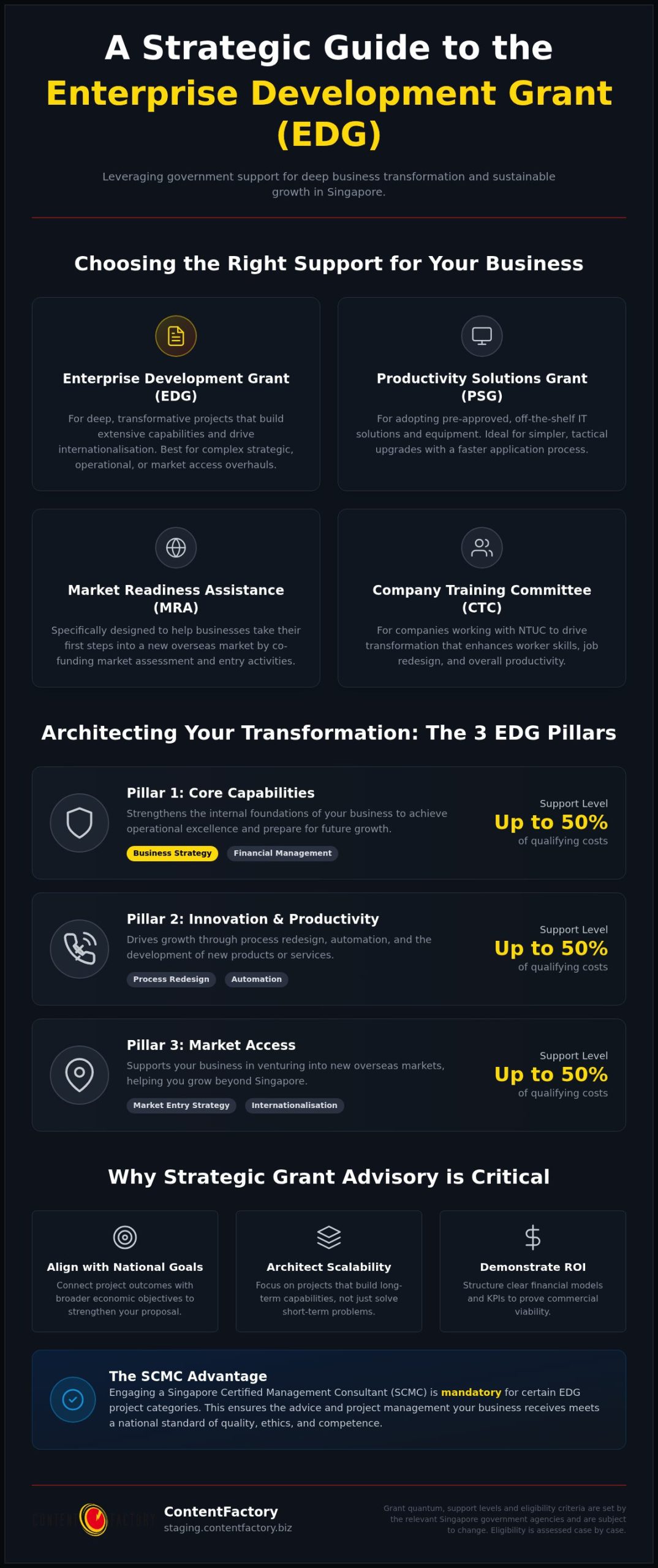
The Enterprise Development Grant (EDG) is a key Singapore government initiative designed to help small and medium-sized enterprises (SMEs) build capabilities, innovate, and expand overseas. In the competitive 2026 business environment, using the EDG is not just about offsetting costs; it is a strategic tool for funding essential transformation projects that drive efficiency, growth, and market resilience. However, navigating the requirements demands a shift from simple “grant hunting” to strategic business engineering.
Many applications are rejected not because the project is unworthy, but because the business case is poorly articulated. This is where professional enterprise development grant advisory becomes critical. An experienced advisor helps frame your business goals in a language that aligns with the grant’s objectives, ensuring your proposal is robust, compliant, and compelling.
The Strategic Shift: Why Grant Advisory Matters Now
The EDG supports projects across three core pillars: Core Capabilities, Innovation and Productivity, and Market Access. A successful application demonstrates a clear link between the proposed project and tangible business outcomes that align with Enterprise Singapore’s national economic goals. The objective is to move your business from a survival footing to a high-growth, scalable model.
- Aligning with National Goals: Advisors help connect your project outcomes—such as improved productivity or new market entry—with broader economic objectives, strengthening your proposal.
- Architecting Scalability: The focus is on projects that build long-term capabilities, not just solve short-term problems. This could involve process reengineering or adopting new technologies.
- Demonstrating ROI: A well-structured proposal includes clear financial models and key performance indicators (KPIs) to prove the project’s commercial viability and return on investment.
The Value of a Singapore Certified Management Consultant (SCMC)
For certain project categories under the EDG, engaging a management consultant with the Singapore Certified Management Consultant (SCMC) certification is a mandatory requirement. This ensures that the advice and project management your business receives meets a national standard of quality, ethics, and competence.
- Mandatory Engagement: SCMC certification is often a prerequisite, making the choice of consultant a critical first step.
- Identifying Blind Spots: A certified consultant acts as a strategic partner, analysing your operations to identify inefficiencies or growth opportunities you may have overlooked.
- Strategic Partner vs. Vendor: A vendor executes a task. A strategic advisor helps you define the task, structure the project for success, and navigate the entire grant lifecycle from application to claims.
Comparing Key Business Grants: EDG, PSG, MRA, and CTC
Understanding the grant landscape is crucial to selecting the right support for your business needs. While the EDG is for deep, transformative projects, other grants serve different purposes. Choosing the correct scheme is the first step towards a successful application.
- Enterprise Development Grant (EDG): Focuses on extensive projects for deep capability building and internationalisation. It requires detailed proposals and is suited for complex transformations in strategy, operations, and market access.
- Productivity Solutions Grant (PSG): Supports the adoption of pre-approved, off-the-shelf IT solutions and equipment. The PSG is for simpler, tactical upgrades with a faster application process.
- Market Readiness Assistance (MRA) Grant: Specifically designed to help businesses take their first steps into a new overseas market. It co-funds activities like market assessment and participation in trade fairs.
- Company Training Committee (CTC) Grant: Aimed at companies that form committees with the National Trades Union Congress (NTUC) to drive business transformation that enhances worker skills and productivity.
A strategic advisor can help you determine the most suitable grant or even explore how to structure a long-term growth roadmap by phasing projects across different grant schemes, a practice known as grant stacking.
The Three Pillars of EDG: Architecting Your Transformation Project
The EDG is structured around three pillars that represent the core areas of business growth. A strong proposal must be clearly categorised under one of these pillars, with project activities and outcomes directly supporting its objectives. An enterprise development grant advisory service helps you scope the project accurately to fit within this framework.
Pillar 1: Core Capabilities
This pillar focuses on strengthening the internal foundations of your business to achieve operational excellence. Projects under this category are about building a strong, scalable organisation ready for future growth. Support is available for up to 50% of qualifying project costs.
- Business Strategy Development: Engaging consultants to facilitate strategic planning, identify new revenue streams, or develop a robust corporate roadmap.
- Financial Management: Implementing advanced financial modelling, cash flow management systems, or preparing for fundraising rounds, often with the support of specialized advisors for founder-led firms like foundedpartners.com.
- Human Capital Development: Overhauling HR processes, implementing performance management frameworks, or designing employee compensation and benefits structures.
- Business Process Reengineering: Analysing and redesigning core workflows to eliminate waste, reduce costs, and improve service delivery.
- Strategic Brand and Marketing Development: Developing a comprehensive brand strategy, conducting market research, and creating a go-to-market plan for B2B growth.
Pillar 2: Innovation and Productivity
This pillar is for projects that use technology and innovation to create new products, services, or more efficient processes. The goal is to enhance your competitive edge through digital transformation and operational automation. Support is available for up to 50% of qualifying costs.
- Product Development: Undertaking research and development (R&D) to design and launch new products or services.
- Process Redesign and Automation: Implementing technologies like robotic process automation (RPA) or enterprise resource planning (ERP) systems to streamline operations.
- Adoption of Technology: Integrating solutions that improve data analytics, cybersecurity, or supply chain management.
Additionally, Enterprise Singapore offers enhanced support for qualifying projects in sustainability. Companies undertaking projects such as the adoption of sustainability standards or developing decarbonisation roadmaps may be eligible for funding of up to 70% of qualifying costs.
Pillar 3: Market Access
For businesses ready to expand beyond Singapore, this pillar supports the activities required to enter new international markets successfully. It is designed to de-risk overseas ventures and provide a structured approach to regionalisation. Support is available for up to 50% of qualifying project costs.
- Market Entry Feasibility Studies: Conducting in-depth research to assess the potential of a target overseas market, including competitor analysis and regulatory reviews.
- Overseas Marketing and PR: Launching targeted marketing campaigns or participating in international trade shows to build brand presence in a new country.
- Local Set-Up: Co-funding the costs associated with establishing an initial physical presence in an overseas market.
Eligibility and Financial Viability: Building a Strong Case
Meeting the basic eligibility criteria is only the starting point. Enterprise Singapore conducts a rigorous assessment of each applicant’s financial health and the commercial viability of the proposed project. A weak business case or poor financial standing are common reasons for rejection.
- The business must be registered and operating in Singapore.
- It must have a minimum of 30% local shareholding (direct or indirect).
- The business must be in a financially viable position to start and complete the project.
The 30% Local Equity Requirement
This rule requires that at least 30% of the company’s ultimate ownership is held by Singapore Citizens or Permanent Residents. For SMEs with complex corporate shareholding structures, demonstrating this can be challenging. An advisor can help navigate these complexities and ensure your ownership structure is presented clearly and accurately in the application.
Demonstrating Financial Viability
This is the most critical and often misunderstood part of the assessment. Enterprise Singapore needs to see that your company has the financial resources and stability to not only co-fund the project but also to sustain operations and capitalise on the project’s outcomes. You will be required to submit recent audited financial statements through the Business Grants Portal.
- Healthy Financial Ratios: The assessment will likely review key metrics such as your current ratio (liquidity), debt-to-equity ratio (leverage), and net profit margin (profitability).
- Positive Cash Flow: Your statements should demonstrate sufficient working capital to manage project expenses, as the grant is disbursed on a reimbursement basis.
- Financial Modelling: For larger projects, submitting a financial model that projects the impact of the project on your revenue and profitability can significantly strengthen your case.
A consultant can help you prepare and present your financial information, highlighting strengths and providing context for any weaknesses to build a convincing case for your company’s long-term viability.
The EDG Application and Claims Process: A Pragmatic Roadmap
A successful EDG journey depends on a structured, methodical approach from initial scoping to final claims. A misstep at any stage can lead to delays or even the withdrawal of the grant offer. Following a clear roadmap is essential for managing the process efficiently.
Step 1: Scoping for Success
Before writing the proposal, you must define the project with precision. This involves setting clear objectives, milestones, and KPIs that are both ambitious and realistic. This is also the stage where you define the “Qualifying Costs.”
- Qualifying Costs: Typically include third-party consultancy fees, software and equipment costs directly related to the project, and the internal manpower costs for your project management team.
- Clear KPIs: Instead of vague goals like “improve efficiency,” use specific metrics such as “reduce order processing time by 25% within 12 months.”
- Realistic Timelines: A detailed project timeline with key phases and deliverables shows the assessors that the project is well-planned and manageable.
Step 2: Proposal Submission and Approval
With the project scope defined, the next step is to prepare a detailed proposal and submit it through the Business Grants Portal (BGP). The proposal should articulate the business challenge, the proposed solution, and the expected commercial outcomes. After submission, Enterprise Singapore will assess the application, which can take several weeks to months. You may be asked for additional clarification during this period.
Step 3: Managing the Claims and Audit Phase
Once the project is approved and the Letter of Offer is accepted, you can begin work. However, meticulous record-keeping is vital for a successful claim. The EDG operates on a reimbursement model, meaning you must pay vendors first and then claim the supported amount from Enterprise Singapore.
- Required Documentation: You will need to submit invoices, payment receipts, bank statements, project reports, and other evidence to prove that the work was done and paid for.
- Project Variations: If there are any significant changes to the project scope or timeline, you must seek approval from Enterprise Singapore in advance. Failure to do so can jeopardise your claims.
- Final Audit: Upon project completion, you submit the final claims report. Enterprise Singapore will audit the documentation to ensure it aligns with the approved project scope before disbursing the funds. A consultant can provide crucial post-approval audit and compliance support to ensure this final step is smooth.
ContentFactory: Your Strategic EDG Advisory Partner
Successfully securing and managing an Enterprise Development Grant requires more than administrative support; it demands a strategic partner who understands how to build a compelling business case. ContentFactory provides expert, hands-on enterprise development grant advisory for Singapore SMEs and mid-market firms. Led by a Singapore Certified Management Consultant (SCMC), our approach is built on a deep understanding of business operations, financial modelling, and the specific assessment criteria used by Enterprise Singapore.
We work as an extension of your leadership team to scope high-impact projects, develop robust financial justifications, and manage the entire application and claims process. Our focus is on turning your strategic vision into a funded, measurable, and executable plan that delivers tangible commercial growth. We help you navigate the complexities of the grant landscape, ensuring your project is not only compliant but positioned for approval.
Book a Strategic Consultation to discuss how we can structure your business transformation for EDG funding.
Frequently Asked Questions (FAQs)
- What is the maximum support level for the EDG in 2026?
For most projects under Core Capabilities, Innovation and Productivity, and Market Access, the EDG provides support for up to 50% of qualifying costs. For qualifying projects related to sustainability, the support level may be up to 70%. These levels are set by Enterprise Singapore and are subject to change.
- How does EDG differ from the Productivity Solutions Grant (PSG)?
EDG is for deep, customised transformation projects that require strategic development and implementation (e.g., business process reengineering, overseas market entry). PSG is for adopting simple, pre-approved, off-the-shelf technology solutions to improve productivity.
- Can I apply for multiple EDG projects at the same time?
Yes, a company can apply for multiple EDG projects. However, each application is assessed on its own merits. You must demonstrate that your company has sufficient resources (financial and manpower) to undertake all projects concurrently.
- How long does the EDG application approval process typically take?
The processing time can vary depending on the complexity of the project and the completeness of the application. It typically takes between 8 to 12 weeks from the date of submission, but this is an estimate and not a guarantee.
- What are the most common reasons for EDG application rejection?
Common reasons include a lack of demonstrated financial viability, a poorly defined project scope with unclear outcomes, a weak business case that does not justify the costs, and failure to meet the 30% local shareholding requirement.
- Do I need to pay the consultant upfront before the grant is disbursed?
Yes. The EDG works on a reimbursement basis. Your company must pay for all project costs, including consultancy fees, first. You can then submit the proof of payment to Enterprise Singapore to claim the grant amount.
- What happens if my EDG project fails to meet its KPIs?
If a project does not meet the agreed-upon KPIs outlined in the Letter of Offer, Enterprise Singapore has the right to reduce the grant amount or even claw back funds that have already been disbursed. It is crucial to set realistic KPIs and manage the project effectively to achieve them.
Disclaimer: Grant quantum, support levels and eligibility criteria are set by the relevant Singapore government agencies and are subject to change. Eligibility is assessed case by case.
Article by
Mayuresh Godse
Mayuresh Godse is a Singapore Certified Management Consultant and Business Strategist specializing in Sustainability, ESG, AI-driven Digital Transformation, and business growth. Based in Singapore, he writes about Sustainability, Digital Innovation, Business Strategy, and Content Marketing for global audiences.
Disclaimer
This article is provided by ContentFactory for general information only and is not legal, tax, accounting or financial advice. Regulations and government scheme criteria change; grant eligibility and quantum are set by the relevant Singapore agencies and assessed case by case, with no outcome guaranteed. Verify current requirements before acting.
One thing worth checking on the tool side: if the disclaimer is switched on globally, the grant caveat already written into your Global Writing Instructions will appear as well, so grant articles will carry the same point twice. Remove the required-disclaimer section from the instructions file if you enable this one.