

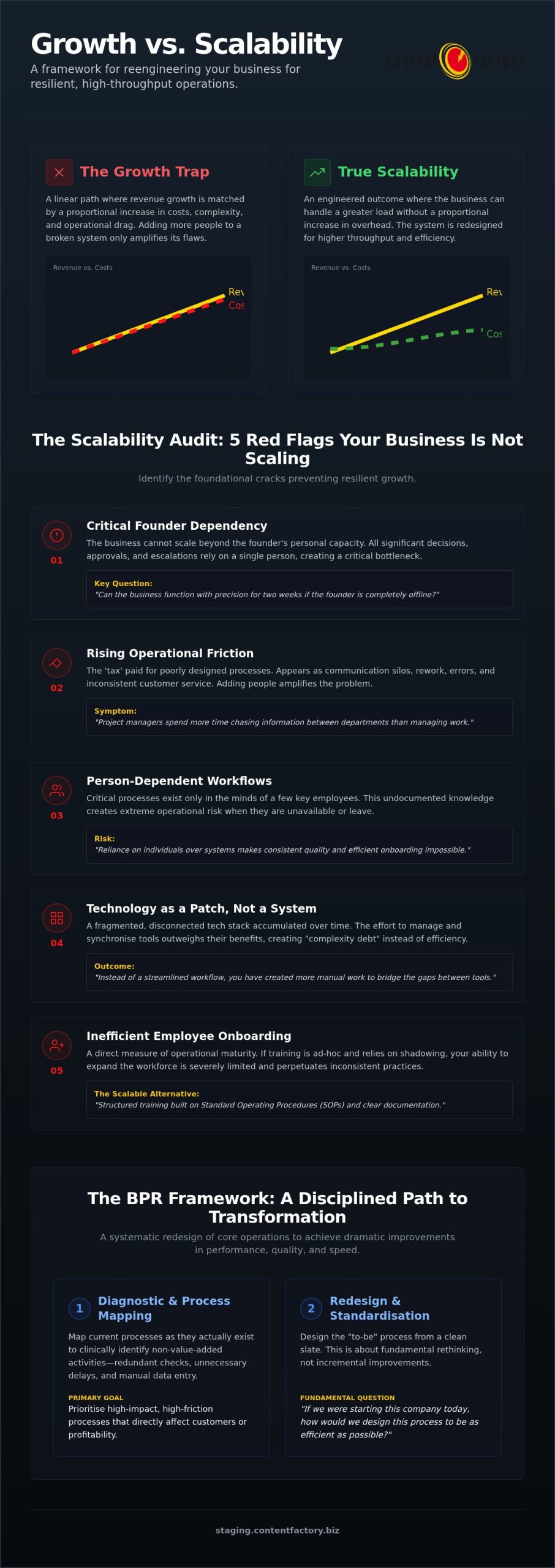
As your business grows, you face a critical juncture. You can either continue adding people and resources at the same rate as revenue, a linear path that leads to increased complexity and diminishing returns. Or, you can reengineer the operational architecture of your business to handle a greater load without a proportional increase in overhead. The first path is growth. The second is scalability.
Many founders and CEOs find themselves in the “growth trap”: revenue is climbing, but so are costs, friction, and the personal burden on leadership. The systems that worked for a team of ten begin to fracture with a team of fifty. This is not a failure of effort, but a failure of design. Your business is not a machine that can be run faster; it is a system that must be redesigned for a higher throughput.
True scalability is the ability of a system to handle an increased load without structural failure. It is an engineered outcome, achieved through a disciplined approach to digital transformation and process redesign. This checklist provides a pragmatic framework for diagnosing your operational bottlenecks and rebuilding your business for scalable, resilient growth in 2026.
The Scalability Audit: 5 Red Flags Your Business Is Growing, Not Scaling
Before you can build, you must diagnose. These five red flags indicate that your company’s foundational processes are cracking under the pressure of growth, creating operational drag that prevents true Scalability. Identifying them is the first step toward meaningful transformation.
Red Flag 1: Critical Founder Dependency
The most common and dangerous bottleneck in a growing mid-market firm is the founder. If you are the central node for all significant decisions, approvals, and client escalations, the business cannot scale beyond your personal capacity. This dependency manifests as delayed decisions, stalled projects when you are unavailable, and a team that is hesitant to take ownership.
To scale, you must transition from being the “chief doer” to the “strategic architect.” This requires building systems and empowering leaders who can execute reliably without your constant intervention. If your business cannot function with precision for two weeks while you are completely offline, you have a dependency problem, not a scalable organisation.
Red Flag 2: Rising Operational Friction
Operational friction is the tax you pay for poorly designed processes. It appears as communication silos between departments, an increase in rework or errors, and customer complaints about inconsistent service. As you add more people to a broken process, you do not solve the problem; you amplify it. The cost of this “information friction” is not just wasted time and money, but also declining morale and employee burnout.
Symptoms include sales teams promising features that operations cannot deliver, finance struggling to reconcile data from disparate systems, and project managers spending more time chasing information than managing work. This is a clear sign that your internal workflows are no longer fit for purpose.
Red Flag 3: Person-Dependent Workflows
In many growing businesses, critical processes exist only in the minds of a few key employees. Their institutional knowledge and undocumented workarounds are essential for getting things done. While valuable, this creates extreme operational risk. When a key person is on leave, overloaded, or resigns, the process grinds to a halt or fails completely.
This reliance on individuals over systems makes consistent quality impossible to maintain and efficient onboarding of new staff a significant challenge. A scalable business runs on documented, standardised processes that anyone with the right training can execute, ensuring resilience and predictability.
Red Flag 4: Technology as a Patch, Not a System
Reacting to operational pain points by adding another piece of software is a common mistake. Over time, this leads to a fragmented and disconnected tech stack. You may have one tool for CRM, another for project management, and a series of spreadsheets to bridge the gaps. This creates “complexity debt,” where the effort required to manage and synchronise the tools outweighs their benefits.
Instead of a streamlined workflow, you have created more work. Data must be manually transferred, reports are difficult to consolidate, and there is no single source of truth. Technology should be a force multiplier for a well-designed process, not a digital patch on a broken one.
Red Flag 5: Inefficient Employee Onboarding
How quickly and effectively you can onboard a new team member is a direct measure of your operational maturity. If training is an ad-hoc process that relies on shadowing a senior employee, your ability to scale your workforce is severely limited. It is time-consuming for both the new hire and the experienced team member, and it perpetuates inconsistent practices.
A scalable organisation has Standard Operating Procedures (SOPs), clear documentation, and structured training programmes. This allows new staff to become productive, value-adding members of the team quickly and predictably, enabling the business to expand its human resources without a corresponding drop in quality or efficiency.
The BPR Framework: A Disciplined Sequence for Transformation
Once you have identified the red flags, the solution is not a series of quick fixes but a systematic redesign of your core operations. Business Process Reengineering (BPR) provides a structured methodology for this transformation. It involves fundamentally rethinking and redesigning how your organisation works to achieve dramatic improvements in performance, quality, and speed.
Step 1: Diagnostic and Process Mapping
You cannot fix what you do not understand. The first phase of any BPR initiative is to map your current processes as they actually exist, not as you believe they should. This involves identifying every step, decision point, and handoff in a given workflow, from customer inquiry to final delivery.
The goal is to prioritise which processes to reengineer first. Focus on those that are high-impact (directly affecting customers or profitability) and high-friction (causing the most delays, errors, or internal frustration). By mapping the value stream, you can clinically identify non-value-added activities—redundant checks, unnecessary delays, and manual data entry—that can be eliminated.
Step 2: Redesign and Standardisation
With a clear map of the “as-is” state, the next step is to design the “to-be” process. This is not about making incremental improvements; it is about cleaning the slate. Ask the fundamental question: “If we were starting this company today, how would we design this process to be as efficient and effective as possible?” This is where expert-led business process reengineering is critical.
The output of this phase is a new, streamlined workflow, documented in clear Standard Operating Procedures (SOPs). Think of SOPs as the “source code” of your business—a precise set of instructions that ensures tasks are performed consistently and correctly every time. This standardisation is the bedrock of quality control, training, and future automation.
Step 3: System Selection and Technology Integration
Only after you have redesigned the process should you consider technology. Automating a bad process only allows you to make mistakes faster and at a greater scale. With a clean, optimised workflow defined, you can now select and implement technology that directly supports and enables that process.
This might involve configuring your existing ERP system correctly, implementing a new CRM that automates lead-to-contract workflows, or using AI-powered tools for predictive operational management. The key is a strategy-led approach to technology adoption and system integration, ensuring that software serves the process, not the other way around. This avoids the “complexity debt” of over-engineered or poorly chosen tools.
To ensure your new workflows are supported by professional design and custom development, you can discover Brandingsys.
Managing the Human Element of Digital Transformation
A redesigned process or a new software system is useless if your team does not adopt it. The human element is often the most challenging aspect of digital transformation. Proactive change management is not an optional extra; it is essential for realising the return on your investment in BPR.
Overcoming Resistance to New Systems
Employee resistance is a natural reaction to change. It is often rooted in a fear of the unknown, concern about job security, or the perceived inconvenience of learning a new system. Simply mandating the change is rarely effective. Successful change management involves addressing these concerns head-on.
- Communicate the “Why”: Clearly articulate the problems with the old process and the specific benefits the new system will bring—not just to the company, but to the employees themselves (e.g., less manual work, fewer errors, less frustration).
- Secure Stakeholder Buy-In: Involve key team members from affected departments in the redesign and selection process. When they feel a sense of ownership, they become champions for the change rather than obstacles.
- Provide Comprehensive Training: Invest in proper training that goes beyond a single demonstration. Offer ongoing support, documentation, and a clear point of contact for questions as the team adapts to the new way of working.
Setting Realistic Timelines and Expectations
Business process reengineering is a strategic project, not an overnight fix. Setting unrealistic expectations can lead to disillusionment and damage the credibility of the initiative. A typical BPR project for a core process in a mid-market firm follows distinct phases and requires patience.
A realistic timeline includes phases for discovery and mapping (weeks), redesign and validation (weeks to months), system selection and implementation (months), and a phased rollout with pilot testing. Communicating this timeline clearly to the entire organisation helps manage expectations and demonstrates a thoughtful, deliberate approach to transformation. An iterative rollout, starting with a single department or team, allows you to refine the process and build momentum from early successes.
Building a scalable business is a deliberate act of strategic design. It requires moving beyond the reactive mindset of day-to-day growth and adopting the proactive discipline of an architect. For those looking to apply this mindset to the federal marketplace, you can learn more about The GovCon Architect to see how strategic consulting helps firms win U.S. government contracts. By systematically identifying your operational weaknesses, reengineering your core processes, and thoughtfully integrating technology, you build an organisation that is resilient, efficient, and capable of handling future growth without buckling under the strain. The practical first step is to choose one critical process, map its failures, and commit to its redesign.
ContentFactory provides the execution-focused expertise needed for a successful digital transformation. Led by a Singapore Certified Management Consultant, our approach is pragmatic and results-led, focusing on redesigning the core processes that unlock scalable growth and operational resilience for SMEs and mid-market firms.
Frequently Asked Questions
-
What is the difference between business growth and business scalability?
Business growth is linear; it typically involves adding resources (people, capital, assets) at the same rate that you add revenue. Your costs increase in direct proportion to your income. Business scalability is the ability to increase revenue at an exponential rate while your costs remain relatively flat or increase only marginally. It is achieved by building systems and processes that can handle a higher volume of work without requiring a proportional increase in labour or overhead.
-
When is the right time to seek business process reengineering services?
The right time is when you begin to feel the “friction” of growth. Key triggers include seeing your profit margins shrink despite rising revenue, experiencing a decline in quality or customer satisfaction, finding that the founder has become a bottleneck for all decisions, or realising that your current processes cannot handle a sudden increase in demand. It is best to be proactive before these issues become critical failures.
-
What are the common pitfalls in reengineering a mid-market firm?
The most common pitfalls include: failing to get buy-in from the employees who will use the new processes; automating a flawed process instead of redesigning it first; choosing technology based on trends rather than strategic needs; underestimating the importance of change management and training; and lacking a clear vision of the desired “to-be” state, which leads to unfocused, incremental changes rather than a fundamental transformation.
-
What is the correct sequence for a digital transformation project?
The correct sequence is always Strategy → Process → Technology. First, define your business strategy and goals (Strategy). Second, map and redesign the operational processes required to achieve those goals efficiently (Process). Only then, as a third step, should you select and implement the technology that best supports the new, optimised process (Technology). Reversing this order is a common and costly mistake.
-
How long does a typical process reengineering project take?
The duration varies depending on the complexity of the process and the size of the organisation. For a single, critical process within a mid-market firm (e.g., order-to-cash), a project can take anywhere from three to six months. This typically includes a diagnostic and mapping phase, a redesign phase, and an initial implementation or pilot phase. Company-wide transformations can take a year or more and are best handled iteratively.
-
How do you manage employees who resist new systems and processes?
Effective management of resistance requires communication, inclusion, and support. Clearly explain the rationale behind the change, focusing on the benefits to the employees and the company. Involve them in the design and testing phases to create a sense of ownership. Provide robust training and readily available support during the transition. Finally, ensure that leadership consistently uses and champions the new system, demonstrating its importance.
-
How can we avoid buying expensive software that just adds more work?
Avoid this by completing the process redesign *before* you start shopping for software. When you have a clearly documented “to-be” process, you can create a detailed list of functional requirements. Use this list to evaluate potential software solutions. This ensures you are buying a tool that fits your optimised workflow, rather than being forced to change your process to fit the limitations of a new tool. Always prioritise solutions that integrate well with your existing systems to avoid creating new data silos.

Article by
Mayuresh Godse
Mayuresh Godse is a Singapore Certified Management Consultant and Business Strategist specializing in Sustainability, ESG, AI-driven Digital Transformation, and business growth. Based in Singapore, he writes about Sustainability, Digital Innovation, Business Strategy, and Content Marketing for global audiences.
Disclaimer
This article is provided by ContentFactory for general information only and is not legal, tax, accounting or financial advice. Regulations and government scheme criteria change; grant eligibility and quantum are set by the relevant Singapore agencies and assessed case by case, with no outcome guaranteed. Verify current requirements before acting.
One thing worth checking on the tool side: if the disclaimer is switched on globally, the grant caveat already written into your Global Writing Instructions will appear as well, so grant articles will carry the same point twice. Remove the required-disclaimer section from the instructions file if you enable this one.