

A board that tries to manage every ESG action can weaken oversight rather than strengthen it. Effective board oversight of ESG risks means setting clear accountability, challenging management’s response and monitoring the issues that could affect the business.
Uncertainty is part of the challenge. ESG reports can contain extensive data without making clear what decisions directors need to take. Emerging issues can also leave boards unsure which questions to ask. Directors do not need to become operational specialists. They do need to define what the board and its committees oversee, what management executes and how material risks reach the board.
This guide sets out practical ways to focus oversight on material ESG risks, ask management about controls and responses, and connect monitoring to business decisions. It also considers how Singapore’s phased climate-related disclosure requirements make clear governance and reliable information increasingly important. The aim is informed challenge without taking management’s responsibilities away from them.
Key Takeaways
- Keep the board focused on setting oversight expectations while management identifies, manages and reports ESG risks.
- Use materiality findings to prioritise issues, assign owners and inform risk registers without treating every ESG topic as a principal risk.
- Choose a board or committee oversight structure that fits your organisation’s material risks and existing governance arrangements.
- Ask focused questions about exposure, accountability, controls and response plans to make ESG reporting more useful for decisions.
- Make board oversight of ESG risks consistent by documenting responsibilities, reporting routes and review cadence, then address specific knowledge gaps through director learning.
What board oversight of ESG risks means in practice
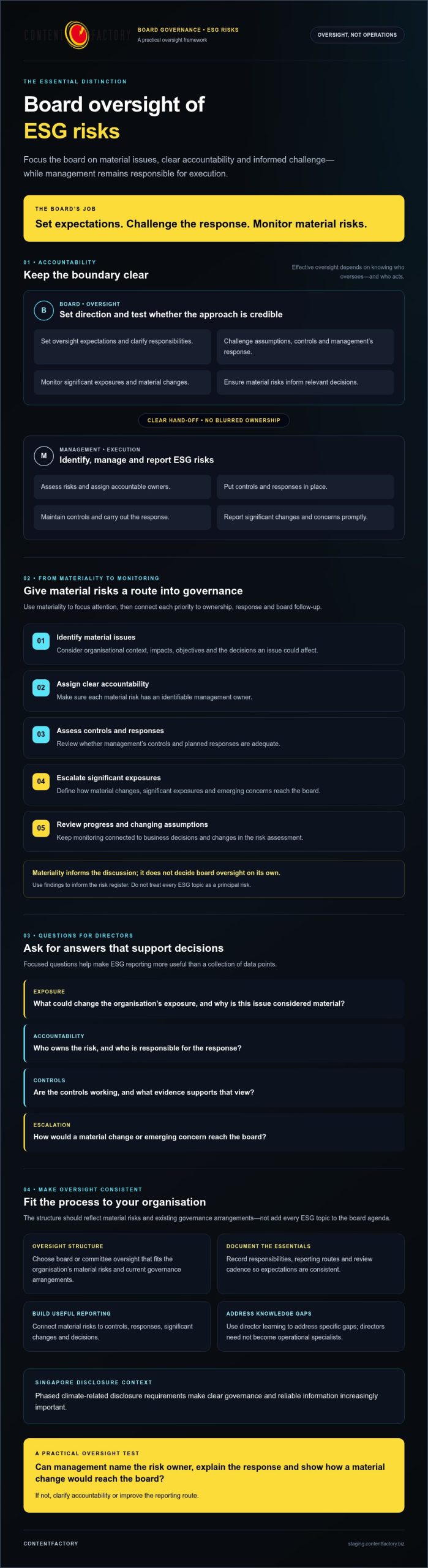
Board oversight of ESG risks means setting expectations, challenging management’s approach and monitoring whether material risks are being managed. Management identifies and assesses those risks, puts controls and responses in place, and reports significant changes or concerns to the board.
ESG risks are environmental, social or governance issues that may affect an organisation’s objectives. The board does not own every issue or operational task. Its role is to ensure material risks have clear accountability, appropriate controls and a place in relevant decisions.
This video explores board oversight of sustainability measurement and reporting.
The board’s role sits within the broader corporate governance framework: it provides direction and oversight, while management carries out the work. In practice, effective board oversight of ESG risks connects material issues to decisions, accountability and monitoring. It does not simply add more topics to the board agenda.
Which ESG risks warrant board attention?
Relevance depends on your organisation’s context, activities and material impacts. A climate-related issue, workforce matter or business-conduct concern may warrant attention if it could affect objectives, operations or decisions. These are examples, not a standard list that applies to every organisation.
Materiality helps distinguish issues with demonstrated decision relevance from broad ESG topics that do not currently warrant board-level focus. ESG readiness and a materiality assessment can help clarify which issues need management attention and board monitoring. Directors should understand why an issue is considered material, who is accountable for it and what could change that assessment.
Where does board oversight stop and management responsibility begin?
The board sets expectations, reviews whether management’s approach is adequate, challenges assumptions and monitors significant exposures and responses. It can ask whether responsibilities are clear, controls are working and emerging concerns are escalated promptly.
Management assesses risks, implements responses, maintains controls and provides timely, decision-useful reporting. Directors oversee whether this system is credible. They do not own each operational control or execute management’s response. This boundary keeps accountability clear while allowing the board to challenge gaps and require follow-up.
A practical test is to ask: can management identify the risk owner, explain the response and show how a material change would reach the board? If not, the oversight process needs clearer reporting routes or accountability.
How boards can connect material ESG risks to governance
Materiality becomes useful to the board when it leads to clear decisions, named accountability and follow-up. Use a practical sequence: identify material issues, assign owners, assess responses, escalate against agreed triggers and review changes over time. This gives board oversight of ESG risks a route into existing governance rather than creating a separate process outside normal risk discussions.
From identified risk to board monitoring: assess what matters, assign an accountable owner, evaluate controls and responses, escalate significant exposures, then review progress and changing assumptions.
How does materiality inform board oversight?
A materiality assessment helps prioritise ESG issues based on the organisation’s context and impacts. It informs the discussion, but it does not decide by itself which risks the board must oversee or how often they should be escalated. Directors should consider the findings alongside organisational objectives, existing risk processes and the decisions each issue could affect. An ESG readiness and gap analysis can help clarify priorities and readiness needs.
Use the findings to inform the risk register, not to label every ESG topic a principal risk. A topic may be relevant to monitoring or reporting without meeting the organisation’s criteria for a principal risk. Record the rationale, note connections to existing risks and revisit the assessment when activities, impacts or assumptions change.
How should ESG risk ownership and escalation work?
Assign each priority risk to an accountable executive or function with the authority and information to manage it. Management should define organisation-specific escalation triggers, such as a control failure, an exposure beyond approved tolerance, an unresolved issue or a material change in assumptions. Avoid universal thresholds where the organisation has not established them.
Agree how escalation reaches the board or relevant committee, what information accompanies it and when follow-up is due. Harvard Law School’s Forum on Corporate Governance offers practical perspectives on board oversight of ESG issues. The board can then challenge whether the response is proportionate, whether gaps have an owner and whether the exposure remains within the organisation’s stated risk appetite.
To put this into practice, review one material ESG issue and confirm its owner, controls, escalation route and next review point. If your organisation needs help clarifying priorities, explore ESG readiness and gap analysis.
Which ESG oversight structure fits the board’s responsibilities?
No single committee model works for every organisation. The right structure for board oversight of ESG risks depends on which issues are material, how complex the organisation is and how its existing governance arrangements operate. The objective is clear accountability and reliable escalation, not creating a new committee by default.
With full-board oversight, directors consider material ESG risks alongside strategy and other significant risks. This can suit organisations with a manageable number of priority issues or where decisions need broad board input. The trade-off is agenda capacity: without clear preparation and reporting, ESG discussion may become too general.
An existing committee can provide a practical home for detailed review. A risk, audit or governance committee may already oversee relevant controls, reporting or risk processes. A dedicated ESG committee can maintain focus where material issues are complex or responsibilities span several areas. It also adds a governance layer, so its remit must not overlap with other committees or management accountabilities.
A separate committee or specialist director is not essential in every organisation. Structure alone does not guarantee effective oversight. Assess whether the chosen arrangement gives directors the information, expertise and time to challenge management, and whether material matters can reach the full board when a decision or broader discussion is needed.
When can an existing board committee oversee ESG risks?
Start by checking the committee’s mandate, relevant expertise and workload. Confirm that ESG issues fit its existing responsibilities, management knows where to report them and the committee can escalate material matters to the full board. If the mandate or reporting route is unclear, revise it rather than relying on informal practice.
When might a dedicated ESG committee be appropriate?
Consider a dedicated committee if material ESG risks are complex, require sustained attention or involve responsibilities dispersed across the organisation. Its focus can support deeper review, but it may also duplicate work or blur accountability. Document what it oversees, what authority it has and how it reports to the full board.
Before choosing a structure, map each priority risk to its management owner, board or committee reviewer, and escalation route. Check whether the arrangement leaves gaps or creates duplicate oversight. Keep it proportionate, and revisit it if material risks or governance arrangements change.
What should directors ask when reviewing ESG risks?
Board papers should help directors judge exposure, management action and any decision required. For effective board oversight of ESG risks, ask questions that test the quality of the assessment and response, not simply whether more information can be added to the report.
Questions about risk information and controls
Start with what has changed and why. Ask management to distinguish new evidence from revised assumptions, changes in the organisation’s activities or gaps in available information. Then test whether the risk has a clear owner and whether relevant controls are operating as intended.
- Which material ESG risks have changed since the last review, and what evidence explains the change?
- Who is accountable for each priority risk, and how does management know the controls are working?
- What uncertainties, data limitations or emerging issues could alter the assessment?
Useful reporting makes the answers visible and supports a decision, challenge or follow-up. A larger data pack is not necessarily more decision-useful. Directors should be able to see the exposure, its significance to the organisation, management’s response and any unresolved concern without having to infer the story from disconnected metrics.
Questions about response plans and accountability
Once the exposure is clear, examine whether the response can be tracked. Ask whether actions have named owners, practical milestones and defined routes for escalation. Ask how management evaluates whether the response is reducing exposure or strengthening resilience, and what would prompt a change in approach.
- What action is underway, who is responsible and when will progress be reviewed?
- What control gaps or unresolved exposures remain, and how are they being escalated?
- Which assumptions could change the risk outlook, and how would the board be informed?
Record decisions, follow-up owners and review dates through existing board or committee processes. Where information quality is a concern, mandatory sustainability assurance readiness can help organisations consider reporting preparedness. It does not replace the board’s own oversight.
As a practical check, take one current board paper and test it against these questions. Note what it answers, what remains unclear and what management should bring back at the next review.
Explore ESG capability building and training to help directors and management address specific knowledge gaps.
How to make board oversight of ESG risks consistent and useful
Consistency comes from making oversight part of existing governance, not treating ESG as a separate annual exercise. Document who reviews priority risks, how information reaches the board and when progress is revisited. Make the process proportionate to your organisation’s risk profile and fit its board and committee calendar.
What should an ESG board oversight plan document?
Keep the plan practical. For each priority risk, record its accountable management owner, the board or committee responsible for oversight, escalation expectations and the information directors need to assess progress. Set a review rhythm that reflects the risk and the organisation’s governance schedule, rather than applying the same frequency to every issue.
Also record information gaps and how management will address them. For example, if a risk assessment relies on incomplete data, note the limitation, the action to improve the information and when the board will review the update. This helps directors distinguish a change in underlying risk from a change in the quality or availability of evidence.
Use existing risk registers, committee terms of reference and board reporting routes where they are fit for purpose. Clear documentation makes responsibilities easier to follow and helps prevent issues from falling between management and board committees.
How can organisations build oversight capability?
Director learning should address specific gaps, not assume every board member needs specialist credentials. Identify which ESG concepts, risk information or reporting processes directors need to understand to challenge management effectively. Capability-building workshops can connect learning to the organisation’s material issues, current reporting and oversight responsibilities.
Assessment, data quality and training strengthen oversight, but they do not replace board accountability. The board remains responsible for setting expectations and asking whether management’s systems and responses are adequate. Management remains responsible for producing reliable information and executing agreed actions.
As a practical step, select one current ESG board paper. Check whether it identifies the priority risk, accountable owner, response, information limitations and next review point. Record any gaps and assign follow-up through the existing governance process.
ContentFactory supports organisations with ESG readiness and materiality work, sustainability reporting and capability building to clarify priorities and develop practical oversight knowledge. Explore ContentFactory’s ESG services to see how this support may fit your needs.
Turn ESG oversight into a repeatable board practice
Effective board oversight of ESG risks starts with a clear boundary: the board sets expectations and monitors material risks, while management assesses exposures, implements controls and reports progress. Focus oversight on issues that matter to your organisation, assign clear accountability and use reporting that helps directors challenge responses and make informed decisions.
A proportionate governance structure, documented escalation routes and a consistent review rhythm can make oversight more reliable. Directors do not need to be specialists in every ESG topic, but targeted learning can help them identify knowledge gaps and ask better questions. Start by reviewing one board paper and checking whether it explains the risk, owner, response, information gaps and next review point.
ContentFactory supports organisations with ESG readiness and gap analysis, carbon accounting, mandatory sustainability assurance readiness and capability building. Mayuresh Godse, a Singapore Certified Management Consultant, brings more than 25 years of consulting experience to this work. Book a 30-minute discovery call to discuss your organisation’s ESG priorities.
Frequently Asked Questions
What does board oversight of ESG risks involve?
Board oversight of ESG risks involves setting expectations, reviewing material exposures and challenging management’s assessment, controls and response. Directors monitor whether important risks have clear owners, reliable information and appropriate escalation routes. They use that information to guide decisions and follow up on unresolved issues. Oversight does not mean the board manages each operational action or treats every ESG topic as a principal risk.
Who is responsible for managing ESG risks: the board or management?
Management manages ESG risks, while the board oversees the approach. Management identifies and assesses exposures, assigns operational responsibility, implements controls and reports material changes or concerns. The board sets direction, challenges whether management’s response is adequate and monitors accountability. This division keeps execution with the people responsible for operations, while giving directors a clear basis to request follow-up if controls, ownership or reporting appear insufficient.
Does a company need a separate ESG committee?
No. A company can assign oversight to the full board or an existing committee if its mandate, expertise, capacity and escalation route are suitable. A dedicated committee may be useful where material issues are complex or responsibilities are dispersed, but it can also duplicate work or blur accountability. Choose a structure that fits your organisation’s risks and governance arrangements, and document its remit and reporting relationship.
What ESG risks should a board oversee?
A board should focus on ESG issues that are material to its organisation, considering its activities, context and impacts. Climate, workforce and business-conduct matters are possible categories, not a universal checklist. Ask whether an issue could affect organisational objectives or decisions, what evidence supports that assessment and who owns the response. Materiality helps prioritise board attention without automatically making every ESG topic a principal risk.
How often should a board review ESG risks?
Set a review rhythm that reflects the organisation’s risk profile, governance calendar and pace of change. Some priority risks may warrant regular scheduled review, while significant changes, control gaps or unresolved exposures may need escalation between meetings under agreed arrangements. Review the cadence when the risk or available information changes. The aim is timely oversight, not a universal frequency applied to every ESG issue.
How can directors oversee ESG risks without being technical specialists?
Directors can oversee ESG risks by asking focused questions about exposure, ownership, controls, response plans and changing assumptions. They should expect management to explain technical information in terms of its relevance to decisions, uncertainties and follow-up. Targeted learning can address specific knowledge gaps; specialist credentials are not essential for every director. The board’s role is to assess whether the information and management response support sound oversight.

Article by
Mayuresh Godse
Mayuresh Godse is a Singapore Certified Management Consultant and Business Strategist specializing in Sustainability, ESG, AI-driven Digital Transformation, and business growth. Based in Singapore, he writes about Sustainability, Digital Innovation, Business Strategy, and Content Marketing for global audiences.
Disclaimer
This article is provided by ContentFactory for general information only and is not legal, tax, accounting or financial advice. Regulations and government scheme criteria change; grant eligibility and quantum are set by the relevant Singapore agencies and assessed case by case, with no outcome guaranteed. Verify current requirements before acting.
One thing worth checking on the tool side: if the disclaimer is switched on globally, the grant caveat already written into your Global Writing Instructions will appear as well, so grant articles will carry the same point twice. Remove the required-disclaimer section from the instructions file if you enable this one.